
CFT Calculator
Score the US Marine Corps Combat Fitness Test on the official tables from MCO 6100.13A. Movement to Contact, the ammunition lift and Maneuver Under Fire, with the grenade throw and the altitude tables applied the way the order says, and a class out of 300.
Your results
Gender
17-20
Where you are testing
The order publishes separate tables for altitude. They cover the MTC and the MANUF only. There is no altitude compensation for the ammunition lift.
Movement to Contact
880 yard run in boots and utilities. Treadmills are not authorized.
m:ss
Ammunition Lift
A 30 lb ammunition can lifted from shoulder height to overhead, as many times as you can in two minutes.
count
Maneuver Under Fire
A 300 yard shuttle course with crawls, a casualty drag and carry, ammunition resupply, a grenade throw and push-ups.
m:ss
Grenade throw
Your CFT score
What do I need for a better class?
out of 300
Your scoring column, top to bottom
| Points | MTC | Ammo lift | MANUF |
|---|
Scoring tables: Marine Corps Fitness Test Standards, Tables 3-3 through 3-7 of MCO 6100.13A with Change 4. This calculator is not an official Marine Corps tool and your score of record is the one entered in MCTIMS.
What the CFT Calculator actually does
The Combat Fitness Test is three events, each scored from 40 to 100 points, for a maximum of 300. This CFT Calculator takes your Movement to Contact time, your ammunition lift repetitions and your Maneuver Under Fire time, finds your column in the published Marine Corps tables by gender and age group, and returns the points for each event, the total and the class.
If you have searched for a USMC CFT calculator or a Marine CFT calculator before and landed on a page that only lists the minimums, the difference here is that these are the full published tables, every point value in every column, rather than a summary of them.
Three things it does that most tools skip. It applies the grenade throw adjustment to your MANUF time before scoring it, because the order says a hit takes five seconds off and a miss puts five seconds on. It carries the separate altitude tables for installations at or above 4,500 feet. And it works backwards: tell it the class you want and it tells you, event by event, exactly what you would have to run or lift to get there.
The three events
- Movement to Contact (MTC). An 880 yard run on a measured course in boots and utilities. Treadmills are not authorized.
- Ammunition Lift (AL). A 30 pound M2A1 ammunition can lifted from shoulder height to overhead, as many correct repetitions as you can manage inside two minutes.
- Maneuver Under Fire (MANUF). A 300 yard shuttle course with a sprint, high and low crawls, a casualty drag and fireman's carry, an ammunition can resupply run, a grenade throw, five push-ups and a sprint home.
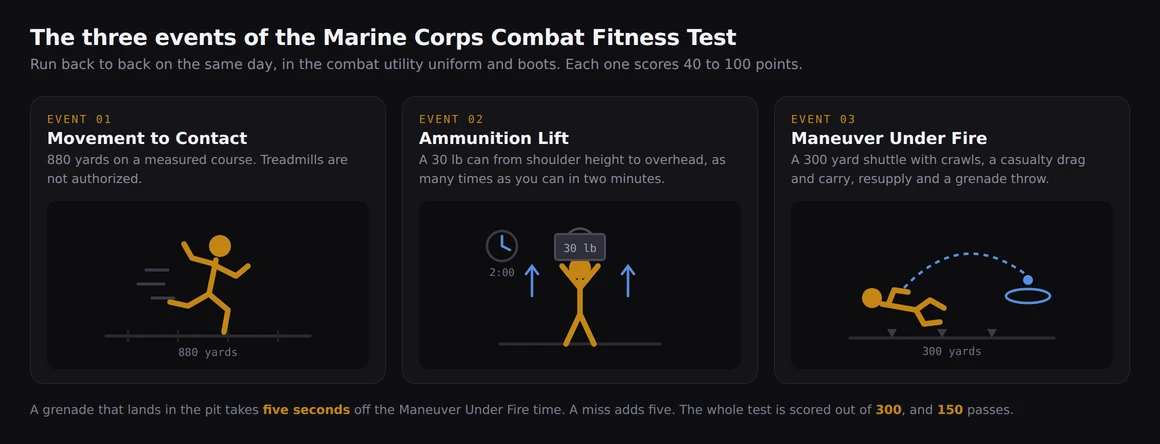
All three are run back to back on the same day, in the Marine Corps Combat Utility Uniform and boots. The green short sleeve t-shirt comes off the blouse for the ammunition lift so a partner can see the elbows lock out, and the blouse goes back on for the Maneuver Under Fire.
Points, classes and the number that actually matters
Each event is worth 40 points at its published minimum and 100 at its published maximum, so the scoring band is 120 to 300. The classification table in the order is short:
- 1st Class: 235 to 300
- 2nd Class: 200 to 234
- 3rd Class: 150 to 199
The minimum combined score required to pass the CFT is 150. Anything below that is a failure, and so is missing the minimum in any single event, however good the other two were.
Why hitting all three minimums still fails you
This is the single most useful thing a USMC CFT calculator can tell you, and almost none of them do. Forty points on each event comes to 120. The pass mark is 150. So a Marine who does exactly the published minimum on all three events fails by thirty points. Chapter 3 of the order states it plainly: the minimum performance in each event will not achieve the points required for a passing score, and additional points have to be earned in at least one event.
Put numbers on it. A male Marine aged 21 to 25 who scrapes the MTC minimum of 3:45 and the ammunition lift minimum of 67 repetitions needs a Maneuver Under Fire of 2:41 to reach 150. His MANUF minimum is 3:18. He has to beat his own minimum by thirty seven seconds in that one event just to pass the test. For a female Marine aged 36 to 40 in the same position, the MANUF has to come in at 3:55 against a minimum of 4:56, a minute and one second faster.
Event by event, and where the points hide
Movement to Contact: the 880 yard run
Half a mile, measured, on reasonably level ground, with a wide turnaround rather than a sharp one. The table runs from a perfect score to the minimum in a surprisingly narrow band. For a male Marine aged 21 to 25 the whole 60 point range sits between 2:38 and 3:45, which is 67 seconds. That works out at about 0.90 points per second. For a female Marine in the same age group the band is 3:13 to 4:41, 88 seconds, or about 0.68 points per second.
The practical reading is that the MTC is the least forgiving event on the test. One bad second costs nearly a point in the younger male columns. If you want a feel for what those splits mean in training, the Running Pace Calculator will convert an 880 target into a per mile pace.
Ammunition lift: where whole point values do not exist
Sixty one point values are printed in every column, from 100 down to 40. In the timed events every one of those values is reachable, because the tables step one second at a time. The ammunition lift does not work that way. A single repetition is often worth more than one point, so some point totals are simply unattainable.
The effect is not small and it is not uniform. In the female 46 to 50 column, 33 of the 61 point values cannot be scored at all. In the male 51 and over column every single one can. A female Marine aged 46 to 50 who adds one repetition can jump two or three points; a male Marine over 51 who adds one repetition gains exactly one. Nobody tells you this, and it changes how you should think about the last thirty seconds of the lift.
Maneuver Under Fire, and the grenade nobody calculates
The MANUF is where the test stops being a fitness test and starts being a skills test. Somewhere in the middle of it you throw a dummy grenade at a pit 22.5 yards out. Hit it and five seconds come off your overall time. Miss it and five seconds go on. The order gives the worked example: a Marine who runs 2:42 and hits the grenade is recorded as 2:37.
That ten second spread between a hit and a miss is worth a real number of points, and the number depends on your column. Across the usable range of the table it is worth 8 to 9 points for a male Marine aged 17 to 20, around 8 for a male aged 21 to 25, 5 to 6 for most female columns, and only 3 to 4 at 51 and over, where the table is stretched so wide that seconds stop mattering. For a Marine sitting on 232 points, a grenade throw is the difference between 2nd Class and 1st.
Enter your raw time in the CFT Calculator above and set the grenade control to hit or miss. It adjusts the clock first and then scores it, which is the order the Marine recording your test uses.
CFT scoring chart: the minimums in full
These are the published minimum performance requirements, Table 3-1 of the order. Meeting the figure in your column is worth exactly 40 points. Missing it fails the whole test.
| Event | 17-20 | 21-25 | 26-30 | 31-35 | 36-40 | 41-45 | 46-50 | 51+ |
|---|---|---|---|---|---|---|---|---|
| Male MTC | 3:45 | 3:45 | 3:48 | 3:51 | 3:58 | 4:11 | 4:28 | 5:07 |
| Male Ammo lift | 62 | 67 | 67 | 67 | 67 | 66 | 65 | 16 |
| Male MANUF | 3:17 | 3:18 | 3:22 | 3:30 | 3:42 | 3:59 | 4:14 | 6:09 |
| Female MTC | 4:36 | 4:41 | 4:45 | 4:46 | 4:55 | 4:58 | 5:26 | 5:52 |
| Female Ammo lift | 30 | 30 | 30 | 30 | 30 | 28 | 26 | 6 |
| Female MANUF | 4:53 | 4:34 | 4:40 | 4:44 | 4:56 | 5:01 | 5:06 | 6:33 |
Two of those numbers look like typographical errors and are not. The male 51 and over ammunition lift minimum really is 16 repetitions, and the female 51 and over minimum really is 6. The tables open up sharply in the oldest bracket, which is why the same performance scores so differently across age groups.
The same test, run by Marines of different ages
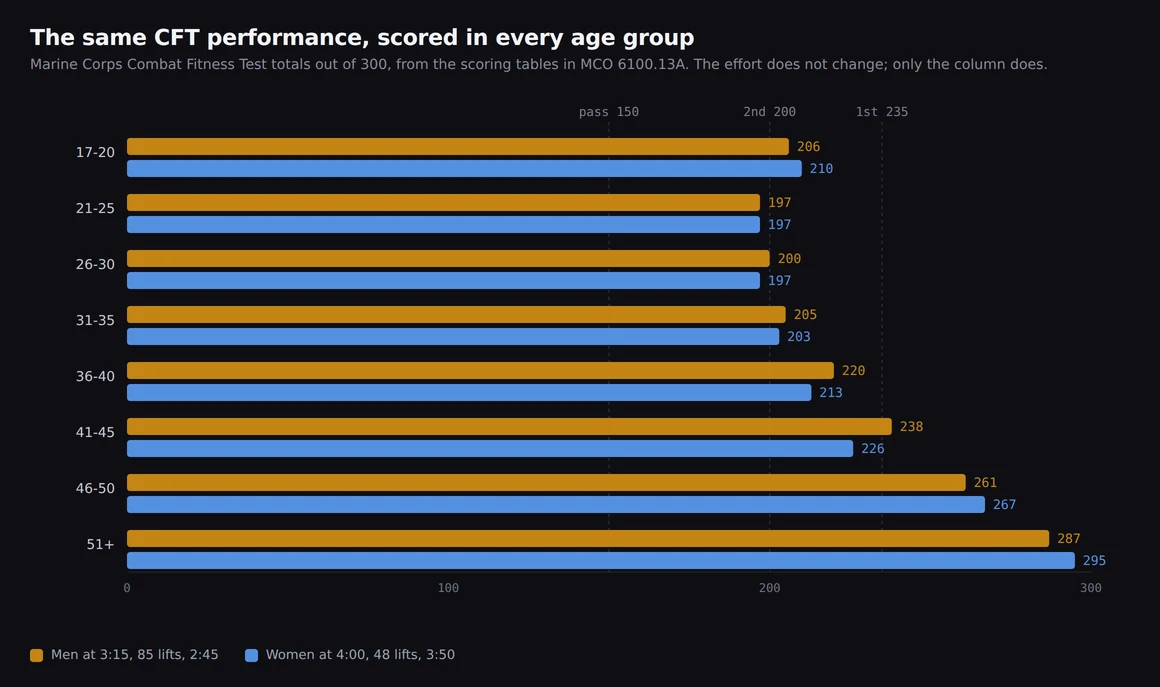
Take one honest performance, 3:15 on the MTC, 85 repetitions on the ammunition lift and 2:45 on the MANUF, and score it in every male column:
| Scored as | 17-20 | 21-25 | 26-30 | 31-35 | 36-40 | 41-45 | 46-50 | 51+ |
|---|---|---|---|---|---|---|---|---|
| Male total | 206 | 197 | 200 | 205 | 220 | 238 | 261 | 287 |
| Male class | 2nd | 3rd | 2nd | 2nd | 2nd | 1st | 1st | 1st |
| Female total | 210 | 197 | 197 | 203 | 213 | 226 | 267 | 295 |
| Female class | 2nd | 3rd | 3rd | 2nd | 2nd | 2nd | 1st | 1st |
The identical male effort is a 197 and a 3rd Class at 21 to 25, and a 287 at 51 and over. The female row behaves the same way, from 197 to 295. That ninety point spread is not a quirk of one event. It is the whole design of the test, which normalizes by age far more aggressively than most Marines expect, and it is why entering your real age matters more than rounding to the bracket you think you are in.
CFT at altitude, and why it is not a rounding error
Units at or above 4,500 feet above sea level score the MTC and the MANUF on separate tables, Tables 3-6 and 3-7. Marines reporting to those units get a thirty day acclimatization period before being tested. Half of the CFT Calculator pages ranking for this term do not offer the altitude tables at all, and none of them explains what they change.
Here is what they change. The MANUF altitude table is the sea level table plus exactly eight seconds, at every one of its 976 point boundaries, for both genders and all eight age groups. The MTC altitude table is not so tidy: its maximum and minimum rows move by six seconds, except the male 51 and over minimum, which moves by four, and the boundaries inside the table shift by four, five or six seconds depending on where you are. That is why the MTC altitude table has two fewer scoring cells than the sea level one.
In points, the same time is worth up to 7 points more at altitude on the MANUF and up to 6 points more on the MTC, averaging between three and five points across the usable range. On a borderline test that is a class.
There is no altitude table for the ammunition lift. Paragraph 9 of Chapter 3 says so directly: there is no altitude compensation for the AL. A calculator that quietly adjusts your lift count at altitude is inventing a standard.
What one second is worth
Because every column covers the same 60 points over a different span of time, the value of a second is not constant. This table is the arithmetic, straight out of the published tables.
| Event | 17-20 | 21-25 | 26-30 | 31-35 | 36-40 | 41-45 | 46-50 | 51+ |
|---|---|---|---|---|---|---|---|---|
| Male MTC | 0.92 | 0.90 | 0.87 | 0.87 | 0.82 | 0.76 | 0.69 | 0.49 |
| Female MTC | 0.78 | 0.68 | 0.63 | 0.64 | 0.62 | 0.65 | 0.56 | 0.51 |
| Male MANUF | 0.86 | 0.81 | 0.78 | 0.75 | 0.70 | 0.63 | 0.64 | 0.30 |
| Female MANUF | 0.51 | 0.55 | 0.51 | 0.52 | 0.49 | 0.48 | 0.66 | 0.36 |
| Male Ammo lift | 1.36 | 1.25 | 1.22 | 1.13 | 1.40 | 1.50 | 1.71 | 0.76 |
| Female Ammo lift | 1.67 | 1.36 | 1.33 | 1.43 | 1.50 | 1.76 | 2.22 | 1.58 |
Two patterns fall out of it. The younger the column, the more a second costs, which is why the oldest brackets feel so much more forgiving. And in every one of the sixteen columns, one extra ammunition lift is worth more points than one second off either run. The lift ranges from 0.76 to 2.22 points per repetition while a second is never worth more than 0.92. If you are deciding where to spend limited training time, that is the number to look at, not the raw times.
What happens if you fail the CFT
Failing is not only a number on a sheet. The order routes a CFT failure through several places at once:
- The fitness report for that reporting period is rendered adverse, and the failure is addressed in the period it happened in, even if a later test was passed.
- The Marine goes into a promotion restriction status until a CFT is passed.
- A page 11, 6105 counseling entry is required.
- For corporals and below, proficiency marks are adjusted to match.
- Once a failed test is passed on a retake, the Marine is credited with the minimum passing score until the next period, not the score actually run.
- Failing in consecutive years, not multiple attempts in the same year, puts the Marine up for administrative separation.
At the other end, a score of 285 and above earns a directed comment on the fitness report, which is why that figure is one of the target options in the calculator.
Partial tests and the PCFT
A Marine on a medical profile may be assigned a Physical Combat Fitness Test, which requires completing at least one of the three events and meeting the minimum for it. Failing to meet that minimum is still a test failure. The full rules sit in the order rather than in any calculator, and your command decides what you take.
When the CFT is run, and who scores on which column
The CFT is an annual, scored requirement for all active duty Marines and for SMCR and IMA reservists, conducted between 1 July and 31 December each year. The PFT occupies the first half of the year. Marines approaching their EAS or retirement date still owe a CFT in the annual period before it, and completing the final physical examination does not excuse it.
Age group is taken from your age on test day, which is why the Chronological Age Calculator matters more than it sounds if your birthday falls inside the testing window. One exception worth knowing: recruits are scored on the 17 to 20 table regardless of their actual age. Officer candidates, Basic and Warrant Officer Course students, and Naval Academy and NROTC midshipmen are scored on their own age group.
The 2026 fitness changes, and what they do not say
On 18 December 2025 the Marine Corps announced updated physical fitness standards through MARADMIN 613/25, effective 1 January 2026, implementing the Secretary of War's military fitness standards memorandum of 30 September 2025. Combat arms Marines must now score at least 210 points on the male, age normed standard, described as seventy percent of the total possible points. Height and weight standards and the tape test are to be replaced with a waist to height methodology once further guidance arrives.
Read the announcement carefully and one thing stands out: it is about the PFT. The release names the Physical Fitness Test and does not mention the Combat Fitness Test at all. No corresponding change to CFT scoring has been published, and the tables this CFT Calculator uses are still the ones in MCO 6100.13A with Change 4. If and when a CFT equivalent is published, the tables here will be updated from the source, not from a news article.
That matters because at least one competing Marine CFT calculator offers a combat arms setting that affects both tests. For the PFT that reflects published policy. For the CFT it is an assumption, and you should treat the output accordingly.
What a sex neutral CFT column would actually mean
The scoring data answers the question directly. Take a female Marine who scores a perfect 300, and re-score exactly those three performances on the male column for the same age group. At 17 to 20 she scores 168. At 26 to 30 she scores 194. At 41 to 45 and at 46 to 50 she does not score at all, because a maximum female ammunition lift of 62 and 53 repetitions sits below the male minimum of 66 and 65. A perfect score becomes a failed test. That is the size of the gap the published tables currently carry, and it is worth knowing before anyone argues about it in either direction.
How to check any CFT Calculator, including this one
Four quick tests will separate a sound Marine CFT calculator from a guess:
- Enter the three minimums for your column. A correct calculator returns 120 and calls it a failure. A tool that calls 120 a pass has the wrong floor.
- Check the 3rd Class floor. The order says 150. Two of the better known CFT tools publish 120, which is the sum of three minimums rather than the published classification boundary.
- Look for the grenade. If there is nowhere to tell it whether you hit the pit, it is scoring a time the Marine Corps would not have recorded.
- Switch on altitude and watch the ammunition lift. If the lift standard moves, the tool is making the altitude adjustment up.
This page is built the same way as our other military scoring tools. If you also take the Army test, the AFT Calculator scores all five Army Fitness Test events and the AFT Score Chart publishes the full Army scale. The Army's new pass or fail Combat Field Test standards are a different test entirely, which is worth saying because the two share an abbreviation.
Where these numbers come from
Every point value on this page is read out of the five scoring tables the Marine Corps publishes on its own fitness site: Table 3-3 and Table 3-6 for the MTC, Table 3-4 for the ammunition lift, and Table 3-5 and Table 3-7 for the MANUF. They were extracted from the PDFs themselves rather than retyped from anybody's summary, then checked back against Table 3-1 of the order, which lists the minimum performance for all three events across both genders and all eight age groups. All 48 of those values score exactly 40 points here, and all 80 published maximums score exactly 100.
The rules, as opposed to the numbers, come from MCO 6100.13A with Change Transmittal 4, and the tables are linked from the Marine Corps Fitness Test Standards page. The 2026 changes come from the Marine Corps' own press release. Nothing here runs on a server, nothing is stored, and the method is documented in our Calculator Accuracy Policy.
This is not an official Marine Corps calculator. The official one lives on MOL and MCTIMS, and the score of record is whatever your unit enters there.
Related tools
If you are training toward a number rather than just checking one, the Running Pace Calculator turns an MTC target into a pace you can hold, the Heart Rate Zone Calculator keeps the easy days easy, and the Protein Intake Calculator covers the recovery side. The rest of the health and fitness calculators sit together in one place.
CFT Calculator FAQs
What is a passing CFT score?
A total of 150 out of 300, with at least the published minimum on all three events. Failing the minimum in any one event fails the entire test regardless of the total, and three minimums together only come to 120, so extra points must come from at least one event.
What are the CFT classes?
1st Class is 235 to 300, 2nd Class is 200 to 234, and 3rd Class is 150 to 199. Anything below 150 is a failure. These are the figures in Table 3-2 of MCO 6100.13A, and they are the same for every age group and both genders.
How is the CFT scored?
Each of the three events is scored from 40 to 100 points against a table chosen by your gender and your age group on test day, giving a maximum of 300. The CFT Calculator on this page looks up all three and adds them, applying the grenade adjustment to the MANUF time and the altitude tables if you select them.
Does the grenade throw change my CFT score?
Yes, and by more than most Marines expect. A hit takes five seconds off your Maneuver Under Fire time and a miss adds five, so the gap between the two is ten seconds. Depending on your column that is worth 3 to 9 points, which is often a class boundary.
What is the maximum CFT score?
300, which means 100 points on all three events. For a male Marine aged 21 to 25 that is 2:38 on the Movement to Contact, 115 ammunition lift repetitions and 2:04 on the Maneuver Under Fire. Beating those figures does not score more than 100.
How heavy is the ammunition can, and how many lifts do I need?
Thirty pounds, an M2A1 can, lifted from shoulder height to overhead for two minutes. The minimum is 62 to 67 repetitions for most male age groups and 30 for most female ones, dropping to 16 and 6 respectively at 51 and over. A perfect 100 runs from 95 to 120 repetitions on the male columns and 44 to 75 on the female ones.
Do CFT standards change at altitude?
Yes, for two of the three events. Units at or above 4,500 feet score the MTC and the MANUF on Tables 3-6 and 3-7, which allow more time, and Marines reporting there get a thirty day acclimatization period. The ammunition lift has no altitude table at all, so any USMC CFT calculator that moves your lift standard at altitude is inventing a number.
When do Marines take the CFT?
Once a year, between 1 July and 31 December. The Physical Fitness Test occupies the first half of the year, from 1 January to 30 June. Reserve Marines follow the same CFT window, and a CFT stays valid for two years for promotion purposes if operational constraints prevent annual testing.
What happens if I fail the CFT?
The fitness report for that period is rendered adverse, you go into promotion restriction until you pass, and a page 11 counseling entry is required. Passing on a retake credits you with the minimum passing score rather than the score you ran. Failing in consecutive years puts you up for administrative separation.
Is this an official USMC CFT calculator?
No. It uses the Marine Corps' own published scoring tables and the rules in MCO 6100.13A, and it is checked against Table 3-1 of that order, but the official calculator is on MOL and your score of record is the one your unit enters in MCTIMS. Treat this as a planning tool.
Did the 2026 fitness changes affect the CFT?
Not as published. MARADMIN 613/25, effective 1 January 2026, sets a sex neutral 210 point minimum for combat arms Marines, and the Marine Corps announcement describes that requirement for the Physical Fitness Test. No corresponding Combat Fitness Test change has been published, so the CFT tables remain those in MCO 6100.13A with Change 4.

Written & verified by
B.Tech Computer Science · 8 years in web development & SEO · Bhilwara, India
About ·
LinkedIn ·
Report an error