
AFT Calculator
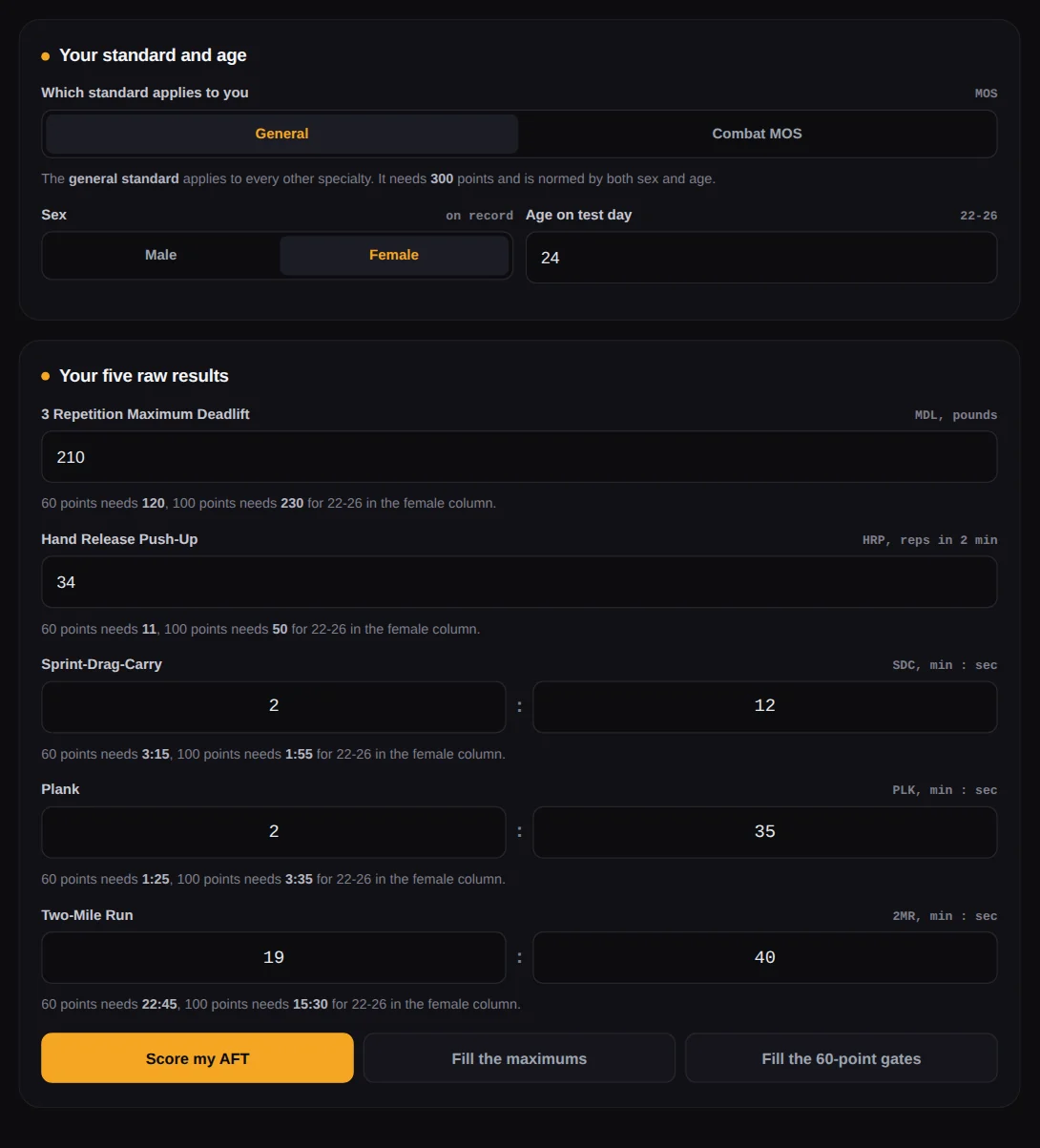
Score the Army Fitness Test on the official scales that took effect on 1 June 2025. Enter five raw results and this AFT score calculator returns the points for each event, your total out of 500, and a GO or NO-GO against both the combat standard of 350 and the general standard of 300 at the same time.
MDL · HRP · SDC · PLK · 2MRYour standard and age
Which standard applies to you MOS
Sex on record
Your five raw results
Sprint-Drag-Carry SDC, min : sec
Plank PLK, min : sec
Two-Mile Run 2MR, min : sec
On a profile
profile routeIf a permanent profile keeps you off an event, check it here. The scorecard then switches to the profile rule: an average of 70 points across the events you can take, and a pass on an alternate aerobic event if the two-mile run is one of them.
Your time min : sec
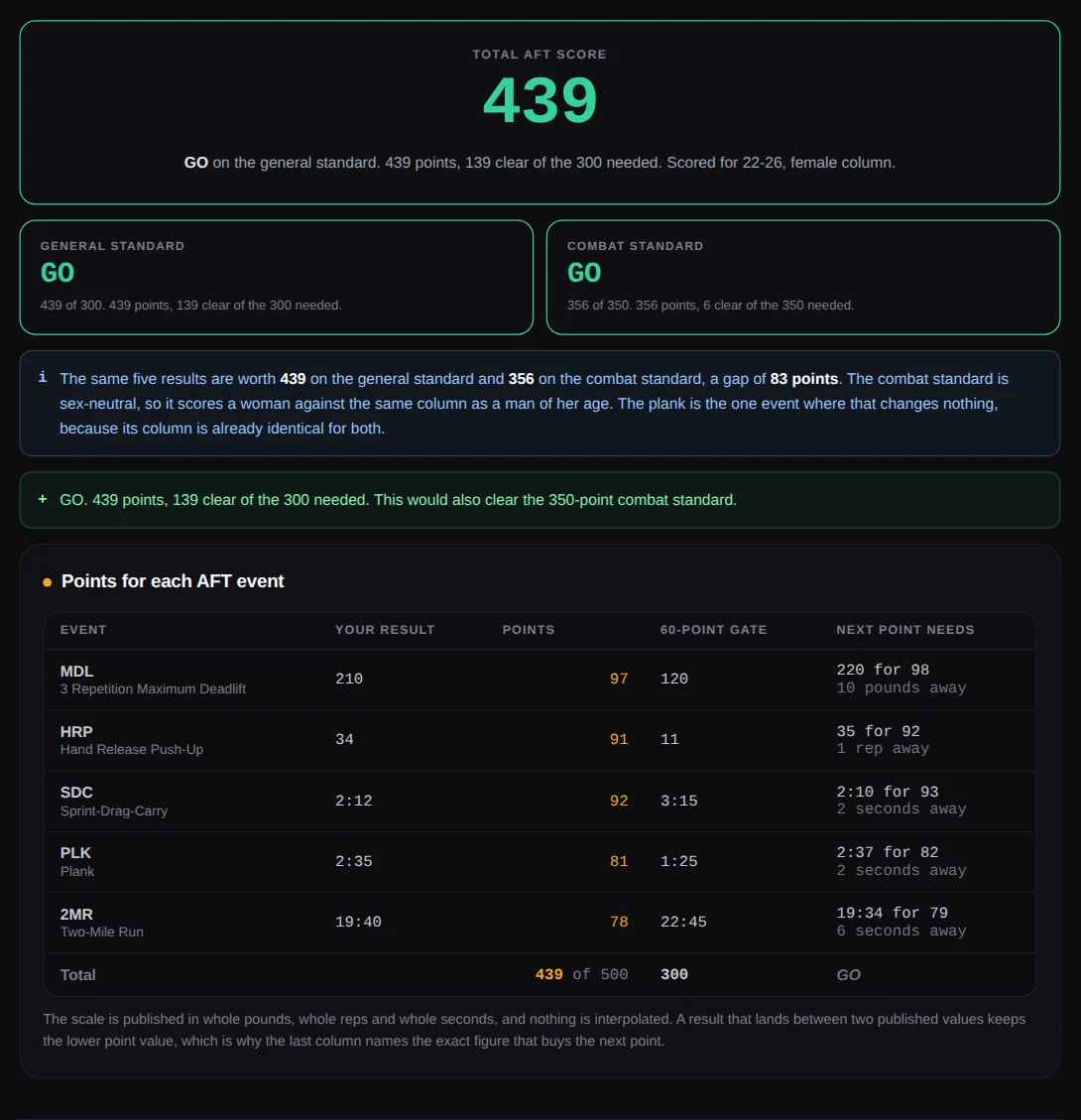
Points for each AFT event
| Event | Your result | Points | 60-point gate | Next point needs |
|---|
Profile route verdict
The same results in the next age bracket
Where the points are
Scoring scales approved 15 May 2025, effective 1 June 2025 · nothing you type leaves your device · not an official US Army tool
What This AFT Calculator Does Differently
Every AFT calculator on the web reads the same five numbers off the same official scale and adds them up. This one does that, and then answers the two questions the scale itself raises and almost nobody surfaces.
First, it scores your raw results against both Army standards at the same time. The combat standard needs 350 points and uses one sex-neutral column. The general standard needs 300 and is normed by sex as well as age. A single scorecard can be a comfortable GO on one and a clear NO-GO on the other, and if you hold one of the 21 combat specialties that difference is the whole point of the test.
Second, it names the exact figure that buys your next point. The published scale is discrete, not a curve, and in places it is startlingly sparse. In the male 17-21 deadlift column only 26 of the 101 point values from 100 down to 0 exist at all. So "lift a bit more" is useless advice and "lift 160 pounds instead of 155, which is worth three more points" is not.
How to Use the AFT Score Calculator
- Pick your standard. Combat MOS if you hold one of the 21 specialties listed further down this page, General for everything else. The tool still shows you both verdicts either way.
- Set your sex and your age on test day. Age brackets run in five-year steps and a birthday can move your score without you training a single session. If you are not sure which side of a bracket you fall on, our chronological age calculator settles it to the day.
- Enter the deadlift in pounds and the hand release push-ups as a straight rep count.
- Enter the sprint-drag-carry, the plank and the two-mile run as minutes and seconds.
- If a permanent profile keeps you off an event, check it in the profile panel. The scorecard then switches to the profile rule instead of the point total.
Nothing is sent anywhere. The whole army fitness test calculator runs in your browser, which is also why it works on a phone with no signal in the back of a truck.
The AFT Passing Score: 350 for Combat MOSs, 300 for Everyone Else
There are two AFT passing scores, and which one applies to you depends on your military occupational specialty rather than your unit or your assignment.
| Standard | Who it covers | Total needed | Per event | Normed by |
|---|---|---|---|---|
| Combat | The 21 designated combat MOSs and AOCs | 350 | 60 | Age only, one sex-neutral column |
| General | Every combat enabling specialty | 300 | 60 | Age and sex |
Spread across five events, 300 points is an average of exactly 60 per event, which is the bare gate. 350 is an average of 70. The combat standard is not the general standard plus a margin of comfort, it is 50 points, a tenth of the whole 500-point scale, above the floor.
The 60-Point Gate Nobody Can Average Around
Both standards also require a minimum of 60 points on every single event. This is the rule that catches people out, because a high total feels like insurance and it is not.
Max four events as a 30-year-old man and you have 400 points, a hundred clear of the general standard and fifty clear of the combat standard. Walk the two-mile run in 25 minutes and you score zero on it, and the whole test is a NO-GO at 400 points. The AFT calculator above flags that case specifically, because the total on its own will tell you the opposite.
What a 300-Point Scorecard Is Worth on the Combat Column
Here is the number worth knowing if you are a woman in a combat specialty, or you lead one. Take a soldier who scores exactly 60 points on all five events under the general female standard, a clean 300 and a GO. Score those identical raw results against the sex-neutral combat column instead:
| Age group | General total | Combat total | MDL | HRP | SDC | PLK | 2MR | Gates missed |
|---|---|---|---|---|---|---|---|---|
| 17-21 | 300 | 163 | 40 | 50 | 13 | 60 | 0 | 4 of 5 |
| 22-26 | 300 | 166 | 40 | 50 | 16 | 60 | 0 | 4 of 5 |
| 27-31 | 300 | 167 | 40 | 50 | 17 | 60 | 0 | 4 of 5 |
| 32-36 | 300 | 179 | 40 | 50 | 14 | 60 | 15 | 4 of 5 |
| 37-41 | 300 | 175 | 40 | 50 | 14 | 60 | 11 | 4 of 5 |
| 42-46 | 300 | 187 | 40 | 50 | 3 | 60 | 34 | 4 of 5 |
| 47-51 | 300 | 181 | 40 | 50 | 2 | 60 | 29 | 4 of 5 |
| 52-56 | 300 | 195 | 40 | 60 | 0 | 60 | 35 | 3 of 5 |
| 57-61 | 300 | 194 | 40 | 60 | 0 | 60 | 34 | 3 of 5 |
| 62+ | 300 | 190 | 40 | 60 | 0 | 60 | 30 | 3 of 5 |
Read the plank column. It is 60 in every row, because the plank is the one event whose male and female columns are already identical in all ten age brackets. The sprint-drag-carry and the two-mile run are where the sex-neutral column bites hardest: at 17-21 the combat two-mile run gate is 19:57 against 22:55, which is two minutes and 58 seconds of difference, and a general-standard 22:55 scores zero on the combat column rather than a reduced number of points.
This is not a judgment about the policy. It is the arithmetic that the January 2026 reclassification window turns on, and it is the single reason to score both standards before you decide whether to ask for a voluntary branch transfer.
AFT Scoring Chart: The 60-Point Gates by Age Group
This is the AFT scoring chart for the passing minimum, straight from the official scales. Where two figures appear, the first is the combat and male column and the second is the general female column. Where one figure appears, both columns are identical.
| Age group | MDL | HRP | SDC | PLK | 2MR |
|---|---|---|---|---|---|
| 17-21 | 150 / 120 | 15 / 11 | 2:28 / 3:15 | 1:30 | 19:57 / 22:55 |
| 22-26 | 150 / 120 | 14 / 11 | 2:31 / 3:15 | 1:25 | 19:45 / 22:45 |
| 27-31 | 150 / 120 | 14 / 11 | 2:32 / 3:15 | 1:20 | 19:45 / 22:45 |
| 32-36 | 140 / 120 | 13 / 11 | 2:36 / 3:22 | 1:15 | 20:44 / 22:50 |
| 37-41 | 140 / 120 | 12 / 10 | 2:41 / 3:27 | 1:10 | 20:44 / 22:59 |
| 42-46 | 140 / 120 | 11 / 10 | 2:45 / 3:42 | 1:10 | 22:04 / 23:15 |
| 47-51 | 140 / 120 | 11 / 10 | 2:53 / 3:51 | 1:10 | 22:04 / 23:30 |
| 52-56 | 140 / 120 | 10 | 3:00 / 4:03 | 1:10 | 22:50 / 24:00 |
| 57-61 | 140 / 120 | 10 | 3:12 / 4:48 | 1:10 | 23:36 / 24:48 |
| 62+ | 140 / 120 | 10 | 3:16 / 4:48 | 1:10 | 23:36 / 25:00 |
Two things stand out. The plank is age-graded but sex-neutral throughout, and from 37-41 onward every bracket shares the same 1:10 minimum. The deadlift barely moves with age at all: 150 pounds for the three youngest male brackets and 140 for the other seven, with the female column flat at 120 across all ten.
AFT Score Chart: The 100-Point Maximums by Age Group
The other end of the AFT score chart. These are the raw results worth a full 100 points, which is what you need five of to post a perfect 500.
| Age group | MDL | HRP | SDC | PLK | 2MR |
|---|---|---|---|---|---|
| 17-21 | 340 / 220 | 58 / 53 | 1:29 / 1:55 | 3:40 | 13:22 / 16:00 |
| 22-26 | 350 / 230 | 61 / 50 | 1:30 / 1:55 | 3:35 | 13:25 / 15:30 |
| 27-31 | 350 / 240 | 62 / 48 | 1:30 / 1:55 | 3:30 | 13:25 / 15:30 |
| 32-36 | 350 / 230 | 60 / 47 | 1:33 / 1:59 | 3:25 | 13:42 / 15:48 |
| 37-41 | 350 / 220 | 59 / 43 | 1:36 / 2:02 | 3:20 | 13:42 / 15:51 |
| 42-46 | 350 / 210 | 57 / 40 | 1:40 / 2:09 | 3:20 | 14:05 / 16:00 |
| 47-51 | 340 / 200 | 55 / 38 | 1:45 / 2:11 | 3:20 | 14:30 / 16:30 |
| 52-56 | 330 / 190 | 51 / 36 | 1:52 / 2:18 | 3:20 | 15:09 / 16:59 |
| 57-61 | 250 / 170 | 46 / 24 | 1:58 / 2:26 | 3:20 | 15:28 / 17:18 |
| 62+ | 230 / 170 | 43 / 24 | 2:09 / 2:26 | 3:20 | 15:28 / 17:18 |
The deadlift maximum peaks at 350 pounds from 22-26 through 42-46, then falls away sharply: 330 at 52-56 and 250 at 57-61, an 80-pound drop in one bracket. The plank maximum goes the other way and plateaus at 3:20 from 37-41 onward, so a 55-year-old and a 25-year-old are 15 seconds apart on that event and 120 pounds apart on the deadlift.
The Five AFT Events, and Where the Points Actually Move
The Army Fitness Test has five events, taken in order on the same day. The Army's own descriptions of what each one measures are quoted below. What follows each description is the thing the scale shows and the official text does not: how far apart the published values sit, which is what decides whether an event is worth training for points or just for the gate.
| Event | Point rows published | Values in the male 17-21 column | Step between two neighboring values |
|---|---|---|---|
| MDL | 47 | 26 | 10 to 20 pounds |
| HRP | 47 | 45 | 1 to 6 reps |
| SDC | 101 | 101 | 1 to 6 seconds |
| PLK | 101 | 71 | 1 to 4 seconds |
| 2MR | 101 | 100 | 2 to 25 seconds |
3 Repetition Maximum Deadlift (MDL)
Three consecutive deadlifts at the heaviest weight you can hold, using a 60-pound hex bar and plates. The bar counts toward the total, so the first plates do not go on until you are already at 60. The Army scores it for lower body, grip and core muscular strength.
The deadlift is the coarsest event on the scale by a wide margin. Values step in 10 and 20 pound jumps, so the male 17-21 column publishes only 26 distinct figures and the entire range from 150 to 340 pounds is covered in 26 steps. Practically, that means most added weight earns you nothing until you cross the next tenfold boundary, and then you jump two or three points at once. It is the one event where the AFT score calculator telling you "160 for three more points" changes what you put on the bar.
Hand Release Push-Up, Arm Extension (HRP)
As many correctly performed hand release push-ups as you can do in two minutes. The Army scores it for upper body muscular endurance.
Above 60 points the push-up scale is fine-grained, mostly one rep per point, so every single repetition counts. Below 60 it is not: there are no rows between 59 and 51, or 49 and 41, and so on. Under the gate the scale drops straight down 50, 40, 30, 20, 10, 0, which is the Army's way of saying that once you are below the minimum the exact number has stopped mattering.
Sprint-Drag-Carry (SDC)
Five 50-meter shuttles: sprint, drag a 90-pound sled, lateral, carry two 40-pound kettlebells, sprint. The Army scores it for muscular endurance, muscular strength, anaerobic power and anaerobic endurance.
The sprint-drag-carry is the most generous event on the scale: all 101 point values exist in the male 17-21 column, and neighboring values sit 1 to 6 seconds apart. Every second you take off the clock is worth something. It is also the event where the sex-neutral combat column widens most with age, from 47 seconds of difference at 17-21 to 96 seconds at 57-61.
Plank (PLK)
Hold a straight-line plank position for as long as you can. The Army scores it for core strength and endurance, with balance as a secondary component.
The plank is the one event where the official table makes no distinction between men and women in any age bracket, which is why a woman moving onto the combat standard loses nothing here. The 100-point hold is 3:40 at 17-21 and 3:20 for everyone 37 and over. The 60-point gate is 1:30 at 17-21 and 1:10 from 37-41 onward. Note that 600 of its 2,020 cells are blank, so many point values simply do not exist and a few seconds of extra hold can be worth nothing at all.
Two-Mile Run (2MR)
A timed two-mile run on a measured course. The Army scores it for aerobic endurance.
The two-mile run has the widest steps at the top of the scale, 2 to 25 seconds between neighboring values, which means a few seconds can be worth several points or nothing depending on exactly where you sit. It is also, on most scorecards, the cheapest place to find the points that get you from 300 to 350. If that is your gap, our running pace calculator converts a target two-mile time into the per-mile and per-400 pace you have to hold, and the running pace guide covers how to build it.
Which 21 MOSs Use the Combat AFT Standard
The Army designates 21 specialties as combat for AFT standards purposes. The combat standard follows the MOS, not the assignment, so it applies whether or not you are serving in a combat unit.
| Branch | MOS and AOC codes |
|---|---|
| Infantry | 11A Infantry Officer, 11B Infantryman, 11C Indirect Fire Infantryman, 11Z Infantry Senior Sergeant |
| Engineer | 12A Engineer, 12B Combat Engineer |
| Field Artillery | 13A Field Artillery Officer, 13F Fire Support Specialist |
| Special Forces | 18A Officer, 180A Warrant Officer, 18B Weapons, 18C Engineer, 18D Medical, 18E Communications, 18F Intelligence, 18Z Senior Sergeant |
| Armor | 19A Armor Officer, 19C Bradley Crew member, 19D Cavalry Scout, 19K M1 Armor Crewman, 19Z Armor Senior Sergeant |
Commanders may set the combat standard as a goal for a whole unit in their training guidance, but they cannot enforce it as pass or fail criteria for soldiers outside these specialties.
Alternate Aerobic Events and the Permanent Profile Rule
If a profile keeps you off the two-mile run, an alternate aerobic event takes its place. There are four, and all four are go or no-go. They earn no points, so they cannot be used to lift a total.
| Event | 17-21 | 27-31 | 42-46 | 52-56 | 62+ |
|---|---|---|---|---|---|
| 2.5-Mile Walk | 31:00 / 34:00 | 30:30 / 33:00 | 31:00 / 34:00 | 32:00 / 35:00 | 33:00 / 36:00 |
| 12-Kilometer Bike | 26:25 / 28:58 | 26:00 / 28:07 | 26:25 / 28:58 | 27:16 / 29:50 | 28:07 / 30:41 |
| 1-Kilometer Swim | 30:48 / 33:48 | 30:20 / 32:48 | 30:48 / 33:48 | 31:48 / 34:48 | 32:50 / 35:48 |
| 5-Kilometer Row | 30:48 / 33:48 | 30:20 / 32:48 | 30:48 / 33:48 | 31:48 / 34:48 | 32:50 / 35:48 |
The swim and the row carry identical times in every column of the official table, and the bike is the tightest of the four. Five age brackets are shown above out of ten. The AFT calculator on this page holds all ten and checks your time against the right one.
For a permanent profile the pass condition changes shape entirely. Instead of a point total, the Army asks for an average of 70 points across the events you are able to take, plus a pass on an alternate aerobic event where the two-mile run is one you cannot. Four events at exactly 60 points each average 60, so they clear every individual gate and still fail the profile route. Check the affected events in the profile panel and the tool switches to that rule rather than the total.
AFT vs ACFT: What Changed on 1 June 2025
The Army Fitness Test replaced the Army Combat Fitness Test as the test of record on 1 June 2025. The scales used by this AFT calculator were approved on 15 May 2025 and took effect on that date.
| ACFT | AFT | |
|---|---|---|
| Events | Six | Five |
| Standing Power Throw | Scored event | Removed |
| Max total | 600 | 500 |
| Passing total | 360 | 350 combat, 300 general |
| Sex-neutral scoring | No | Yes, for 21 combat MOSs |
| Age-normed | Yes | Yes, both standards |
The Army removed the standing power throw citing its technical nature and injury risk, supported by RAND analysis, and drew on performance data from close to a million ACFT records. That is why an ACFT calculator and an AFT calculator are not interchangeable: the event list, the maximum and the passing totals all moved.
A separate Combat Field Test is also coming for combat specialties under Army Directive 2026-07. It is a continuous seven-event test in uniform and boots, timed as a single event with a 30-minute cap, graded pass or fail, and age and sex-neutral. Phased implementation begins 17 April 2026 and testing for record begins 17 April 2027. It sits alongside the AFT rather than replacing it, so the scorecard on this page stays the one your AFT is measured on.
What Happens If You Fail the AFT
Timelines matter as much as the score here, and they differ by component.
- Retest windows. Active duty, Active Guard Reserve and Reserve soldiers on orders of more than 60 days retest within 90 days of a first record failure. National Guard and other Reserve soldiers have 180 days.
- Transition period. Soldiers who miss the AFT general standard during the transition period are not flagged, under HQDA G-1 and G-3 exceptions to policy that supersede AR 350-1 and AR 600-8-2.
- Combat standard dates. No administrative action was taken on the combat standard before 1 January 2026 for the Regular Army, Active Guard Reserve and Reserve component soldiers on active duty orders over 60 days. Other Army Reserve component soldiers have until 1 June 2026.
- Reclassification. A soldier in a combat MOS who clears 300 but not 350 is subject to in-service reclassification. During the voluntary window of September to December 2025, soldiers from PVT to SSG with under 18 years of total active federal service could request voluntary reclassification, and BOLC-qualified officers from 2LT to CPT could request a voluntary branch transfer.
- Promotion points. 120 points remains the maximum the test can contribute to semi-centralized promotions, on a revised points table. Centralized promotions are unaffected.
Other Calculators Worth Having Open
Scoring the test is one job. Getting the number up is another, and these are the tools on this site that bear on it directly.
- Running pace calculator, for turning a target two-mile time into the pace you have to hold.
- Heart rate zone calculator, for keeping easy aerobic work actually easy between hard sessions.
- BMI calculator, as a rough first look before the Army's own body composition screening, which is not conducted on the same day as the AFT.
- Protein intake calculator, for the deadlift and push-up end of the scorecard.
- Chronological age calculator, for settling which five-year bracket you are in on test day.
- More in health and fitness.
Frequently Asked AFT Calculator Questions
What is a passing AFT score?
60 points on every event, plus a total of 350 for the 21 designated combat MOSs or 300 for every combat enabling specialty. Both conditions have to hold. A 400-point scorecard with one event under 60 is still a NO-GO, and a scorecard with all five events over 60 that totals 340 fails the combat standard. This AFT calculator checks both gates separately and says which one you missed.
Is the AFT calculator on this page using the current scoring tables?
Yes. Every point value comes from the Army's published AFT Scoring Scales, approved 15 May 2025 and effective 1 June 2025, including all ten age brackets, both columns, the blank cells where a point value is not attainable, and the four alternate aerobic events. Nothing is interpolated or estimated.
How does AFT scoring work for combat MOSs?
The combat standard is sex-neutral but still age-normed. Every soldier in one of the 21 combat specialties is scored against the same column as a man of the same age, and needs 350 points with a minimum of 60 per event. Age brackets still apply, so a 45-year-old 11B and a 20-year-old 11B are not held to the same raw numbers.
What is the AFT minimum two-mile run time?
On the combat and male column it is 19:57 for ages 17-21, 19:45 for 22-31, 20:44 for 32-41, 22:04 for 42-51, 22:50 for 52-56 and 23:36 for 57 and over. On the general female column it is 22:55 at 17-21 rising to 25:00 at 62 and over. Those are the times worth exactly 60 points, so one second slower drops you below the gate.
What is the minimum AFT plank time?
1:30 for ages 17-21, 1:25 for 22-26, 1:20 for 27-31, 1:15 for 32-36 and 1:10 for every bracket from 37-41 onward. The plank is the one AFT event whose standards are identical for men and women in every age group, which is also why it is the one event where moving onto the sex-neutral combat standard costs a female soldier nothing.
What is the Gritty Soldier AFT calculator?
Gritty Soldier is a military fitness retailer that publishes a free gritty soldier aft calculator alongside an AFT scoring chart and a copy of the DA Form 705-TEST scorecard. It is a decent tool and a common search because people remember where they used one rather than what it was called. It scores one standard at a time, so if you want to see what the same five results are worth on both the combat and the general column at once, use the calculator at the top of this page.
Does a result between two values on the scale round up or down?
Down. The scale is published in whole pounds, whole reps and whole seconds, and nothing between two published values is interpolated. A 155-pound deadlift at 17-21 scores the same 60 points as 150, because the next row up asks for 160. That is why the calculator above lists the exact figure that buys your next point in the last column of the event table.
How do I score the AFT with a permanent profile?
Soldiers with a permanent profile must average 70 points across the events they are able to take, and pass an alternate aerobic event if the two-mile run is one they cannot. The point total is not the measure. Check the affected events in the profile panel of the calculator and it switches to that rule, works out the average and checks your alternate event time against the published go or no-go limit for your age and standard.
How many points is the AFT worth for promotion?
120 points remains the maximum the test can contribute to semi-centralized promotions, on a revised points table the Army published with the AFT. Centralized promotion boards are unaffected. AFT general scores had to be recorded in DTMS from 1 October 2025 to earn those points, and combat scores from 1 January 2026.
Can I use an ACFT calculator for the AFT?
No. The AFT dropped the standing power throw, so it has five events instead of six and a maximum of 500 instead of 600. The passing total also changed, from 360 on the ACFT to 350 for combat specialties and 300 for everyone else. An ACFT calculator will give you a total against a scale that stopped being the test of record on 31 May 2025.
Is this an official US Army tool?
No. It is a free army fitness test calculator built on the Army's own published scoring scales, and it is accurate to those tables, but it is not affiliated with or endorsed by the US Army. Your record score is the one your grader puts on the DA Form 705-TEST. Use this to know the number before you get there.
Sources. Scoring, event descriptions, the combat MOS list, the retest windows and the promotion point rules all come from the Army's own Army Fitness Test page and the AFT Scoring Scales effective 1 June 2025. Every statistic on this page about the shape of the scale was computed from those tables rather than taken from another site.

Written & verified by
B.Tech Computer Science · 8 years in web development & SEO · Bhilwara, India
About ·
LinkedIn ·
Report an error