
Heart Rate Zone Calculator
Work out all five heart rate training zones in beats per minute, including your Zone 2 range. Choose the max heart rate formula, or use the Karvonen method with your resting heart rate for more personal numbers.
Your details
Measure it lying still before getting up. Needed for the Karvonen method.
If you have a tested figure, it overrides every formula.
Max heart rate formula
Zone method
Karvonen needs your resting heart rate and gives higher, more individual numbers.
Threshold heart rate (optional, for trained runners and cyclists)
Average heart rate over a hard 30 minute time trial, last 20 minutes. Adds a second set of threshold-based zones.
How to use this heart rate zone calculator
Enter your age and press calculate. That is the minimum. Everything else on the form makes the answer more personal rather than more complicated, and the sections below explain what each option actually changes.
Enter your age
Age alone gives you five heart rate zones based on an estimated maximum. It is the least accurate route, and still the one most people need.
Add your resting heart rate
Measure it lying still before you get up. This unlocks the Karvonen method, which accounts for how efficient your heart already is rather than treating everyone your age the same.
Override with a tested maximum if you have one
A figure from a lab test, a race finish or a hard hill repeat session beats every formula on this page. Enter it and the estimate is ignored.
Your five heart rate zones explained
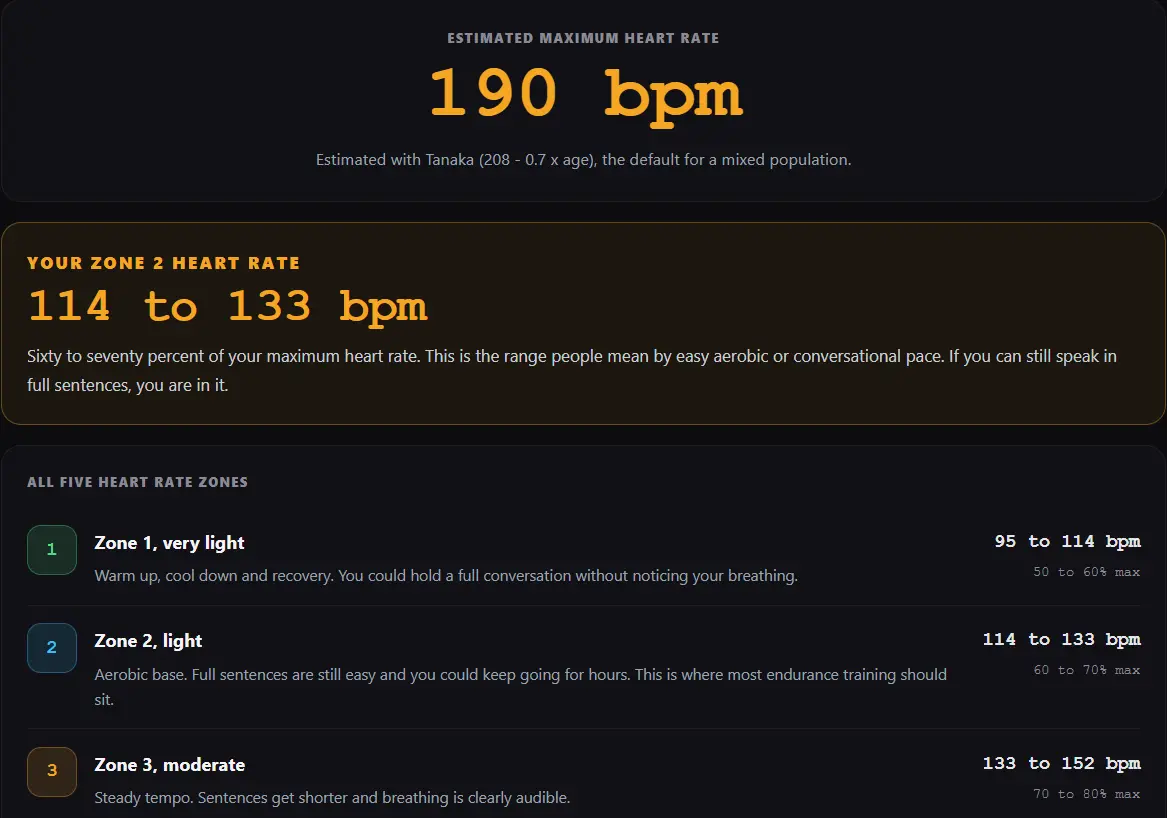
The five-zone model splits the range between easy and all-out into bands, each of which trains something different. Percentages here are of maximum heart rate. The talk test in each row is usually more reliable than the number on your watch, because it responds to how you feel today rather than to an estimate made from your birthday.
| Zone | % of max | What it trains | Talk test |
|---|---|---|---|
| 1 Very light | 50 to 60 | Recovery, warm up, cool down | Full conversation, no effort |
| 2 Light | 60 to 70 | Aerobic base and fat oxidation | Full sentences, comfortable for hours |
| 3 Moderate | 70 to 80 | Aerobic capacity, steady tempo | Short sentences, breathing audible |
| 4 Hard | 80 to 90 | Lactate threshold, speed endurance | A few words at a time |
| 5 Maximum | 90 to 100 | Peak power, short intervals | No talking at all |
Zone boundaries are conventions, not biology. Nothing measurable happens to your body at exactly 70 percent of maximum. The zones are a way of talking about intensity, and treating a one-beat difference as meaningful is the most common mistake people make with heart rate training.
Zone 2 heart rate: what it is and how to calculate it
Zone 2 gets more attention than the other four combined, so it is worth being precise about what it means. In the five-zone model above, Zone 2 is 60 to 70 percent of your maximum heart rate. The calculator shows your range at the top of the results, in beats per minute.
What is my Zone 2 heart rate?
Enter your age and read the highlighted box. For a 40 year old using the Tanaka formula, maximum heart rate comes out at 180 bpm, which puts Zone 2 at roughly 108 to 126 bpm. Add a resting heart rate of 60 and switch to Karvonen and the same person gets 132 to 144 bpm instead. Both are defensible. They answer slightly different questions, which is covered further down.
How to calculate Zone 2 heart rate by hand
Estimate your maximum, then take 60 and 70 percent of it. Using Tanaka: 208 minus 0.7 times your age, then multiply by 0.6 and 0.7. For the Karvonen version, subtract your resting heart rate from your maximum to get your heart rate reserve, take 60 and 70 percent of that, and add your resting heart rate back on.
What heart rate is Zone 2 supposed to feel like?
Conversational. You should be able to speak in complete sentences without pausing for breath, and you should finish feeling like you could have kept going. If you are gasping between words you have drifted into Zone 3, which is the single most common error in easy training. Most people run their easy days too hard and their hard days too easy.
Why the Zone 2 everyone talks about is not exactly the Zone 2 on your watch
The physiological definition of Zone 2 comes from blood lactate, usually the intensity at which lactate sits around 2 mmol per litre. That threshold is individual and can only be found with a lab test or a well designed field test. The 60 to 70 percent band is a reasonable proxy for most people, but for a well trained endurance athlete the true lactate-defined zone often sits higher than a percentage of maximum would suggest. If that is you, use the threshold-based zones in the calculator instead.
The Karvonen formula and heart rate reserve
The Karvonen formula calculates a target heart rate from your heart rate reserve, which is the gap between your resting and maximum heart rates. Written out:
Why the Karvonen formula gives higher numbers
A plain percentage of maximum ignores where your heart actually starts. Karvonen anchors the scale to your resting rate, so the whole range shifts upward. Take a maximum of 180 and a resting rate of 60. Sixty percent of maximum is 108 bpm. Sixty percent of the 120 beat reserve is 72, added to the resting 60, giving 132 bpm. That is a 24 beat difference at the same stated intensity, and it is the reason two calculators can both be right while disagreeing completely.
Which method should you use?
If you know your resting heart rate reasonably well, Karvonen is the better of the two because it reflects something real about you rather than about people your age. If you are unsure of your resting rate, a percentage of maximum is the safer default, because a wrong resting figure distorts every zone. Whichever you choose, stay with it. Switching methods halfway through a training block makes your own history unreadable.
Maximum heart rate formulas, and why calculators disagree
Almost every disagreement between heart rate zone calculators comes from one place: which formula they use for maximum heart rate. This tool offers four published options and shows what each would give you, so the disagreement is visible instead of hidden.
| Formula | Equation | Derived from |
|---|---|---|
| 220 minus age | 220 − age | The classic. Simple, widely quoted, and the least accurate at both ends of the age range. |
| Tanaka | 208 − 0.7 × age | Meta-analysis of 18,712 healthy adults, cross-validated on 514 more. Tanaka, Monahan and Seals, 2001. |
| Gulati | 206 − 0.88 × age | 5,437 women aged 35 and over, St James Women Take Heart Project, Gulati and colleagues, 2010. |
| Nes | 211 − 0.64 × age | 3,320 healthy adults aged 19 to 89, HUNT Fitness Study. |
How to calculate maximum heart rate, and what the number is worth
Every equation above is a line drawn through a cloud of individual results. The studies behind them report a spread of roughly ten beats per minute either side, meaning two people of the same age can genuinely differ by twenty beats or more with neither being unusual. The research group behind the HUNT study says plainly that genetics contribute more to maximum heart rate than fitness does. So the estimate is a starting point, not a fact about your body.
Why 220 minus age keeps being wrong
It overestimates in young adults and underestimates in older ones. The HUNT researchers note it can be out by as much as 40 beats per minute in seniors. It survives because it is easy to remember and because the American Heart Association still quotes it as a rough guide. If you are under 30 or over 55, one of the other three will serve you better.
Why women often get a different number
Most classic equations were derived largely from men and then applied to everyone. The Gulati equation was built specifically on women, and it produces a lower maximum than 220 minus age at most ages. The practical consequence, in the words of the researchers, was that women were previously being given targets they struggled to reach, and sometimes being told their exercise test results looked worse than they were. This calculator selects Gulati automatically when you choose female, and you can override it.
Heart rate zones by age
Here is what the Tanaka formula gives across the age range, as percentages of maximum heart rate. Use it as a rough sanity check on your own result rather than as a target, since it takes no account of your resting heart rate or your training history.
| Age | Est. max HR | Zone 2 (60 to 70%) | Zone 4 (80 to 90%) |
|---|---|---|---|
| 20 | 194 | 116 to 136 | 155 to 175 |
| 30 | 187 | 112 to 131 | 150 to 168 |
| 40 | 180 | 108 to 126 | 144 to 162 |
| 50 | 173 | 104 to 121 | 138 to 156 |
| 60 | 166 | 100 to 116 | 133 to 149 |
| 70 | 159 | 95 to 111 | 127 to 143 |
Threshold-based zones for runners and cyclists
Once you are training seriously, zones anchored to your lactate threshold describe your sessions better than zones anchored to a maximum you probably have not measured. Threshold heart rate is far easier to test than maximum heart rate, and unlike maximum it moves as you get fitter, which makes it a more useful reference point.
How to find your threshold heart rate
Warm up thoroughly, then run or ride as hard as you can sustain for 30 minutes on your own, on flat ground, with no drafting. Take your average heart rate over the final 20 minutes. That figure is a good working estimate of lactate threshold heart rate. Enter it in the calculator and a second set of zones appears, expressed as percentages of threshold rather than of maximum.
Threshold heart rate is sport-specific. Cycling values typically run several beats lower than running values for the same person, because less muscle mass is involved and you are supported by the bike. If you train in both, test in both and keep two sets of zones.
When these numbers do not apply
Heart rate zones are only useful while the assumptions behind them hold. This is where most calculators stop, and it is the part that matters most.
You take medication that affects heart rate
Beta blockers and some other cardiac medications lower both your maximum and your working heart rate. Every zone on this page will be too high. The AHA is explicit that if you take medication affecting heart rate you should ask your clinician what your range should be.
You have a heart condition or are in cardiac rehab
Prescribed exercise ranges come from a supervised test, not from an equation. Use the range you were given.
You are pregnant
Guidance has moved away from fixed heart rate ceilings toward perceived exertion and the talk test. Follow your own clinician's advice rather than a formula.
You are reading from a wrist optical sensor
Wrist sensors lag during intervals and can lock onto your cadence instead of your pulse. If your zones look strange during hard efforts, suspect the sensor before the maths. A chest strap resolves most of it.
It is hot, you slept badly, or you are ill
Heart rate drifts upward in heat, dehydration, illness and poor sleep. On those days the same effort sits in a higher zone. Trust how it feels over what the number says.
You have never actually measured your maximum
Then the entire chart rests on an estimate carrying roughly ten beats of uncertainty each way. Treat zone edges as soft, and pay attention to whether you can talk.
Heart rate zone calculator FAQ
How do I calculate my heart rate zones?
Estimate your maximum heart rate, then take percentage bands of it: 50 to 60 percent for Zone 1, 60 to 70 for Zone 2, 70 to 80 for Zone 3, 80 to 90 for Zone 4 and 90 to 100 for Zone 5. If you know your resting heart rate, the Karvonen method is better: subtract resting from maximum to get your heart rate reserve, take the same percentages of that, then add your resting rate back on. This calculator does both and shows you the difference.
What is my Zone 2 heart rate?
Zone 2 is 60 to 70 percent of your maximum heart rate. For a 40 year old with an estimated maximum of 180 bpm that is about 108 to 126 bpm. With the Karvonen method and a resting heart rate of 60 the same person gets 132 to 144 bpm. Enter your own numbers above for your range, and use the talk test to confirm it: in Zone 2 you can still speak in full sentences.
What is the Karvonen formula?
Target heart rate equals your resting heart rate plus the intensity percentage multiplied by your heart rate reserve, where heart rate reserve is maximum minus resting. It produces higher and more individual targets than a plain percentage of maximum because it accounts for how low your heart rate sits at rest, which reflects your current fitness.
How do I calculate my maximum heart rate?
Any of four published formulas will estimate it: 220 minus age, Tanaka at 208 minus 0.7 times age, Gulati at 206 minus 0.88 times age for women, or Nes at 211 minus 0.64 times age. All four carry a spread of roughly ten beats per minute either side. A supervised maximal test or a genuinely all-out effort gives a real figure, and this calculator lets you enter that instead.
Is 220 minus age accurate?
Not particularly. It overestimates maximum heart rate in younger adults and underestimates it in older ones, and the HUNT researchers report it can be out by up to 40 beats per minute in seniors. It persists because it is memorable. Tanaka or Nes will usually serve you better, and Gulati was derived specifically on women.
Why do different heart rate zone calculators give me different numbers?
Two reasons. They use different maximum heart rate formulas, which can differ by more than ten beats at the same age, and they split zones by either percentage of maximum or percentage of heart rate reserve, which differ by twenty beats or more at the low end. Neither is wrong. This calculator shows all four formulas side by side so you can see the spread rather than guess at it.
What heart rate should I train at to burn fat?
The proportion of energy coming from fat is highest at low intensity, which is roughly Zone 2, and that is where the fat burning zone idea comes from. But total calories burned rise with intensity, and body composition is driven by overall energy balance rather than by which fuel you used during the session. Train in Zone 2 to build an aerobic base you can sustain, not because it is a shortcut.
How much of my training should be in Zone 2?
Endurance coaching commonly puts the majority of weekly volume at easy aerobic intensity with a small proportion hard, often described as a roughly eighty twenty split. The precise ratio matters less than the discipline of keeping easy days genuinely easy. If every session sits in Zone 3, you accumulate fatigue without the benefits of either end.
Do heart rate zones change as I get fitter?
Your maximum heart rate barely moves with training and declines slowly with age. What changes is everything else: your resting heart rate falls, your threshold rises, and you produce more power or speed at the same heart rate. That is why threshold-based zones are worth re-testing every couple of months while maximum-based zones can sit unchanged for years.
Are heart rate zones different for men and women?
The zone percentages are the same. The maximum heart rate they are calculated from often is not. Most classic equations were derived largely on men, and the Gulati equation, built on 5,437 women, gives a lower maximum than 220 minus age at most ages. This calculator selects it automatically when you choose female, and you can override that.
Can I use this heart rate zone calculator if I take beta blockers?
No. Beta blockers lower both your maximum and your working heart rate, so every zone here will be too high for you. The same applies to several other cardiac medications. Ask the clinician who prescribed them what your training range should be, or use perceived exertion and the talk test instead of heart rate.
Sources and limits
The four maximum heart rate equations come from Tanaka, Monahan and Seals (2001), Gulati and colleagues, the St James Women Take Heart Project (2010), the HUNT Fitness Study, and the long-standing 220 minus age convention. The moderate and vigorous intensity bands follow the American Heart Association target heart rate guidance. Threshold zones follow the widely used percentage-of-threshold model from endurance coaching practice.
Everything on this page is an estimate for healthy adults and none of it is medical advice. If you have a heart condition, are pregnant, or take medication that affects heart rate, the numbers here do not apply to you and your clinician's range does. See our calculator accuracy policy for how these formulas were checked.

Written & verified by
B.Tech Computer Science · 8 years in web development & SEO · Bhilwara, India
About ·
LinkedIn ·
Report an error