
Water Intake Calculator
Work out how much water per day you actually need, based on your body size, what you are doing, and the climate you are in. This water intake calculator estimates your daily water intake from the published Adequate Intake figures rather than a made up formula, shows every adjustment it makes, and tells you plainly where the evidence runs out. Used as a hydration calculator it will give you a starting figure; section 03 covers the check that matters more.
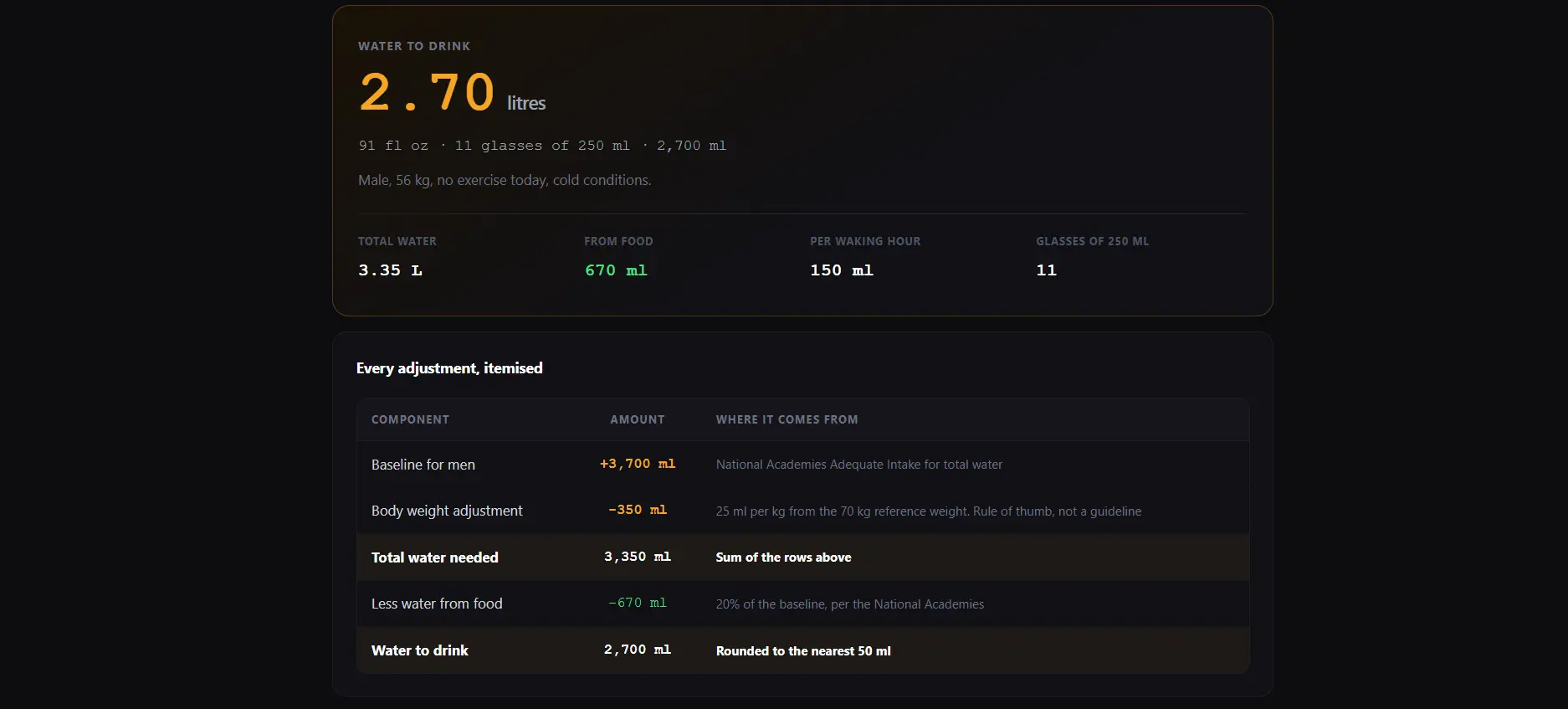
| Component | Amount | Where it comes from |
|---|
This is the more useful signal, and unlike a calculator it responds to your actual body. Pick the closest match.
01 How much water should you drink a day?
Search for how much water per day you need and you will land on one figure almost everywhere. It comes from the US National Academies, and it is worth reading carefully, because it does not say what most articles claim it says. The report states that "women who appear to be adequately hydrated consume an average of approximately 2.7 liters (91 ounces) of total water, from all beverages and foods, each day, and men average approximately 3.7 liters (125 ounces) daily."
Two things follow from that sentence. First, those are figures for total water, including what is in your food and in every drink you have, not for glasses of plain water. Second, they describe what already hydrated people were observed to consume. They are a description, not a prescription.
The report is blunter still in its own summary: "the vast majority of healthy people adequately meet their daily hydration needs by letting thirst be their guide." That is the actual expert guidance, and it sits awkwardly with the entire genre of page this one belongs to, including this one. It is stated here rather than buried because it is true.
So what is a calculator for? Two things it does genuinely well: giving you a starting figure when thirst is an unreliable guide, which it is during hard exercise, in heat, in older age and in illness; and showing you how much the number moves when conditions change. Use it that way rather than as a daily quota.
02 Where these numbers come from
Every figure this calculator adds is listed in the results table with its source, so you can see which parts are published guidance and which are estimates. The short version:
- Baseline. The Adequate Intake for total water: 3.7 L for men, 2.7 L for women. Published figures.
- Water intake by weight. 25 ml added or removed per kilogram away from the reference weights those figures were set against, 70 kg and 57 kg. This is a damping rule of thumb, not a guideline. A widely used clinical shorthand is 30 to 40 ml per kg of body weight, and that is where the order of magnitude comes from.
- Sweat. Mid-range sweat rates by intensity, multiplied by your duration. Individual sweat rates vary by more than a factor of five, so this is the roughest input on the page. Section 04 shows how to measure your own in one session.
- Climate. Estimates. Heat and altitude both raise losses, but by how much depends on humidity, acclimatisation and clothing.
- Pregnancy and breastfeeding. The gaps between the pregnancy AI of 3.0 L, the lactation AI of 3.8 L, and the 2.7 L baseline. Published figures.
- Food. 20% of total water comes from food, per the same report, which is why the drinking target is lower than the total.
What the calculator deliberately does not do: apply a multiplier for your sex on top of a weight rule, penalise you for a low carbohydrate diet, or add water for caffeine. The previous version did all three, and section 05 covers why the caffeine one in particular is wrong.
03 Read your body, not the number
Whatever daily water intake the calculator gave you, urine color is the most practical hydration check available to anyone without a lab. Pale straw is the target. Consistently dark yellow or amber suggests you are behind. Consistently colorless can mean you are drinking more than you need, which is harmless for most people but worth noticing.
Thirst is the other signal, and for healthy adults under ordinary conditions it is reliable. It becomes less reliable in three situations worth knowing: during sustained hard exercise, when sweat losses can outrun the thirst response; in older adults, where the thirst sensation genuinely diminishes; and in young children, who may not act on it. Those are the cases where planning ahead beats waiting for the signal.
04 Exercise is the biggest variable, and you can measure it
Sweat rate is where the guesswork on this page is largest. Two people of the same size doing the same session in the same room can differ by more than a litre an hour. The good news is that measuring your own takes one session and a set of scales.
Weigh yourself with minimal clothing before training and again straight after, towelled dry. Every kilogram lost is roughly a litre of fluid. Add whatever you drank during the session, and you have your sweat rate for those conditions. The American College of Sports Medicine's position stand puts the replacement target at "one pint of fluid per pound of body weight reduction", which works out at very close to a litre per kilogram.
The same document recommends "ingestion of 400 to 600 ml of water 2 h before exercise" so the kidneys have time to regulate before you start, and during exercise suggests "600 to 1200 ml per hour" of fluid, with carbohydrate for sessions long enough to need it. For efforts beyond an hour, particularly in heat, plain water is not the whole answer: sodium matters too, and the same position stand suggests around 0.5 to 0.7 g of sodium per litre.
05 Caffeine does not dehydrate you
This is the single most persistent myth in hydration advice, and the previous version of this page repeated it by adding extra water for caffeine.
In a crossover trial published in PLoS One in 2014, Killer and colleagues compared coffee against water at 4 mg of caffeine per kilogram of body weight and concluded: "there were no significant differences across a wide range of haematological and urinary markers of hydration status between trials. These data suggest that coffee, when consumed in moderation by caffeine habituated males, provides similar hydrating qualities to water."
The National Academies report agrees on the accounting, noting that the 80% of total water coming from beverages includes "caffeinated beverages". Your morning coffee counts toward your intake. It does not need to be paid back.
The FDA cites "400 milligrams a day" as an amount not generally associated with negative effects in healthy adults, which is roughly two to three cups of coffee. That threshold is about sleep, heart rate and anxiety rather than hydration. The calculator reports your total against it and makes no adjustment either way.
Alcohol is genuinely different. It suppresses the hormone that tells your kidneys to conserve water, so you lose more fluid than the drink contains. The calculator adds 250 ml per drink, which is the familiar "a glass of water per drink" advice rather than a precise measurement, and it is labelled that way in the results table.
06 When drinking more water is the wrong advice
Hydration content almost never mentions this, and it should. For some people a higher fluid target is actively harmful.
Conditions where fluid is restricted
People with heart failure, advanced kidney disease, liver cirrhosis with ascites, or a condition called SIADH are frequently placed on a deliberate fluid restriction, sometimes as low as 1 to 1.5 litres a day. Certain medications, including some diuretics and antidepressants, also affect fluid and sodium balance. If you are in any of these groups, the number your clinician gave you overrides anything a web page tells you.
Drinking too fast
Hyponatremia is what happens when blood sodium is diluted faster than the kidneys can correct. Healthy kidneys can excrete roughly 0.8 to 1 litre an hour, so problems come from drinking at or above that rate rather than from a high daily total spread out sensibly. It has caused deaths in endurance events, in water drinking contests, and in people following aggressive detox regimes.
Early symptoms are easily mistaken for dehydration, which is what makes it dangerous: nausea, headache, confusion and bloating. If someone has been drinking heavily and feels worse rather than better, more water is the wrong response. Seek medical help.
The practical rule is simple. Spread intake across the day, do not exceed roughly 800 ml to 1 litre in any single hour, and for prolonged sweating replace sodium as well as water. This calculator flags any plan that would require more than 800 ml an hour across your waking day.
07 The water you eat
About a fifth of your total water arrives as food, which is why the drinking target this calculator gives is smaller than the total water figure beside it. The National Academies put it directly: "about 80 percent of people's total water comes from drinking water and beverages, including caffeinated beverages, and the other 20 percent is derived from food."
| Food | Water content | Water in a typical serving |
|---|---|---|
| Cucumber | about 96% | 96 ml per 100 g |
| Lettuce and leafy salad | about 95% | 48 ml per 50 g |
| Tomato | about 94% | 94 ml per 100 g |
| Watermelon | about 92% | 138 ml per 150 g |
| Broth-based soup | about 92% | 230 ml per bowl |
| Strawberries | about 91% | 91 ml per 100 g |
| Orange | about 87% | 113 ml per 130 g |
| Apple | about 86% | 129 ml per 150 g |
A diet built mainly on vegetables, fruit and soups can push the food share closer to 28%, which is the adjustment the "mostly plants" tick box makes. A diet of dry staples pushes it the other way. Neither shifts the total you need, only how much of it you have to drink deliberately.
08 Water intake FAQ
The National Academies observed that adequately hydrated men consume about 3.7 litres and women about 2.7 litres of total water daily, from all drinks and food combined. Since roughly 20% comes from food, that corresponds to drinking about 3.0 litres and 2.2 litres respectively. Those are averages of hydrated people rather than targets, and the same report says most healthy people meet their needs by letting thirst guide them. Body size, exercise, heat, pregnancy and illness all move the figure, which is what the calculator adjusts for.
Eight 250 ml glasses is 2 litres, which lands in a sensible range for many adults but has no particular authority behind it. It is close to the drinking portion of the women's Adequate Intake and somewhat below the men's. It ignores body size, activity and climate entirely. Treat it as a memorable approximation rather than a rule, and use urine color to tell you whether it is enough for you.
Yes. The National Academies explicitly include caffeinated beverages in the 80% of total water that comes from drinks. A 2014 crossover trial in PLoS One comparing coffee with water at 4 mg of caffeine per kilogram found no significant difference across haematological and urinary markers of hydration, concluding that coffee in moderation provides similar hydrating qualities to water. The idea that you need extra water to offset coffee is a myth, and this calculator makes no such adjustment.
A common clinical shorthand is 30 to 40 ml per kilogram of body weight per day of total water, so roughly 2.1 to 2.8 litres for a 70 kg adult. This calculator uses body weight differently: it starts from the published Adequate Intake and adds or removes 25 ml per kilogram away from the reference weights of 70 kg for men and 57 kg for women. That keeps an average-sized person on the published figure while still scaling for body size, rather than replacing the guideline with a per-kilogram rule.
It depends on your sweat rate, which varies between individuals by more than a factor of five. The ACSM position stand recommends 400 to 600 ml of water about two hours before exercise, and 600 to 1200 ml per hour during it, with sodium added for sessions beyond an hour. To find your own rate, weigh yourself before and after a session: each kilogram lost is roughly a litre of fluid, and the ACSM replacement target is one pint per pound of body weight lost.
The Adequate Intake for total water is 3.0 litres a day during pregnancy and 3.8 litres during lactation, against 2.7 litres for other women. That is 300 ml above baseline for pregnancy and 1,100 ml above baseline for breastfeeding. Breastfeeding is the larger adjustment on this page by a wide margin, since breast milk is itself mostly water. Discuss your own needs with your midwife or doctor, particularly if you have any condition affecting fluid balance.
Yes. Hyponatremia occurs when blood sodium is diluted faster than the kidneys can correct, and it has caused deaths in endurance events and water drinking contests. Healthy kidneys clear roughly 0.8 to 1 litre an hour, so the danger comes from drinking rate more than daily total. Keep single-hour intake below about 800 ml to 1 litre, and replace sodium as well as water during prolonged sweating. Early symptoms, including nausea, headache and confusion, resemble dehydration, so if someone feels worse after drinking heavily, more water is the wrong response.
Pale straw is the usual target. Consistently dark yellow or amber suggests you are behind on fluid. Colorless urine usually just means you have drunk more than you needed. Color has other causes though: B vitamin supplements produce a bright, almost fluorescent yellow, beetroot and blackberries can tint it pink, and several medications change it. Red or brown urine with no dietary explanation should be checked by a doctor rather than treated with more water.
Not necessarily more, but more deliberately. The thirst sensation genuinely diminishes with age, so an older adult can be behind on fluid without feeling thirsty. That makes scheduled drinking, with a glass at fixed points in the day, more reliable than waiting for the signal. This matters alongside a common complication: many older adults take diuretics or have kidney or heart conditions where fluid intake is medically managed, so it is worth raising with a GP rather than following a calculator.
09 Limits, sources and medical disclaimer
What this cannot know
Your actual sweat rate, your acclimatisation, humidity, what you are wearing, your kidney function, your sodium status, your medications, and whether you have a condition that changes any of the above. Sweat rate alone varies between individuals by more than a factor of five, which is wider than every other adjustment on this page combined. The output is a starting estimate for a healthy adult, nothing more.
Sources
Adequate Intake figures and the food share from the National Academies report Dietary Reference Intakes for Water, Potassium, Sodium, Chloride, and Sulfate. Exercise fluid guidance from the American College of Sports Medicine position stand on exercise and fluid replacement. Caffeine threshold from the FDA on how much caffeine is too much. Coffee and hydration from Killer, Blannin and Jeukendrup, PLoS One, 2014. Every figure quoted here was read on the linked source, in line with the Editorial Policy.
An earlier version of this page carried a badge reading "Science-Based, NIH and ACSM Guidelines" above a formula that produced totals roughly a third below the Adequate Intake figures it named, gave breastfeeding as +700 ml when the published gap is 1,100 ml, reduced women's targets by a further 10% on top of a per-kilogram rule, added water to offset caffeine, and carried no warning for readers on a medical fluid restriction. All of that has been corrected or removed.
Not medical advice
Calcxi is an independent calculator site. It is not a medical provider and is not affiliated with the National Academies, the ACSM, the FDA or any health body. Nothing here is a diagnosis, a treatment plan or a substitute for advice from a qualified clinician who knows your history. If you have a kidney, heart or liver condition, are pregnant, are caring for a child or an older adult, or take medication affecting fluid balance, ask a doctor before changing how much you drink.
10 Related calculators

Written & verified by
B.Tech Computer Science · 8 years in web development & SEO · Bhilwara, India
About ·
LinkedIn ·
Report an error