
Chronological Age Calculator
Enter a date of birth and a test date to get exact age in years, months and days. Built for standardized testing, so it shows the borrow arithmetic, both rounding conventions, and corrected age for prematurity.
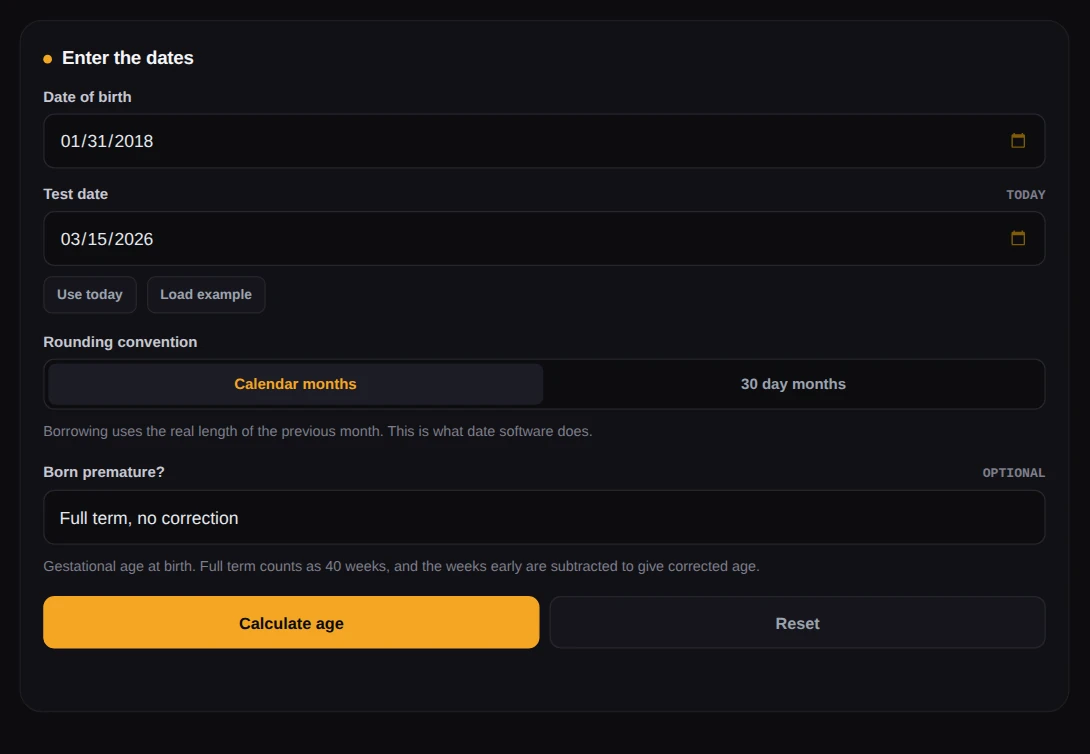
Enter the dates
Gestational age at birth. Full term counts as 40 weeks, and the weeks early are subtracted to give corrected age.
The arithmetic, step by step
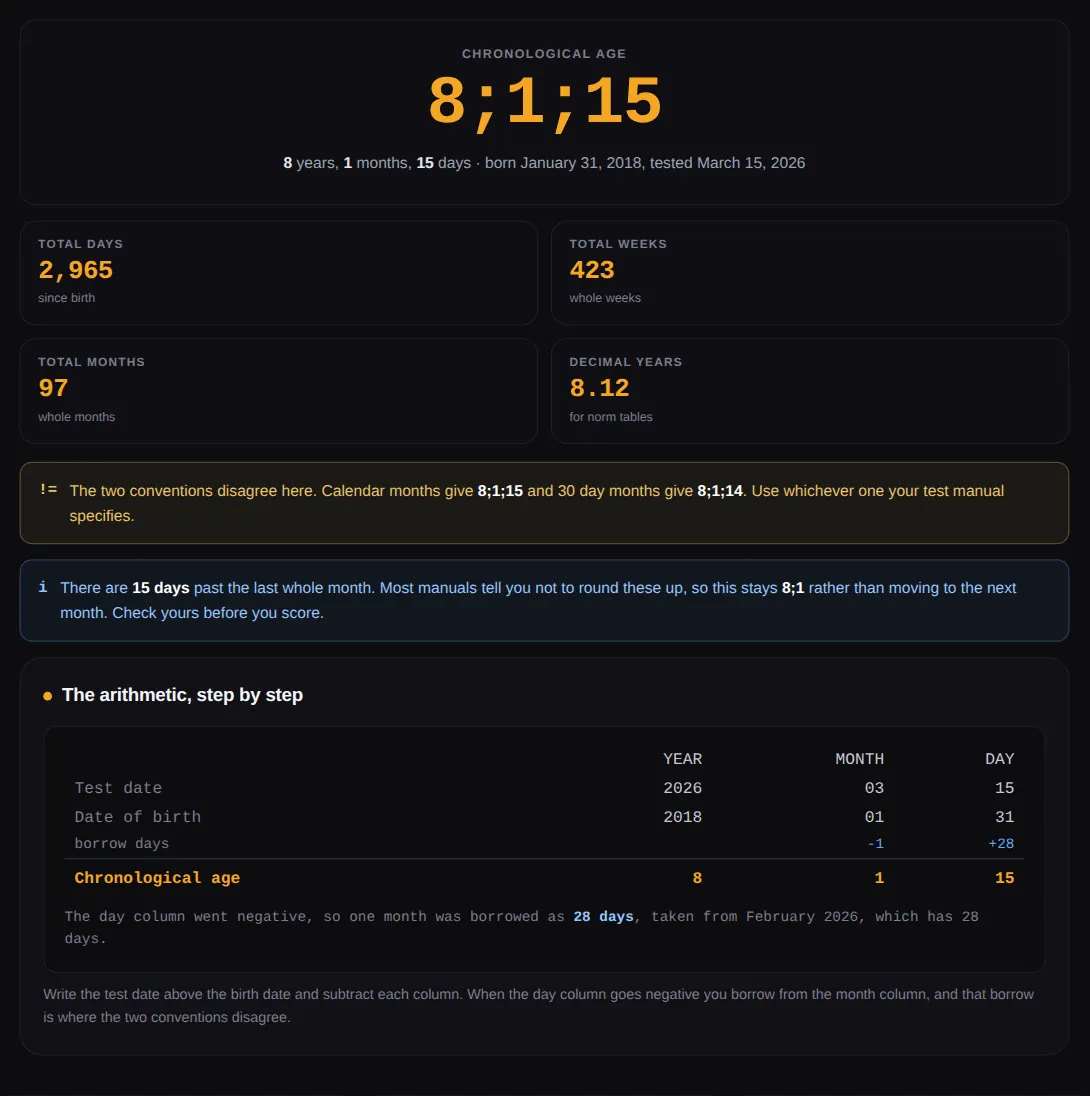
Write the test date above the birth date and subtract each column. When the day column goes negative you borrow from the month column, and that borrow is where the two conventions disagree.
Corrected age for prematurity
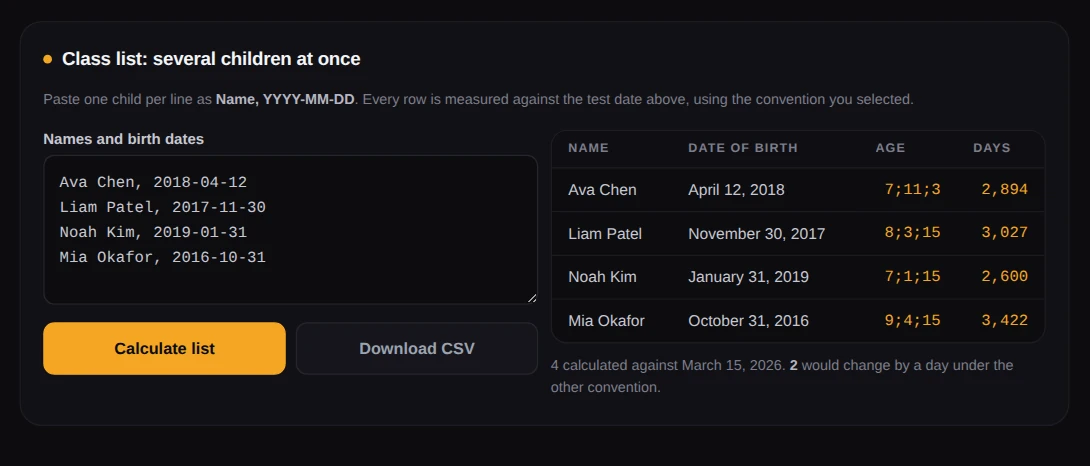
Class list: several children at once
Paste one child per line as Name, YYYY-MM-DD. Every row is measured against the test date above, using the convention you selected.
| Name | Date of birth | Age | Days |
|---|---|---|---|
| No list calculated yet. | |||
Runs entirely in your browser · No dates are uploaded or stored · Corrected age uses 40 weeks as full term · Always follow the rounding rule printed in your test manual
What Is a Chronological Age Calculator?
A chronological age calculator works out exactly how old someone is on a given date, expressed as years, months and days rather than a rounded number of years. You enter a date of birth and a test date, and it returns the precise gap between them.
Ordinary age is a single number that changes once a year. Chronological age is the full measurement. A child who
turned eight last month and a child who turns nine next week are both "eight years old" in conversation, but they
are 8;1;4 and 8;11;22 on a score sheet, and those two children are compared against
different norm tables. That gap is the whole reason this tool exists.
How to Calculate Chronological Age by Hand
The method is column subtraction. Write the test date on top, the date of birth underneath, and subtract each column separately, working right to left.
- Write both dates as year, month, day.
- Subtract the day column.
- Subtract the month column.
- Subtract the year column.
- If the day column came out negative, borrow one month and add those days back.
- If the month column came out negative, borrow one year and add twelve months back.
A worked example
A child born on 31 January 2018, tested on 15 March 2026. Subtracting the day column gives 15 minus 31, which is negative, so a month has to be borrowed.
| Year | Month | Day | |
|---|---|---|---|
| Test date | 2026 | 03 | 15 |
| Date of birth | 2018 | 01 | 31 |
| Borrow one month | −1 | +28 or +30 | |
| Chronological age | 8 | 1 | 15 or 14 |
Look at that last row. The answer depends entirely on how many days you decided to borrow, and that is not a detail most people expect to matter.
Where the mistakes happen
Almost every error in calculating chronological age by hand comes from the same three places. The day column is borrowed from without adjusting the month column. The month column is borrowed from without adjusting the year column. Or the days are quietly rounded up because twenty eight days feels close enough to a month. The calculator above shows the borrow line explicitly so you can check your own working against it.
The Two Rounding Conventions, and How Often They Disagree
There are two conventions in circulation for that borrow step, and this is the part no other chronological age calculator explains clearly.
Calendar months
You borrow the real length of the month before the test date. If the test is in March you borrow February, so you add 28 days, or 29 in a leap year. This is what date software does, and it is what a calendar genuinely measures.
Thirty day months
You always borrow 30 days, whatever month it happens to be. This is the hand method taught for assessment scoring, because it keeps the arithmetic uniform across every examiner and every test date.
How often does the choice change the answer?
We ran both methods across every birth date in a twenty year window, measured against weekly test dates through 2026. That is 387,165 date pairs.
Roughly one calculation in three. The difference is usually a single day, which sounds harmless until you
remember that a single day can move a child across a norm table boundary. In the worked example above, calendar
months give 8;1;15 and thirty day months give 8;1;14.
This figure is ours. We generated it with the same engine that runs the calculator on this page, and you can reproduce it by running both conventions over the same date range.
Which one should you use?
Whichever your test manual specifies. That is the only correct answer, and it is why this tool shows both rather than picking for you. If your manual is silent, calendar months are the more literally accurate measure of elapsed time. If you are checking someone else's hand calculation, try the thirty day convention first, because that is what most people are taught.
How to Calculate a Child's Chronological Age for Testing
Standardized tests are normed in age bands. To score one you need the child's exact age on the day the test was administered, not the day you entered the results. Enter the real test date, not today's date, or the age you score against will drift.
Do not round days up to the next month
A child who is 7 years, 11 months and 29 days old is scored as 7;11, not as 8 years. The extra days
are recorded but they do not promote the child to the next band. The calculator flags this whenever the day
figure is large enough to tempt you, because it is the single most common scoring error and it always inflates
the child's age band.
Writing the age as Y;M;D
Assessment reports write chronological age with semicolons, as years;months;days. An age of
6;4;19 means six years, four months and nineteen days. The semicolon matters, because
6.4 written as a decimal means something different again: six and four tenths of a year, which is
six years and about five months. The calculator gives you both, and the copy button puts the Y;M;D string on
your clipboard in the exact format score sheets expect.
Corrected Age for Babies Born Premature
For a baby born early, developmental expectations are usually measured against corrected age rather than chronological age. Full term is counted as 40 weeks. You subtract the weeks of prematurity from the chronological age to get the corrected age.
A baby born at 28 weeks was 12 weeks early. At a chronological age of 1;6;18, the corrected age is
1;3;26. That is a three month gap, and at that stage of development three months is an enormous
difference in what you would expect a child to be doing.
Select the gestational age at birth in the calculator and the corrected age appears alongside the chronological age. How long a service continues to use corrected age varies between programs and manuals, so follow your own protocol rather than a fixed cutoff.
Looking for the Pearson Chronological Age Calculator?
A lot of people searching for a chronological age calculator are specifically looking for the Pearson one, because Pearson publishes many of the assessments that need it. As of this writing, that page says plainly: "We no longer have a live age calculator on our site." It points visitors to a third party date duration tool instead.
It also carries one instruction worth repeating, because it changes the result: do not include the end date in the calculation. Counting the test date itself as a whole day adds one day to every age you compute. The calculator on this page measures the gap between the two dates and does not count the end date, so it already follows that rule.
Biological Age vs Chronological Age
Searches for a biological age vs chronological age calculator are asking about two different ideas that happen to share a word.
| Chronological age | Biological age |
|---|---|
| Time elapsed since birth | An estimate of how the body has aged |
| Measured exactly from two dates | Modeled from biomarkers, fitness or lifestyle |
| Identical for everyone born the same day | Differs between people of the same birth date |
| Used to score standardized tests | Used in health and longevity contexts |
| One correct answer | Depends entirely on the model used |
This page calculates the first one. Chronological age has a single defensible answer, which is what makes it usable for scoring. Biological age estimates vary widely depending on which model produces them, so treat any single number with caution.
What This Online Chronological Age Calculator Gives You
Most tools return three numbers and stop. This online chronological age calculator returns the working as well:
- Exact age as years, months and days, plus the Y;M;D string ready to copy
- The column subtraction, including which month was borrowed and how many days it contributed
- Both rounding conventions, with a warning when they disagree
- Total days, total weeks, total months and decimal years
- Corrected age when a gestational age at birth is entered
- A class list mode for calculating a whole group against one test date
- Copy and CSV export for both a single result and the full list
The class list exists because testing is rarely a one child job. Paste a group in as name and birth date, set the test date once, and every age is calculated together, with a note telling you how many of them would shift by a day under the other convention.
Who Uses a Chronological Age Calculator
- Speech language pathologists scoring language and articulation assessments
- School psychologists and educational diagnosticians working with age normed tests
- Special education teachers checking eligibility windows
- Audiologists and occupational therapists using developmental norms
- Early intervention staff who need corrected age as well as chronological age
- Parents and students who simply want an exact age between two dates
Related Calculators
Several tools on this site take age as an input, so the exact figure from this page feeds straight into them:
- Heart Rate Zone Calculator, which builds its zones from your age
- BMI Calculator for height and weight against the standard ranges
- Protein Intake Calculator, where age changes the recommendation
- Water Intake Calculator
- Sleep Calculator for bedtime and wake time cycles
- More in Health & Fitness tools
Frequently Asked Questions
What is a chronological age calculator?
A chronological age calculator measures the exact time between a date of birth and a test date, and reports it as years, months and days. It is used to score age normed assessments, where a rounded age in years is not precise enough.
How do I calculate chronological age manually?
Write the test date above the date of birth as year, month and day, then subtract each column from right to left. If the day column goes negative, borrow one month and add those days back. If the month column goes negative, borrow one year and add twelve months back.
How do you calculate a child's chronological age for testing?
Use the date the test was actually administered, not the date you are scoring it. Subtract the date of birth from that test date to get years, months and days, and do not round the days up to the next month. Record the result as Y;M;D.
Should days be rounded up to the next month?
No. A child who is 7 years, 11 months and 29 days is scored as 7;11, not as 8 years. Rounding days up moves the child into an older age band and lowers the standard score they receive. Check your manual, because a small number of tests do specify their own rule.
Why do two chronological age calculators give different answers?
Because of how each one borrows days. One convention borrows the real length of the previous month, the other always borrows 30 days. Across 387,165 date pairs we tested, the two approaches disagree 32.4% of the time, almost always by a single day.
Is there still a Pearson chronological age calculator?
Pearson's age calculator page states that they no longer host a live age calculator, and it directs visitors to a third party date duration tool. It also advises not to include the end date in the calculation, which the calculator on this page already does.
What does Y;M;D mean in an assessment report?
It is years;months;days written with semicolons. An age of 6;4;19 is six years, four months and nineteen days. Semicolons are used so the figure is not mistaken for a decimal, since 6.4 years would mean roughly six years and five months.
How is corrected age different from chronological age?
Chronological age counts from the date of birth. Corrected age subtracts the weeks a baby was born early, counting full term as 40 weeks. A baby born at 32 weeks was 8 weeks early, so the corrected age is 8 weeks less than the chronological age.
What is the difference between biological age and chronological age?
Chronological age is the exact time since birth and has one correct answer. Biological age is an estimate of how the body has aged, based on biomarkers or lifestyle, and it varies depending on which model produces it. Only chronological age is used to score standardized tests.
Is this online chronological age calculator free?
Yes. There is no sign up, no account and no limit on how many ages you calculate. Everything runs in your browser, so the dates you enter are never uploaded or stored anywhere.

Written & verified by
B.Tech Computer Science · 8 years in web development & SEO · Bhilwara, India
About ·
LinkedIn ·
Report an error