
Calcxi · Health & Fitness
Protein Intake Calculator
Work out how much protein you need a day from your body weight, in grams, per kilogram and per pound. Instead of one number, this protein calculator shows every published band that applies to you and names the body that issued it, because the amount that prevents deficiency and the amount that supports training are two different answers to two different questions.
A daily total tells you nothing about whether you can actually use it. The ISSN position stand puts a single serving at 0.25 g per kg of body weight, or 20 to 40 g, spread every 3 to 4 hours. This checks your split against both forms of that recommendation.
Per meal
·
ISSN dose for your weight
·
0.25 g per kg
Absolute band
·
Per serving
Spacing
·
Between servings
Search for a good protein to calorie ratio and you get opinions. There is a published answer: the Acceptable Macronutrient Distribution Range puts protein at 10 to 35 percent of energy for adults. Protein carries 4 calories per gram, so that converts straight into grams.
Protein share of calories
·
Published range
·
Of total energy
That range in grams
·
Per 100 calories
·
Grams of protein
Four rules of thumb for the same question, worked out for your body weight, each labelled with who published it. Three come from expert bodies. One does not, and it is the one you hear most often in a gym.
kg
How to use this protein intake calculator
A protein intake calculator turns your body weight into a daily target in grams. The awkward part, which most of them hide, is that there is no single target. The amount that prevents a deficiency and the amount that supports hard training are two different published numbers answering two different questions, and they differ by a factor of more than two. This tool shows you every band that applies to you and names the expert body that issued it.
Get your daily target
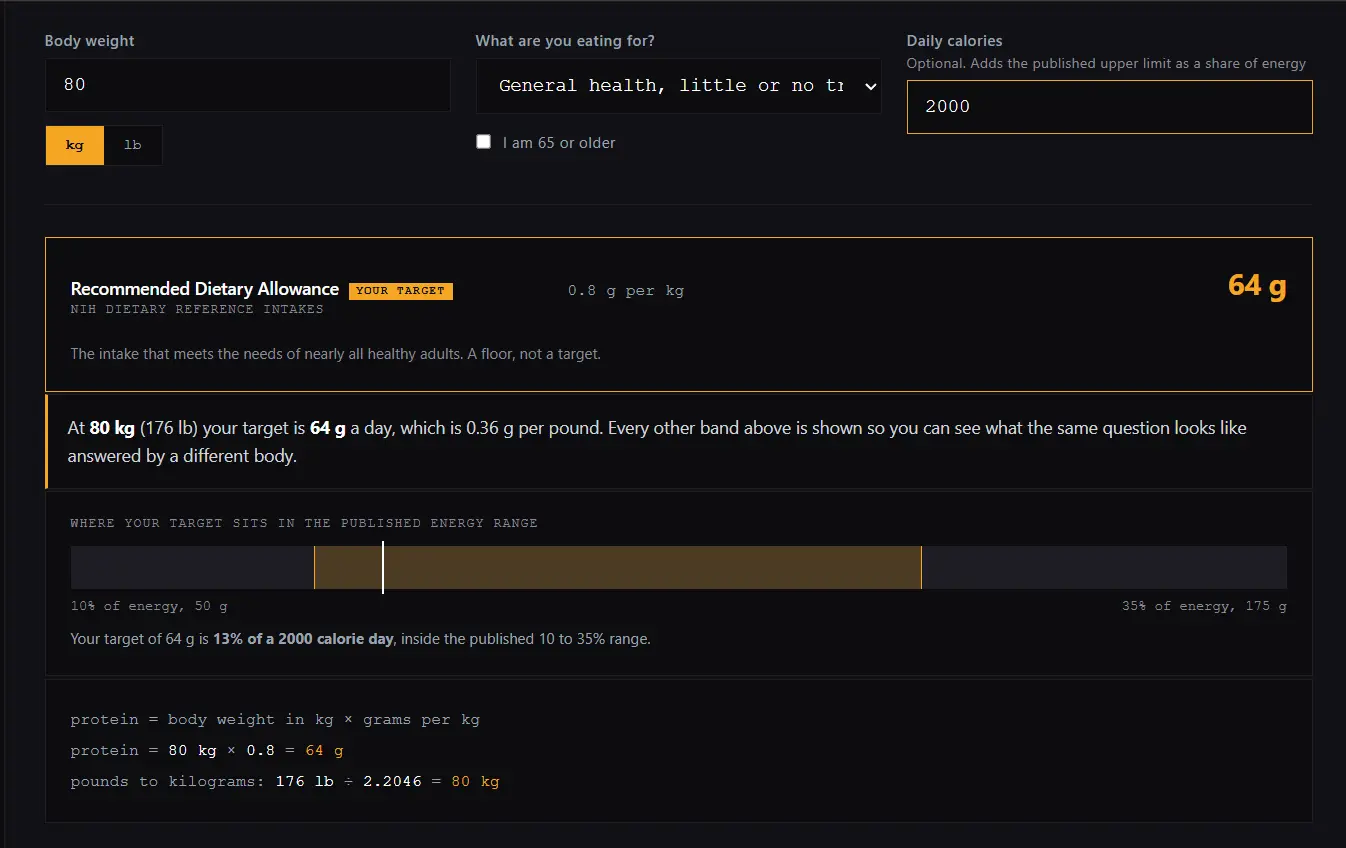
Type your body weight, pick kilograms or pounds, and say what you are eating for. The first tab returns each published band that applies, labelled with its source. At 80 kg the reference intake is 64 g a day, the range published for healthy older adults is 80 g to 96 g, and the range published for people who train is 112 g to 160 g. All three are correct. They are just not answers to the same question.
Split the total across your day
A daily total says nothing about whether your body can use it. The second tab checks your split against the per serving figures in the International Society of Sports Nutrition position stand, which are 0.25 g per kg of body weight or an absolute 20 g to 40 g, spaced every 3 to 4 hours.
Check your protein to calorie ratio
The third tab answers a question the other calculators ignore completely. There is a published range for how much of your energy should come from protein, it is 10 to 35 percent for adults, and because protein carries 4 calories per gram that converts directly into grams. On 2,000 calories a day the band runs from 50 g to 175 g.
Compare the rules of thumb side by side
The fourth tab works out four common rules for your weight at once and marks which ones come from a published guideline and which one does not. The one that does not is the one you hear most often in a gym.
What is a protein intake calculator?
A protein intake calculator is a tool that multiplies your body weight by a recommended amount of protein per unit of weight to produce a daily target in grams. Every one of them does that same multiplication. What separates a useful one from a misleading one is which multiplier it picks, and whether it tells you where that multiplier came from.
The multipliers in circulation are not interchangeable. The reference intake published in the Dietary Reference Intakes used by the US National Institutes of Health is 0.8 g per kg of body weight per day. The International Society of Sports Nutrition position stand puts the figure for people who exercise at 1.4 to 2.0 g per kg per day. The ESPEN Expert Group recommends at least 1.0 to 1.2 g per kg per day for healthy older adults. Feed the same 80 kg body into those three and you get 64 g, 112 g to 160 g and 80 g to 96 g.
Why one number is the wrong output
A calculator that returns a single figure has quietly made a decision on your behalf about which of those questions you were asking, and it usually does not tell you which one it picked. That is why two calculators can give you wildly different answers from the same weight and both be citing real science. The disagreement is not in the arithmetic. It is in the premise.
What a protein intake calculator cannot do
It cannot see your body composition, your kidney function, your training history or what you actually ate yesterday. It multiplies one number by another. Treat the output as a starting range to aim at and adjust from, not a prescription.
How much protein do I need a day? The three published answers
Here is every sourced band, worked out across a spread of body weights. Every figure in this table was produced by the calculator above, from the same engine, so the page and the tool cannot disagree with each other.
| Body weight | Reference intake 0.8 g/kg | Healthy over 65 1.0 to 1.2 g/kg | People who train 1.4 to 2.0 g/kg |
|---|---|---|---|
| 50 kg (110 lb) | 40 g | 50 g to 60 g | 70 g to 100 g |
| 60 kg (132 lb) | 48 g | 60 g to 72 g | 84 g to 120 g |
| 70 kg (154 lb) | 56 g | 70 g to 84 g | 98 g to 140 g |
| 80 kg (176 lb) | 64 g | 80 g to 96 g | 112 g to 160 g |
| 90 kg (198 lb) | 72 g | 90 g to 108 g | 126 g to 180 g |
| 100 kg (220 lb) | 80 g | 100 g to 120 g | 140 g to 200 g |
| 110 kg (243 lb) | 88 g | 110 g to 132 g | 154 g to 220 g |
The three published bands at common body weights. Kilograms are the unit all three sources publish in; the pound column is a conversion.
0.8 g per kg: the amount that prevents a deficiency
This is the Recommended Dietary Allowance, and it is widely misread. An RDA is set to meet the requirement of nearly everybody in a healthy population. It is a floor built to avoid inadequacy, not a target built to optimise anything. The same reference tables give it in absolute terms too: 56 g a day for adult men and 46 g a day for adult women. If you are sedentary and healthy and want to know the minimum that keeps you out of trouble, this is your number.
1.0 to 1.2 g per kg: healthy adults over 65
The ESPEN Expert Group recommends "at least 1.0 to 1.2 g protein/kg body weight/day" for healthy older adults, and 1.2 to 1.5 g per kg per day for older people with an acute or chronic illness. The reason is that ageing muscle responds less readily to the same stimulus, so maintaining it takes more, not less. Tick the box on the first tab and the calculator adds this band to your results.
1.4 to 2.0 g per kg: people who train
The ISSN position stand states that an intake in the range 1.4 to 2.0 g per kg of body weight per day "is sufficient for most exercising individuals". Note the word sufficient. It is a range, not a threshold you have to hit exactly, and the top of it is a ceiling on what the evidence supports rather than a stretch goal.
How to read three overlapping answers
They are not competing estimates of one true value. Ask which question describes you. If you are sedentary, the reference intake is the relevant floor. If you lift or run several times a week, the training range is where you should be. If you are over 65, you have a floor higher than the reference intake regardless of whether you train. If two apply to you, use the higher floor, because the lower one is a minimum and clearing a minimum is not a problem.
The protein intake formula
The daily target
Working in pounds
Protein as a share of your calories
Per serving
How much protein per pound of body weight?
Almost nobody searching this question weighs themselves in kilograms, and every source publishes in kilograms. That mismatch is where a very popular piece of misinformation lives, so here is the conversion done properly.
| Published figure | Grams per pound | Who publishes it |
|---|---|---|
| 0.8 g per kg | 0.36 g | NIH RDA |
| 1.0 g per kg | 0.45 g | ESPEN floor, older adults |
| 1.2 g per kg | 0.54 g | ESPEN ceiling, older adults |
| 1.4 g per kg | 0.64 g | ISSN floor |
| 2.0 g per kg | 0.91 g | ISSN ceiling |
| 2.2 g per kg | 1 g | Gym convention, not a published guideline |
Each published multiplier divided by 2.2046 to give grams per pound. The bottom row is not a guideline, it is a convention, and it is listed here so you can see where it sits relative to the ones that are.
The line that matters is the ISSN ceiling. 2.0 g per kg is 0.91 g per pound. Not one gram. The top of the range published for exercising individuals lands just under nine tenths of a gram per pound of body weight, and the familiar "a gram per pound" rule sits above it.
| Body weight | In kilograms | Reference intake | Training range | At 1 g per pound |
|---|---|---|---|---|
| 120 lb | 54.4 kg | 44 g | 76 g to 109 g | 120 g |
| 140 lb | 63.5 kg | 51 g | 89 g to 127 g | 140 g |
| 150 lb | 68 kg | 54 g | 95 g to 136 g | 150 g |
| 160 lb | 72.6 kg | 58 g | 102 g to 145 g | 160 g |
| 180 lb | 81.6 kg | 65 g | 114 g to 163 g | 180 g |
| 200 lb | 90.7 kg | 73 g | 127 g to 181 g | 200 g |
| 220 lb | 99.8 kg | 80 g | 140 g to 200 g | 220 g |
| 250 lb | 113.4 kg | 91 g | 159 g to 227 g | 250 g |
The same bands at common pound weights, with the one gram per pound figure alongside for comparison.
Is 1 gram of protein per pound of body weight too much?
One gram per pound works out to 2.2 g per kg, which is above the top of the 1.4 to 2.0 g per kg range published by the ISSN for exercising individuals. It is a round number that survived because pounds and kilograms happen to differ by roughly 2.2, not because a study landed on it.
At 180 lb the rule asks for 180 g a day. The ISSN ceiling for the same body is 163 g. The gap is 17 g a day of protein you are being told to find, source, chew and pay for on the strength of a unit conversion coincidence.
| Rule | At 180 lb | Source |
|---|---|---|
| 0.8 g per kg | 65 g | NIH Dietary Reference Intakes |
| 1.0 to 1.2 g per kg | 82 g to 98 g | ESPEN, older adults |
| 1.4 to 2.0 g per kg | 114 g to 163 g | ISSN position stand |
| 1 g per pound | 180 g | Gym convention, not a published guideline |
Four rules applied to the same 180 lb body. Three carry a named publisher. One does not.
So is it harmful?
Above the range is not the same as dangerous. The ISSN also notes that intakes above 3.0 g per kg per day "may have positive effects on body composition in resistance-trained individuals", which is a long way clear of 2.2, so the honest description of one gram per pound is not risky but unnecessary. If you find it easy to hit and you enjoy eating that way, it is very unlikely to be the thing holding you back. What it should not be is the number you feel guilty about missing.
Why the myth is so sticky
It is memorable, it requires no arithmetic, and it errs on the high side, which means anybody following it will comfortably clear every published floor. Rules of thumb that fail safe tend to survive. The cost is that it sets an expensive target and presents it with the confidence of a guideline.
How much protein to build muscle?
The published answer is 1.4 to 2.0 g per kg of body weight per day, the same range the ISSN gives for exercising individuals generally. There is no separate, higher muscle-building band in that position stand, which surprises people who expect gaining tissue to require some special allocation.
Set the goal selector to building muscle and the calculator puts you in the upper part of that range rather than inventing a number above it. At 80 kg that means 112 g to 160 g, and the tool shows the whole band because where you sit inside it matters less than being inside it at all.
Total matters more than timing
The evidence on which the ISSN range rests is about daily totals first. Distribution is a refinement on top of a total that is already adequate, not a substitute for one. A perfectly spaced day that comes to 90 g will not out-build a sloppily spaced day that comes to 150 g.
Protein does not build muscle by itself
It is the raw material. The stimulus is resistance training, and the permission is an energy intake that is not deeply negative. Eating 200 g a day without training produces expensive urine, not muscle. This is worth saying plainly because a calculator that only asks for your weight can leave the impression that grams are the whole story.
How much protein per meal?
The ISSN position stand gives a per serving figure twice over: "0.25 g of a high-quality protein per kg of body weight, or an absolute dose of 20 to 40 g". It also says servings should be "evenly distributed, every 3 to 4 h". The second tab of the calculator checks your split against both forms.
| Meals a day | Protein per meal | Against the 20 to 40 g band |
|---|---|---|
| 3 | 46.7 g | Above the 40 g band |
| 4 | 35 g | Inside the 20 to 40 g band |
| 5 | 28 g | Inside the 20 to 40 g band |
| 6 | 23.3 g | Inside the 20 to 40 g band |
140 g a day for an 80 kg body, split different ways, checked against the 20 to 40 g absolute band.
Three meals puts 46.7 g on each plate, which is above the band. Four to six all land inside it. For this weight and this total the calculator reports an ideal spread of 4 to 7 eating occasions, which is the range where every serving clears the 20 g floor without any of them overshooting 40 g.
Does anything above 40 g go to waste?
No. Waste is the wrong model. A larger serving is still digested and absorbed; the argument is about how much of it drives muscle protein synthesis in that window versus being used for other things. The practical reading of the 20 to 40 g band is that spreading your total gives you more bites at that particular cherry, not that a 60 g dinner is thrown away.
Does the 3 to 4 hour spacing matter?
It is what the position stand recommends, and it falls out naturally from eating four to six times. Chasing it with alarms is not the point. If your day already has breakfast, lunch, something in the afternoon and dinner, you are inside it.
What is a good protein to calorie ratio?
Search for this and you get opinions, ratios pulled from apps, and numbers with no publisher attached. There is a sourced answer, and it comes from the same reference tables as the RDA. The Acceptable Macronutrient Distribution Range puts protein at 10 to 35 percent of total energy for adults.
Because protein carries 4 calories per gram, that percentage converts straight into grams once you know your calories.
| Daily calories | Protein at 10 percent | Protein at 35 percent | Grams per 100 calories |
|---|---|---|---|
| 1,500 kcal | 38 g | 131 g | 2.5 g to 8.8 g |
| 1,800 kcal | 45 g | 158 g | 2.5 g to 8.8 g |
| 2,000 kcal | 50 g | 175 g | 2.5 g to 8.8 g |
| 2,200 kcal | 55 g | 193 g | 2.5 g to 8.8 g |
| 2,500 kcal | 63 g | 219 g | 2.5 g to 8.8 g |
| 3,000 kcal | 75 g | 263 g | 2.5 g to 8.8 g |
The published 10 to 35 percent range expressed in grams at a spread of daily calorie intakes, with the same range as grams per 100 calories.
Grams per 100 calories, which is the form people mean
Expressed the way the question is usually asked, the range is 2.5 g to 8.8 g of protein per 100 calories, and it does not change with your calorie intake because it is a proportion. Anything inside that is inside the published range. If you are lifting and eating in a deficit you will be near the top of it; if you are sedentary you will be near the bottom.
The calorie to protein ratio, the other way round
Some people prefer calories per gram of protein, which is the same relationship inverted. At the 35 percent ceiling you get about 11 calories per gram of protein; at the 10 percent floor, about 40. Low numbers mean a diet built around lean protein sources, high numbers mean protein is a small slice of what you eat. The third tab reports both directions so you do not have to do the flip yourself.
When the two answers collide
The percentage range and the per kilogram range can genuinely conflict, and the calculator says so rather than quietly picking one. A 120 kg person training and eating 1,500 calories a day has an ISSN ceiling of 240 g, but the AMDR ceiling at that intake is 131 g, or 64 percent of energy. Both cannot be satisfied. That is not a bug in the guidance, it is a signal that the calorie intake is very low for the body it is feeding, and the calculator flags the clash instead of hiding it.
Protein needs by age and life stage
Children and teenagers
The energy share range is different for young people: 5 to 20 percent of energy for ages 1 to 3, and 10 to 30 percent for ages 4 to 18. The third tab has an age selector that switches to the correct band. Per kilogram requirements are higher in childhood than adulthood because growth is happening, and this calculator does not publish a per kilogram figure for children, because the reference tables set those by narrow age band and a tool that asks only for weight cannot pick the right one.
Adults under 65
The reference intake is the floor and the training range applies if you train. Nothing about being 30 rather than 50 changes the multiplier in the published guidance.
Adults over 65
This is the one age adjustment with a clear published number, and it goes up rather than down. At least 1.0 to 1.2 g per kg per day for healthy older adults, rising to 1.2 to 1.5 with acute or chronic illness, from the ESPEN Expert Group. The practical problem at this age is usually appetite rather than arithmetic, which makes the per serving tab more useful than the daily one.
Pregnancy, breastfeeding and medical conditions
Requirements rise in pregnancy and lactation, and they change in chronic kidney disease, liver disease and several other conditions, sometimes downwards. Those are not numbers this tool will guess at. They belong to a clinician who knows your case.
How much protein for weight loss?
Set the goal selector to losing fat while training and the calculator keeps you in the ISSN range rather than dropping you towards the reference intake, and the reasoning is worth stating.
Why the target does not fall when calories do
When you eat less than you burn, some of the shortfall can come out of muscle. Protein is the input that argues against that, and training is the other. So a deficit is the situation in which the amount you need stays put while everything else on the plate shrinks, which means it takes up a larger share of a smaller total.
Satiety is a real second reason
Protein is the most satiating of the three macronutrients for most people, so a higher share tends to make a deficit easier to hold rather than harder. That is a behavioural benefit rather than a metabolic one, and it is not a licence to ignore total calories.
Watch the percentage ceiling
This is exactly where the energy share range starts to bite. Hold a high per kilogram target while cutting calories hard and protein can push past 35 percent of your intake. The first tab draws a bar showing where your target sits inside the published range as soon as you enter your calories, so you can see the squeeze rather than discover it.
Can you eat too much protein?
The honest answer has two halves, and calculators tend to give only whichever half suits them.
What the guidance actually says
The reference tables set no Tolerable Upper Intake Level for protein, so there is no published number above which an adult is officially over. What they do set is the 10 to 35 percent energy range, and the top of that is the closest thing to a ceiling that carries a source. This calculator will never tell an adult they have exceeded a limit that has not been published, which is why the daily tab reports a position inside the energy range rather than a pass or fail.
What the practical limits are
Every gram of protein you add is a gram of something else you have displaced, and a diet at 45 percent protein is a diet short of carbohydrate or fat or fibre. Very high intakes are also expensive and, for most people, tedious. If you have kidney disease, existing guidance may restrict intake and none of the ranges on this page apply to you without a doctor's involvement.
The one sentence version
For a healthy adult, the risk in protein intake is far more commonly too little than too much, and the sensible operating range for anyone who trains is 1.4 to 2.0 g per kg, which is 0.64 to 0.91 g per pound.
When a protein calculator is not enough
Everything above is general information, not medical advice, and no calculator can account for a condition it has not been told about. Speak to a doctor or a registered dietitian rather than a calculator if any of the following apply.
- Kidney disease, reduced kidney function or a single kidney. Protein intake is often deliberately managed in these cases and the published ranges here are for healthy adults.
- Liver disease. Requirements and restrictions can both apply depending on the stage.
- Diabetes, especially with any degree of kidney involvement.
- Pregnancy or breastfeeding. Requirements are higher and specific.
- You are trying to gain or lose weight rapidly, or you have a history of disordered eating. A number in a box can become something it should not be, and a clinician is the right person to set targets.
- You are feeding a child or a teenager. Growth changes the arithmetic and the age bands are narrow.
- You have unexplained weight loss, muscle loss or persistent fatigue. That is a symptom to investigate, not a target to adjust.
Protein intake calculator FAQ
How much protein do I need a day?
It depends which question you are asking, and there are three published answers. The reference intake is 0.8 g per kg of body weight per day, which is a floor for a healthy sedentary adult and works out at 56 g for men and 46 g for women in absolute terms. The ISSN puts people who exercise at 1.4 to 2.0 g per kg. The ESPEN Expert Group puts healthy adults over 65 at a floor of 1.0 to 1.2 g per kg. The protein intake calculator above shows every band that applies to you at once.
How many grams of protein per pound of body weight?
The published ranges converted to pounds are 0.36 g per pound for the reference intake and 0.64 to 0.91 g per pound for the ISSN training range. Every source publishes per kilogram, so any per pound figure is a conversion. Note that the top of the training range is 0.91 g per pound, not a full gram.
Is 1 gram of protein per pound of body weight too much?
It is above the published range, though not a known risk for a healthy adult. One gram per pound is 2.2 g per kg, and the ISSN range for exercising individuals tops out at 2.0 g per kg. At 180 lb that is 180 g against a ceiling of 163 g, an extra 17 g a day. The rule survives because 2.2 is the pound to kilogram conversion factor, not because a study produced it.
How much protein do I need to build muscle?
1.4 to 2.0 g per kg of body weight per day, which is the same range the ISSN position stand gives for exercising individuals in general. There is no separate higher band for muscle gain in that guidance. At 80 kg that is 112 g to 160 g a day. Resistance training is what turns those grams into tissue, so the training is not optional.
What is a good protein to calorie ratio?
10 to 35 percent of total energy for adults, which is the Acceptable Macronutrient Distribution Range from the same reference tables that set the RDA. In the form people usually mean, that is 2.5 g to 8.8 g of protein per 100 calories. On 2,000 calories a day it works out at 50 g to 175 g.
How much protein per meal can the body use?
The ISSN position stand puts a serving at 0.25 g per kg of body weight, or an absolute 20 to 40 g, spaced every 3 to 4 hours. Above 40 g is not wasted; it is simply less of it going towards muscle protein synthesis in that window. Spreading your total across four to six eating occasions keeps every serving inside the band.
How much protein should I eat to lose weight?
Keep the per kilogram target where it is rather than lowering it with your calories. In a deficit, protein is what argues against losing muscle alongside fat, and it is also the most satiating macronutrient, which makes the deficit easier to hold. Watch the energy share as you cut: a high gram target on low calories can push protein past 35 percent of your intake, and the calculator above draws that position for you.
Can you eat too much protein?
No Tolerable Upper Intake Level has been set for protein, so there is no published figure above which a healthy adult is over the limit. The nearest thing to a ceiling is the 35 percent of energy top end of the distribution range. The real costs of a very high intake are displacement of other foods, expense and monotony. If you have kidney disease, that is a separate situation and one for your doctor.
How much protein do older adults need?
At least 1.0 to 1.2 g per kg of body weight per day for healthy adults over 65, and 1.2 to 1.5 g per kg for older adults with an acute or chronic illness, both from the ESPEN Expert Group. This is higher than the 0.8 g per kg reference intake, not lower, because ageing muscle responds less readily to the same amount. Tick the 65 or older box in the calculator to add this band.
Does this protein calculator use body weight or lean mass?
Total body weight, because that is what all three sources publish their figures against. The ISSN range is stated per kilogram of body weight, not per kilogram of lean mass. Lean mass based targets exist but they need a body composition measurement, and substituting one for the other silently would change your result by a large margin.
How much protein is in 2,000 calories?
Between 50 g and 175 g if you stay inside the published 10 to 35 percent of energy range. Protein carries 4 calories per gram, so 50 g is 200 calories and 175 g is 700. The third tab of the calculator does this for any calorie intake and any of the three published age bands.
Does this protein intake calculator store what I enter?
No. Every calculation runs inside your own browser and nothing is sent to a server or saved anywhere. Your weight, your calories and your goal never leave your device.
Sources and limits
The 0.8 g per kg reference intake, the 56 g and 46 g absolute figures, the 10 to 35 percent energy range for adults, the 5 to 20 percent and 10 to 30 percent ranges for children, and the 4 calories per gram conversion all come from the Dietary Reference Intakes published by the National Academies and used by the US National Institutes of Health.
The 1.4 to 2.0 g per kg range, the 0.25 g per kg serving dose, the 20 to 40 g absolute serving band, the 3 to 4 hour spacing and the 3.0 g per kg observation come from the International Society of Sports Nutrition position stand on protein and exercise.
The 1.0 to 1.2 g per kg floor for healthy older adults and the 1.2 to 1.5 g per kg figure for older adults with illness come from the ESPEN Expert Group recommendations on protein intake and exercise for optimal muscle function with ageing.
What this page deliberately does not do is invent a number where the guidance does not publish one. There is no per kilogram figure for children here, no protein target derived from lean mass, no upper limit presented as though a Tolerable Upper Intake Level existed, and no single recommended figure standing in for three different published bands. Where an assumption is unavoidable, such as the default meal count, it is an editable input rather than a hidden constant. Every table on this page was generated by the same engine that runs the calculator, so a sentence cannot drift away from the figure beside it.
This is general information, not medical advice, and it cannot diagnose or treat anything. If you have kidney disease, liver disease, diabetes, are pregnant or breastfeeding, or are setting targets for a child, speak to a doctor or a registered dietitian before acting on any figure here.
Related calculators

Written & verified by
B.Tech Computer Science · 8 years in web development & SEO · Bhilwara, India
About ·
LinkedIn ·
Report an error