
Combat Field Test Standards
The Combat Field Test is the US Army's new pass or fail assessment for 24 combat specialties. Seven events, run back to back in uniform and boots, timed as one continuous effort with a hard cap of 30 minutes. There is no point scale and no individual event is timed. This page sets out every published CFT standard, straight from the Army's own directive and testing guidance.
Pass or fail · age and sex neutral · 30:00 capYour 30-minute budget
the only standardThe two one-mile runs bookend the test and are the largest, most predictable part of it. Put your realistic mile times in and this shows what is left for the other five events. That is the whole calculation, because the Army publishes nothing else to calculate.
First one-mile run min : sec
Second one-mile run min : sec
both mile runs left for the other five events
| Event | What it is | Timed on its own |
|---|
Order is the order Annex B gives. Only the cumulative time counts, so a slow event is only a problem because of what it takes from the rest.
Army Directive 2026-07 and HQDA EXORD 103-26 · nothing you type leaves your device · not an official US Army tool
What the Combat Field Test Is
The Combat Field Test is a new US Army assessment for soldiers in 24 designated combat specialties, introduced by Army Directive 2026-07 and signed by Secretary of the Army Dan Driscoll. The Army announced it on 22 April 2026, saying it is meant to align fitness standards with the demanding realities of modern combat.
It is not a replacement for the Army Fitness Test. It sits alongside it. The AFT is a scored test with five events, ten age brackets and a 500-point scale. The CFT is the opposite of all of that: seven events, one clock, no points, no age brackets and no separate column by sex. You either finish inside 30 minutes or you do not.
| AFT | Combat Field Test | |
|---|---|---|
| Events | Five | Seven, continuous |
| Scoring | 0 to 100 per event, 500 total | Pass or fail |
| Age brackets | Ten | None |
| Sex | Normed, except on the combat standard | Neutral |
| Standard | 350 combat, 300 general, 60 per event | Finish in 30:00 |
| Uniform | PT uniform | ACU and boots |
| Who | Every soldier | 24 combat specialties |
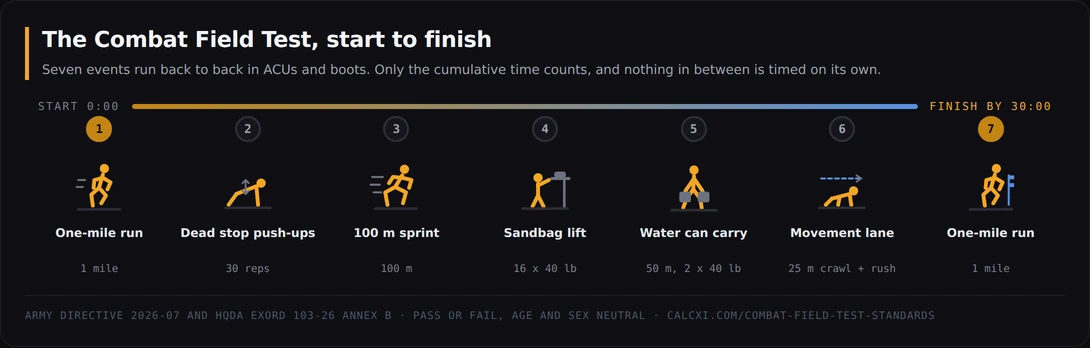
The Seven CFT Events in Order
These are the Combat Field Test events and their published requirements, taken from Annex B of HQDA EXORD 103-26. Soldiers move to the next station only after their grader clears them.
1. One-mile run
The first of two. No physical help from anyone is allowed. Walking is authorized but, in the Army's own words, strongly discouraged.
2. Dead stop push-ups
Thirty correct repetitions. The chest touches the ground, the hands lift off, and the knees may not stay in contact with the ground during the repetition. You may stop and rest in any position, but you have to return to the original starting position before resuming.
3. 100-meter sprint
A total sprint of 100 meters on the validated course.
4. Sandbag lift
Sixteen sandbags, 40 pounds each, lifted onto a platform 65 inches high. That is 640 pounds moved to above head height for most soldiers, and on a lot of scorecards it is the event that costs the most time.
5. Water can carry
Two five-gallon Army water cans, 40 pounds each, carried 50 meters. The cans have to be filled to capacity, and intentionally removing water terminates the test. You may set the cans down as many times as necessary.
6. Movement lane
Fifty meters, split in half: a 25-meter high crawl, then a 25-meter rush. The rush is done in three bounds of roughly 8 meters, each run lasting 3 to 5 seconds.
7. One-mile run
The second mile, on a designated route, run in the same general manner as the first. Together the two runs are the biggest single claim on your 30 minutes, which is why the planner at the top of this page starts there. If you want to work on them, our running pace calculator turns a target mile time into the per-400 pace you need to hold, and the running pace guide covers how to build it.
The 30-Minute Cap Is the Whole Standard
Annex B puts it plainly. The requirement is that the CFT must be completed in 30:00 or less, and the cumulative time of all events is what decides a pass or a fail. In the same section it states that no individual event is timed.
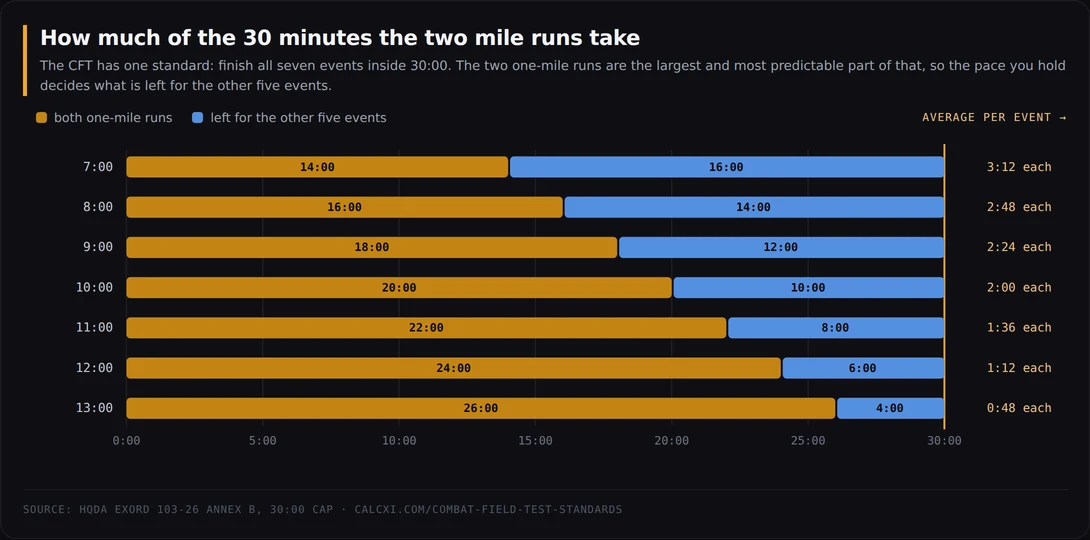
That has a practical consequence worth sitting with. Because the clock is cumulative and nothing is timed individually, a slow sandbag lift does not fail you on its own. It fails you by eating minutes the second mile run then does not have. The test rewards knowing your own split, which is exactly the arithmetic the planner above does.
| Mile pace | Both runs | Left for the other five | Average per event |
|---|---|---|---|
| 7:00 | 14:00 | 16:00 | 3:12 |
| 8:00 | 16:00 | 14:00 | 2:48 |
| 9:00 | 18:00 | 12:00 | 2:24 |
| 10:00 | 20:00 | 10:00 | 2:00 |
| 11:00 | 22:00 | 8:00 | 1:36 |
| 12:00 | 24:00 | 6:00 | 1:12 |
At a nine minute mile pace you have twelve minutes for the five middle events, which is comfortable. At eleven minutes you have eight, which is not. The relationship is simply two to one: every thirty seconds you take off your mile pace hands a full extra minute to the rest of the test.
What You Wear and What Counts
The CFT is taken in Army Combat Uniform top and bottoms, a belt, a brown T-shirt and boots approved under AR 670-1. This is not a PT test in shorts, and that is deliberate. A mile in boots and an ACU is not the same mile you ran at the AFT.
- Grader clearance. Soldiers move to the next station or event only after being cleared by their grader.
- No physical help. Receiving physical assistance, or leaving the course dishonestly, terminates the test.
- Equipment is fixed. Sandbags weigh 40 pounds each and water cans must be filled to capacity at 40 pounds each.
- Errors are repeated, not fatal. An error on a single event means repeating that portion, not restarting the whole test.
- Profiles get no modifications. The directive states that test and event modifications are not available for soldiers on profiles.
Which 24 Specialties Take the CFT
Army Directive 2026-07 lists these as combat specialties for CFT standards purposes. Note that this list is three longer than the 21 used for the AFT combat standard: 12D, 89D and 89E are on it.
| Branch | Codes |
|---|---|
| Infantry | 11A Infantry Officer, 11B Infantry Soldier, 11C Indirect Fire Infantry Soldier, 11Z Senior Infantry Leader |
| Engineer | 12A Engineer Officer, 12B Combat Engineer, 12D Army Diver |
| Field Artillery | 13A Field Artillery Officer, 13F Fire Support Specialist |
| Special Forces | 18A Officer, 180A Warrant Officer, 18B Weapons Sergeant, 18C Engineer Sergeant, 18D Medical Sergeant, 18E Communications Sergeant, 18F Assistant Operations and Intelligence Sergeant, 18Z Team Sergeant |
| Armor | 19A Armor Officer, 19C Bradley Fighting Vehicle Crewman, 19D Cavalry Scout, 19K M1 Armor Crewman, 19Z Armor Senior Sergeant |
| EOD | 89D Explosive Ordnance Disposal Specialist, 89E Explosive Ordnance Disposal Officer |
How Often You Take the CFT
Frequency depends on your component, and so does the minimum gap between record tests.
| Component | Tests per year | Minimum gap between record tests |
|---|---|---|
| Regular Army | One CFT and one record AFT | 4 months |
| Active Guard Reserve | One CFT and one record AFT | 4 months |
| Reserve component on orders of 365 days or more | One CFT and one record AFT | 4 months |
| Other Army National Guard and Army Reserve | One test per calendar year, alternating AFT and CFT | 8 months |
Guard and Reserve soldiers outside the first three rows may also take an extra record AFT inside the eight month window if they need one for promotion or schooling.
What Happens If You Fail
The CFT is pass or fail, so there is no partial credit and nothing to average. Failing to complete an event terminates the test and is recorded as a failure.
- Flag and reconditioning. A failing soldier is flagged and enrolled in reconditioning under unit standard operating procedures detailed in FM 7-22.
- Retest window. 90 days after the failure. For Guard and Reserve soldiers who are not AGR and not on orders of 365 days or more, it is 180 days.
- After a failed retest. The unit commander or other authorized official initiates reclassification or utilization action, unless the soldier holds an approved waiver.
- Two consecutive failures. Enlisted soldiers may be involuntarily separated under AR 635-200 chapter 13 for the Regular Army, or AR 135-178 chapter 9 for the Reserve component, if they refuse to extend or reenlist to allow reclassification or are otherwise ineligible to reclassify.
- Officers. In the same circumstances officers may be eliminated under AR 600-8-24 paragraph 4-2(a), or AR 135-175 paragraph 2-12 for those not on active duty, if they refuse or are ineligible for an involuntary branch transfer.
None of this applies during the first year. The directive sets a transition period in which no administrative action is taken solely because a soldier failed a CFT or holds a permanent profile that prevents taking it.
Profiles, Waivers and Who Cannot Take It
There is a strict eligibility gate, and it connects the CFT directly to the AFT. Annex A states that a soldier must be able to complete all events of the Army Fitness Test, with no alternate events, in order to take the CFT. If you need the 2.5-mile walk, the bike, the swim or the row in place of the two-mile run on your AFT, you are not eligible for the CFT. You can check which alternate events apply to you in our AFT calculator.
- Permanent profile. A combat specialty soldier with a permanent profile that prevents performing any primary AFT event is ineligible to complete the CFT, and is evaluated for reclassification.
- Waivers. Waiver authority sits with the GCMCA or the first general officer in the chain of command. Decisions weigh DA Pamphlet 611-21, the soldier's performance, chain of command recommendations and ability to meet the requirements of the specialty. A denial can be appealed to the next higher commander.
- Waivers are not permanent. They are reassessed annually, and a waived soldier still owes the annual AFT requirement.
- Temporary profile. Including pregnancy and postpartum. The soldier follows the profile and the AFT guidance in FM 7-22 until able to take the CFT.
The CFT Implementation Timeline
The Army describes the rollout as phased. The directive frames it in days from publication; the Army's own AFT page gives the calendar dates.
| When | What happens |
|---|---|
| 22 April 2026 | The Army announces the Combat Field Test |
| 17 April 2026 | Phased implementation begins. Soldiers in the designated specialties take diagnostic tests |
| Through 16 April 2027 | No adverse administrative action results from a failed CFT |
| 17 April 2027 | Full implementation. Testing for record begins and failures carry administrative action |
| Full implementation plus 12 months | Combat specialty soldiers without a record CFT are flagged, unless a temporary profile prohibits it |
| 18 months after publication | Evaluations with a thru date on or after this point must record CFT pass, fail or waiver status |
The directive is rescinded once the revised regulations that absorb it are published, which the Army expects within two years.
How CFT Results Are Recorded
Scorecards go into the Army Training Information System. A failed diagnostic or record CFT is flagged
in IPPS-A under code AECFTDQ, which the guidance describes as non-punitive. Approved
waivers are tracked under AECFTWV, and commanders send quarterly waiver reports through
their G-1. From 2027, a failing result also carries a mandatory evaluation comment, recorded in
Part IV Block A of the DA Form 2166-9 series for enlisted soldiers.
Training for the CFT
There is no official training plan in the published guidance, so treat what follows as reading of the standards rather than Army doctrine. Three things fall out of the structure of the test itself.
- The runs are the lever. Two miles of the seven events are running, and they are the only part with a predictable duration. Everything the planner above shows comes from that.
- Train in boots. The test is run in ACUs and AR 670-1 boots. A mile in boots is not the mile you ran in trainers, and the gap is bigger than most people expect.
- Practice the transitions. Nothing is timed individually, but the grader has to clear you between stations, and the clock does not stop while you catch your breath. The 640 pounds of sandbag and the loaded carry both come after a mile and 30 push-ups.
For the scored test that runs alongside this one, use the AFT calculator for your five event total, or the AFT score chart to look up any individual point value. More tools in health and fitness.
Frequently Asked Questions About the Combat Field Test
Is the Combat Field Test scored or pass or fail?
Pass or fail. Annex B of HQDA EXORD 103-26 states that the cumulative time of all events decides whether a soldier passes or fails, and that the test must be completed in 30:00 or less. The Army has published no point scale for the CFT, so there is nothing to total and no score to calculate.
What is the CFT time limit?
Thirty minutes for the whole test, measured as one continuous effort from the start of the first one-mile run to the end of the second. The same guidance states that no individual event is timed, so there are no per event standards to hit along the way. That single cap is the entire scoring system.
What are the seven CFT events?
In order: a one-mile run, 30 dead stop push-ups, a 100-meter sprint, 16 lifts of a 40-pound sandbag onto a 65-inch platform, a 50-meter carry of two 40-pound water cans, a 50-meter movement lane made up of a 25-meter high crawl and a 25-meter rush, and a second one-mile run. All seven are performed in Army Combat Uniform, belt, brown T-shirt and AR 670-1 boots.
Who has to take the Combat Field Test?
Soldiers in 24 designated combat specialties listed in Army Directive 2026-07, covering infantry, engineer, field artillery, special forces, armor and explosive ordnance disposal. That is three more than the 21 specialties held to the AFT combat standard, because the CFT list adds 12D Army Diver, 89D and 89E. The requirement follows the specialty, not the assignment.
Is the CFT age and sex neutral?
Yes. There are no age brackets and no separate column by sex. Every soldier in a designated combat specialty is held to the same 30 minute cap. This is different from the AFT, which is age normed for everyone and sex normed for anyone outside the combat standard.
Does the CFT replace the AFT?
No. They run alongside each other. Regular Army, Active Guard Reserve and reserve component soldiers on orders of 365 days or more in a combat specialty take one CFT and one record AFT each year. Other Guard and Reserve soldiers in those specialties take one test per calendar year, alternating between the two.
What happens if I fail the Combat Field Test?
You are flagged and enrolled in reconditioning under FM 7-22, and you retest within 90 days, or 180 days if you are Guard or Reserve and not on long orders. After a failed retest the commander initiates reclassification or utilization action unless you hold an approved waiver. Two consecutive failures can lead to involuntary separation for enlisted soldiers or elimination for officers. None of that applies during the first year of implementation.
Can I take the CFT if I am on a profile?
Only if you can complete every Army Fitness Test event with no alternate events. A permanent profile that prevents any primary AFT event makes a soldier ineligible for the CFT and triggers evaluation for reclassification, with a waiver route through the GCMCA or the first general officer in the chain of command. A temporary profile, including pregnancy and postpartum, means following the profile and FM 7-22 guidance until able to test. Event modifications are not available.
When does the CFT start counting for record?
17 April 2027, according to the Army's own AFT page. Phased implementation began on 17 April 2026 with diagnostic tests, and no adverse administrative action results from a failed CFT through 16 April 2027. The directive itself frames this as a 365 day transition from publication rather than naming calendar dates.
Is there a CFT calculator?
There cannot be one in the usual sense, because there is no score to compute. What is useful is the pacing arithmetic at the top of this page: the two one-mile runs are the largest and most predictable part of the 30 minutes, so subtracting them tells you what is left for the other five events. For the test that does have a point scale, use the AFT calculator.
What is the difference between the Army CFT and the Marine Corps CFT?
They share an abbreviation and nothing else. The Marine Corps Combat Fitness Test is a scored three event test with points by age and sex. The Army Combat Field Test is a seven event, pass or fail test with a single 30 minute cap and no scoring at all. If you are searching for scoring tables and finding points, you have almost certainly landed on the Marine Corps test.
Sources. Every requirement, date and rule on this page comes from the Army's own published documents: Army Directive 2026-07, HQDA EXORD 103-26, its Annex A implementation guidance and Annex B testing guidance, the Army's Army Fitness Test page, and the announcement of 22 April 2026. Where this page says something is not published, that means it is not in those documents.

Written & verified by
B.Tech Computer Science · 8 years in web development & SEO · Bhilwara, India
About ·
LinkedIn ·
Report an error