Furnace replacement cost is one of those numbers that gets quoted with more confidence than the data actually supports. Most homeowners see a range like “$3,800 to $10,000” and are left no better off than before they searched, because that range hides the two things that actually decide where your job lands inside it: your home’s fuel type and region, and whether your ductwork needs work.
This guide breaks the cost to replace a furnace down by fuel type, home size, efficiency rating, and region, and it does something most furnace cost guides skip entirely: it separates the furnace unit from installation labor, so you can see exactly where a contractor’s quote should be itemized and what each line is actually paying for.
We also cover the current, correct federal tax credit situation for 2026, which several other guides currently get wrong.
Furnace Replacement Cost: The Quick Answer
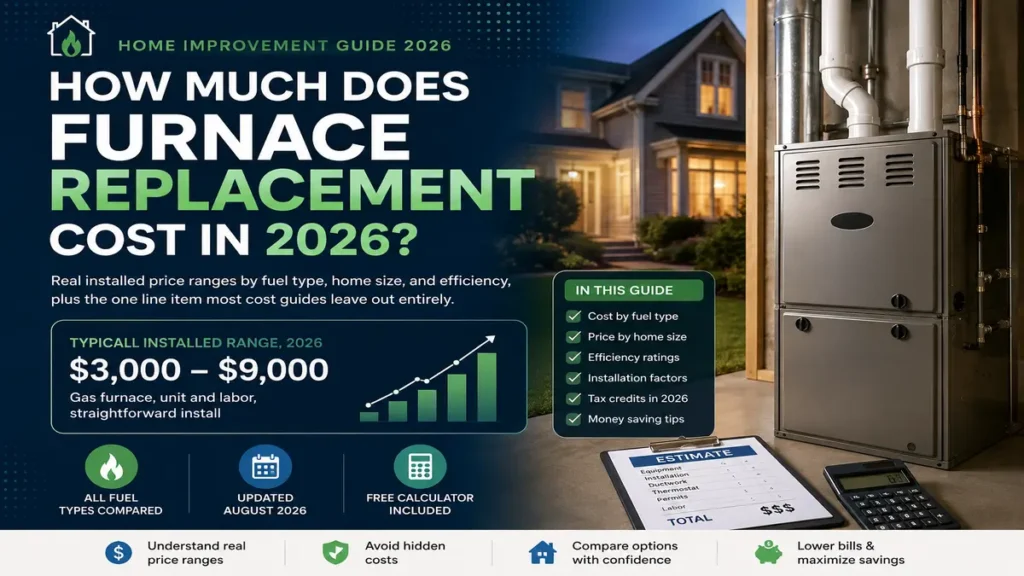
Most complete furnace replacements, unit plus professional installation, land between $3,000 and $9,000 for a straightforward swap into existing ductwork. Gas furnaces sit around the middle of that range, electric furnaces are usually cheaper to buy and install, and oil furnaces tend to run higher on both equipment and labor.
That range can widen considerably. A job that also needs new ductwork, a venting upgrade for a high-efficiency condensing unit, or electrical work can add several thousand dollars on top, sometimes pushing the total past $12,000. The furnace itself is rarely what determines whether your job is at the bottom or top of the range. It is almost always the condition of what is already in your house.
| Fuel Type | Typical Installed Range | Notes |
|---|---|---|
| Natural Gas | $2,500 to $11,200 | Most common choice in US homes |
| Electric | $1,500 to $6,500 | No gas line needed, always 100% AFUE |
| Propane | $1,900 to $6,200 | Rural homes without a gas main |
| Oil | $2,650 to $7,300 | Common in the Northeast |
These are planning ranges, not quotes. Always get three itemized quotes from licensed local contractors before committing.
New Furnace Cost by Fuel Type
Fuel type is the first fork in the road for furnace replacement cost, because it determines both the equipment price and how much labor the installation requires.
Natural Gas
The most popular choice in American homes. Moderate to buy, cheap to run in most regions, and the widest selection of models and efficiency tiers available.
Electric
Cheapest to buy and install because there is no combustion, no flue, and no gas line to run. Usually the most expensive fuel to run monthly, since electricity typically costs more per unit of delivered heat than gas.
Oil
Mostly found in the Northeast. Higher equipment and labor cost than gas, and running cost tracks heating oil prices, which fluctuate significantly more than natural gas rates.
Propane
For homes without access to a natural gas main. The furnace itself is similar to a gas unit, but the fuel typically costs more per unit of heat delivered.
Furnace Replacement Cost by Home Size
Home size determines the BTU output your furnace needs, which is a major driver of equipment cost. Larger homes need more heating capacity, which generally means a larger, more expensive unit and sometimes more labor to install.
These are typical installed ranges for a gas furnace replacement in a straightforward job, excluding ductwork work:
| Home Size | Furnace Size | Typical Installed | Can Reach |
|---|---|---|---|
| Under 800 sq ft | 40,000 BTU | $2,500 to $3,800 | $6,000 |
| 800 to 1,200 sq ft | 60,000 BTU | $2,800 to $4,200 | $7,000 |
| 1,200 to 1,600 sq ft | 80,000 BTU | $3,200 to $4,800 | $8,000 |
| 1,600 to 2,000 sq ft ★ | 100,000 BTU | $3,800 to $5,500 | $9,200 |
| 2,000 to 2,500 sq ft | 120,000 BTU | $4,400 to $6,400 | $10,500 |
| 2,500 sq ft and up | 140,000 BTU | $5,000 to $7,500 | $12,000 |
★ 1,600 to 2,000 sq ft is the most common home size range in this search, which is why Synchrony and other sources often cite roughly $7,000 as a national average figure.
Square footage alone is a rough starting point. A proper heat load calculation, known in the trade as a Manual J, accounts for insulation levels, window quality and quantity, ceiling height, and how airtight the house is. Two 1,800 square foot homes in the same neighborhood can genuinely need different furnace sizes. If your contractor is only using square footage to size your furnace, that is worth asking about.
Furnace Installation Cost: Equipment vs Labor
On a typical job, the furnace unit itself is roughly half to two thirds of the total bill, and labor makes up the rest. That surprises a lot of homeowners who assume the box is most of the cost, but a furnace swap is skilled work involving gas, electricity, and combustion byproducts, usually requiring a permit and a follow-up inspection.
Labor for a licensed technician typically runs $75 to $100 per hour, and a straightforward install takes roughly one day, while a more complex job involving new venting or ductwork can take significantly longer.
What a Proper Furnace Installation Quote Itemizes
A quote that gives you one number with no breakdown is not really a quote, it is a figure. Before comparing anything, make sure each contractor’s quote itemizes:
- The exact model number and its AFUE rating, not just “high efficiency”
- The BTU output of the unit being installed
- Labor as its own line item, with the number of days estimated
- Whether the price includes the permit and inspection fee
- Any ductwork, venting, or electrical work, priced separately from the base install
- Removal and disposal of the old unit
- The warranty on both the part and the labor, which are usually different lengths
AFUE Efficiency and What It Adds to the Price
AFUE stands for Annual Fuel Utilization Efficiency. It measures the percentage of fuel that actually becomes heat inside your home rather than escaping up the flue. An 80% AFUE furnace turns 80 cents of every fuel dollar into warmth in your living room.
80% AFUE, Standard Efficiency
The lowest upfront equipment cost. Vents through a conventional flue. A sensible choice in a mild climate or a home you plan to sell relatively soon.
92 to 95% AFUE, Mid Efficiency
Adds roughly $1,200 to equipment cost over standard efficiency. Usually a two-stage burner that runs gently most of the time and only kicks into high gear when needed, giving quieter and steadier heat.
96 to 98% AFUE, High Efficiency
Adds roughly $2,200 to equipment cost. These condensing furnaces extract heat from the exhaust, which means they need PVC venting and a condensate drain, adding to installation labor as well as unit price.
Working Out Your Own Payback Period
Rather than relying on someone else’s average, work out your own payback using your actual heating bill. Going from 80% to 96% AFUE cuts fuel use by roughly one sixth. So if your annual heating spend is $1,500, that efficiency jump saves approximately $250 a year.
Divide the extra upfront cost of the higher-efficiency unit by that annual saving, and you get a payback period based on your own numbers. In a cold climate with a large heating bill, high efficiency usually pays for itself within the furnace’s lifespan. In a mild climate with a small heating bill, it often does not.
The Line Item Most Cost Guides Leave Out
Here is the single biggest gap in most furnace replacement cost content: the furnace unit is rarely what pushes a job to the expensive end of the range. It is almost always what happens to be hiding behind your walls and in your basement.
A straight swap into ductwork that is already sized correctly and in good condition sits at the bottom of every range in this guide. The moment ductwork needs sealing, resizing, or full replacement, the job jumps categories entirely. These are the additional cost items that most commonly turn a $4,000 estimate into an $8,000 final bill:
| Additional Item | Typical Cost Range |
|---|---|
| Ductwork sealing or resizing | $800 to $2,500 |
| Full ductwork replacement | $1,400 to $5,600 |
| Venting upgrade (PVC for condensing units) | $300 to $1,200 |
| Smart thermostat | $150 to $450 |
| Electrical or gas line modifications | $250 to $2,500 |
| Permits and inspection | $100 to $500 |
Why this matters for reading a quote: If two contractors quote wildly different totals for what sounds like the same job, the difference is very often not the furnace brand. It is whether one of them actually inspected your ductwork and included the cost of fixing it, while the other assumed it was fine and will hit you with a change order once the old unit is already out.
Furnace Repair vs Replacement Cost
Before committing to the cost of a full furnace replacement, it is worth knowing when repair genuinely makes more financial sense, and when it does not.
| Average Cost | Lifespan Extension | |
|---|---|---|
| Repair | $200 to $1,200 | 1 to 3 years |
| Replace | $3,000 to $9,000 | 15 to 20 years |
Signs It Is Time to Replace Rather Than Repair
Furnace is 15 to 20 years old
Most gas furnaces run 15 to 20 years. Past 15, money spent on repairs is often money spent on a unit you will replace soon anyway.
Repair costs approach half the replacement price
A common rule of thumb: multiply the repair cost by the furnace's age in years. If that number exceeds the price of a new unit, replacement is usually the better financial choice.
A cracked heat exchanger
Not a repair decision. A cracked exchanger can leak carbon monoxide into the house, and on an older furnace the part often costs close to what a new unit would.
Rising bills with no change in habits
A furnace losing efficiency often shows up on the utility bill well before it shows up as an outright breakdown.
Safety, not budgeting: If you smell gas, hear a persistent rumble after the burner shuts off, see soot around the unit, or your carbon monoxide alarm sounds, stop reading cost guides. Leave the house and call your gas utility's emergency line. No estimate on this page is worth staying inside for.
Get Your Personal Furnace Replacement Cost Estimate
Every table on this page uses national averages, which is a starting point but not a personal answer. Your actual number depends on your fuel type, exact square footage, region, target efficiency, and whether any additional work applies to your specific ductwork and electrical setup.
The Furnace Replacement Cost Calculator at Calcxi walks through those same inputs in the order a contractor would actually ask about them, and splits the result into equipment, labor, and additional work, so you can see exactly where your estimate is coming from.
If you are also comparing full HVAC system replacement or air conditioning alongside your furnace, the HVAC System Cost Calculator and AC Replacement Cost Calculator use the same honest, itemized approach.
See Your Furnace Replacement Cost, Split by Line Item
Fuel type, home size, region, efficiency, and any additional work. Free, instant, no email required.
🧮 Open the Free CalculatorFurnace Tax Credits and Rebates in 2026
This section matters more than it might look, because a lot of furnace cost content published before mid-2025 still describes a federal tax credit that no longer applies to a 2026 installation. Getting this wrong can change someone’s real out-of-pocket cost by hundreds of dollars.
The federal Energy Efficient Home Improvement Credit, known as Section 25C, previously offered up to $600 for a qualifying furnace. Under the One Big Beautiful Bill Act, signed July 4, 2025, this credit was terminated for any equipment placed in service after December 31, 2025. There is no grandfather clause and no transition relief. What matters is the date the furnace was placed in service, not when a contract was signed or a deposit was paid.
If you install a furnace in 2026, the federal 25C tax credit does not apply. Any guide, calculator, or contractor quote that lists a federal tax credit as part of your 2026 furnace replacement cost is working from outdated information.
What Is Actually Still Available in 2026
The federal credit is gone, but it is not the only incentive that ever existed. These paths remain open:
- State and local rebate programs. Many states and municipalities run their own efficiency rebate schemes independent of federal law, and these were not affected by the federal repeal
- Utility company rebates. Local gas and electric utilities frequently offer their own rebates for high-efficiency equipment, sometimes stacking with state programs
- IRA-funded HOMES and HEAR programs. These are separate, income-based rebate programs funded through the Inflation Reduction Act and administered at the state level, distinct from the terminated 25C credit
Check the IRS Energy Efficient Home Improvement Credit page for the current federal position, and your own state energy office or utility website for local programs that may still apply.
How to Get a Fair Price and Avoid Overpaying
Get Three Itemized Quotes
From licensed and insured contractors. Ask each for a full breakdown showing model number, AFUE, BTU output, labor, permits, and disposal. This is the single most effective way to avoid overpaying, and it quickly reveals if one contractor has sized the furnace differently from the others.
Time It for Spring or Early Autumn
Contractors have more availability and more willingness to negotiate outside peak heating and cooling season. Replacing a clearly failing furnace before winter arrives is almost always cheaper than waiting until the first cold snap forces an emergency call-out.
Consider Replacing the AC at the Same Time
If both are of a similar age, replacing them together saves a second round of labor and avoids matching a new furnace to an old, mismatched coil. If your air conditioner is significantly newer, there is no reason to replace it early.
Ask for a Manual J Load Calculation
A furnace sized purely by square footage risks being oversized, which causes short cycling, uneven heat, more wear on parts, and often a higher bill than a correctly sized unit. A proper heat load calculation accounts for insulation, windows, and airtightness.
The same tactics apply if you are replacing the whole system rather than just the furnace, with a few extra levers worth knowing about. Our guide to getting the best price on a new HVAC system covers the 2026 incentive position and which lines on a quote are actually negotiable.
How Much Does Furnace Replacement Cost FAQs
How much does a new furnace cost installed?
Most complete furnace replacements fall between $3,000 and $9,000 including installation, with gas furnaces typically landing around the middle of that range and electric furnaces usually at the lower end. What most often pushes a job to the top of the range is not the furnace itself but the surrounding work, such as ductwork repairs, venting changes for a condensing unit, or electrical modifications. Use the Furnace Replacement Cost Calculator for an estimate based on your specific home.
What is the cost to replace a furnace by home size?
For a typical gas furnace replacement excluding ductwork work, homes under 800 square feet run roughly $2,500 to $3,800, homes in the 1,600 to 2,000 square foot range (the most common home size) run roughly $3,800 to $5,500, and homes over 2,500 square feet run roughly $5,000 to $7,500. These figures scale with the BTU output the home needs, which increases with square footage. Square footage is a starting point rather than a precise sizing method, since insulation, window area, and ceiling height also affect the correct furnace size.
Is an electric furnace cheaper than a gas furnace?
Electric furnaces are generally cheaper to buy and install because there is no combustion, no flue, and no gas line required, which reduces both equipment and labor cost. However, electric furnaces are usually more expensive to run monthly, since electricity typically costs more per unit of delivered heat than natural gas in most parts of the United States. Compare your own local utility rates rather than relying on national averages, since the price gap between gas and electric heating varies significantly by state and region.
Is a high efficiency furnace worth the extra cost?
It depends on your climate and your current heating bill, so the honest answer is to calculate it yourself rather than accept a general rule. Going from 80% to 96% AFUE cuts fuel use by roughly one sixth. Divide the extra equipment cost of the high-efficiency unit by your expected annual fuel savings to find your specific payback period. In a cold climate with a large heating bill, high efficiency usually pays back within the furnace’s lifespan. In a mild climate with a small heating bill, it often does not.
Are there tax credits for a new furnace in 2026?
No federal tax credit currently applies to a furnace installed in 2026. The federal Energy Efficient Home Improvement Credit, Section 25C, was terminated under the One Big Beautiful Bill Act for any equipment placed in service after December 31, 2025, with no grandfather clause. State and local rebate programs, along with utility company rebates and separate IRA-funded programs like HOMES and HEAR, are independent of this federal repeal and may still apply. Check the IRS Energy Efficient Home Improvement Credit page and your state energy office for current, accurate options.
Should I repair or replace my furnace?
A well-maintained furnace typically lasts 15 to 20 years. If yours is under 15 years old, a repair is usually the more sensible near-term investment. A common rule of thumb multiplies the repair cost by the furnace’s age in years; if that number exceeds the cost of a replacement, replacing is generally the better financial choice. Any furnace with a cracked heat exchanger should always be replaced rather than repaired, since it presents a carbon monoxide safety risk regardless of the unit’s age.
What size furnace do I need for my house?
As a starting point, multiply your heated square footage by roughly 30 to 50 BTU depending on your climate, then round to the nearest standard furnace size. This gives a ballpark figure only. A contractor should ideally perform a proper heat load calculation, called a Manual J, which accounts for insulation, window area, ceiling height, and air leakage before finalizing the furnace size. An oversized furnace causes short cycling, uneven heat, and premature wear on components, so bigger is not automatically better.
When is the cheapest time of year to replace a furnace?
Spring and early autumn tend to be the least expensive times, when both heating and cooling demand are low and contractors have more schedule availability, which often translates to more room for negotiation on price. Replacing a clearly aging or failing furnace before winter arrives is almost always cheaper than waiting for a breakdown during the first cold snap, when emergency call-out demand fills contractor schedules and drives up urgency pricing.
The Bottom Line
Furnace replacement cost in 2026 typically falls between $3,000 and $9,000 for a straightforward gas furnace installation, with electric furnaces usually landing cheaper and oil furnaces often costing more. But the number that matters most for your household is not a national average. It is your specific fuel type, home size, region, target efficiency, and whether your existing ductwork and electrical setup need any additional work.
The furnace unit itself is often less than two thirds of the total bill. Always ask for an itemized quote, always get three quotes from licensed contractors, and always confirm whether ductwork or venting changes are included before comparing prices.
For an estimate built around your own home’s numbers, the Furnace Replacement Cost Calculator splits equipment from labor and additional work, so you know exactly what a fair quote should look like before a contractor ever walks through your door.
Published on calcxi.com · · Sources: IRS Energy Efficient Home Improvement Credit page, HomeAdvisor cost data

Written & verified by
B.Tech Computer Science · 8 years in web development & SEO · Bhilwara, India
About ·
LinkedIn ·
Report an error