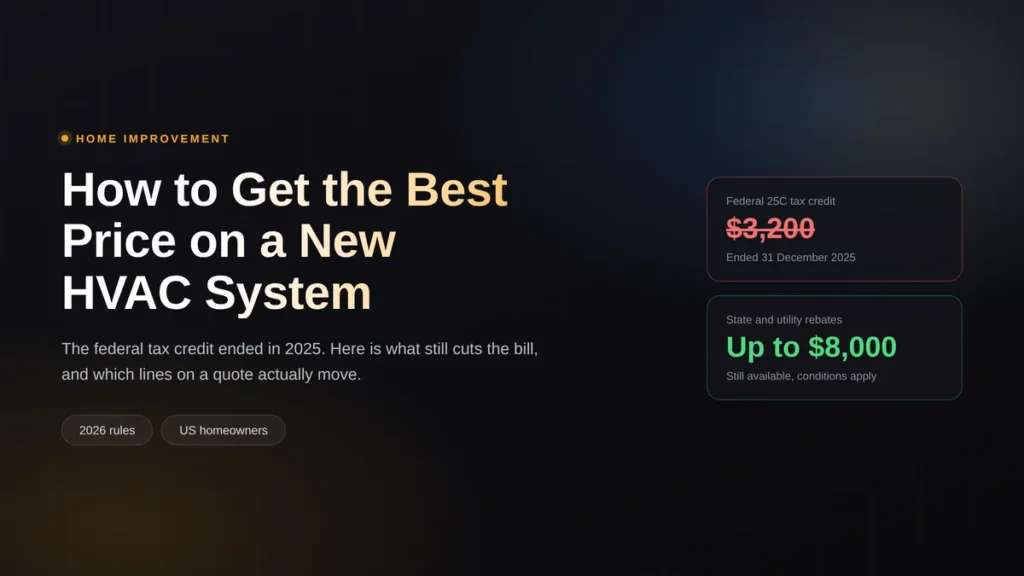
Most advice on how to get the best price on a new HVAC system is a list of tips that were written once and never updated. The single largest saving those articles point at no longer exists, and following them will leave several thousand dollars out of your budget calculation.
So start with what changed, then work through what actually still moves the number.
Key takeaways
- The federal 25C tax credit ended on 31 December 2025. There is no federal HVAC tax credit in 2026.
- What remains is state HEAR rebates, utility rebates and manufacturer promotions, and they are not automatic.
- Timing is the biggest lever you control: buying in the shoulder season instead of mid crisis changes what contractors will quote.
- Equipment price is close to fixed. Labour, ductwork and accessories are where a quote has give.
- Three itemised quotes, not three totals, is the difference between comparing and guessing.
The federal HVAC tax credit ended, and most guides have not caught up
The Energy Efficient Home Improvement Credit, known as section 25C, gave homeowners 30% of qualifying costs up to $2,000 for a heat pump and up to $1,200 for a central air conditioner or furnace, capped at $3,200 a year.
It is gone. Public Law 119-21, the One Big Beautiful Bill Act signed on 4 July 2025, terminated 25C and 25D for property placed in service after 31 December 2025. The IRS confirmed it in Fact Sheet FS-2025-05. There is no phase down and no reduced rate.
Two details matter if you are close to the line. What counts is the date the system was installed and operating, not the date you signed a contract. And the credit was non refundable, so people who claimed it in 2025 only benefited up to their tax liability anyway.
Check any article you read on this topic against that date. The page currently ranking near the top of Google for saving money on a new HVAC system still tells readers they can claim “up to $3,200 a year until 2032”. That was true when it was written. Budget around it today and you are three thousand dollars short.
What incentives still exist in 2026
Federal money did not vanish entirely, it moved. The rebates that survived are administered by states rather than claimed on your tax return, which makes them harder to find and easier to miss.
| Incentive | Status in 2026 | Worth | Catch |
|---|---|---|---|
| Federal 25C tax credit | Ended 31 Dec 2025 |
Was up to $3,200 a year | Terminated by Public Law 119-21. Nothing to claim for equipment installed in 2026. |
| State HEAR rebate Home Electrification and Appliance Rebates |
Varies by state | Up to $8,000 heat pump $14,000 household cap |
Income tested. $8,000 at or below 80% AMI, $4,000 at 80 to 150%. Some states not launched, some already fully reserved. |
| Utility rebate | Active | $100 to $2,000 | Not income tested, so the most reliable option for most households. Usually tied to an efficiency tier. |
| Manufacturer promotion | Seasonal | Varies | Runs in the shoulder seasons. Ask the contractor which brands are on promotion this month. |
Checked September 2026. Incentive programmes change and state funding is finite, so confirm with your own state energy office and utility before signing.
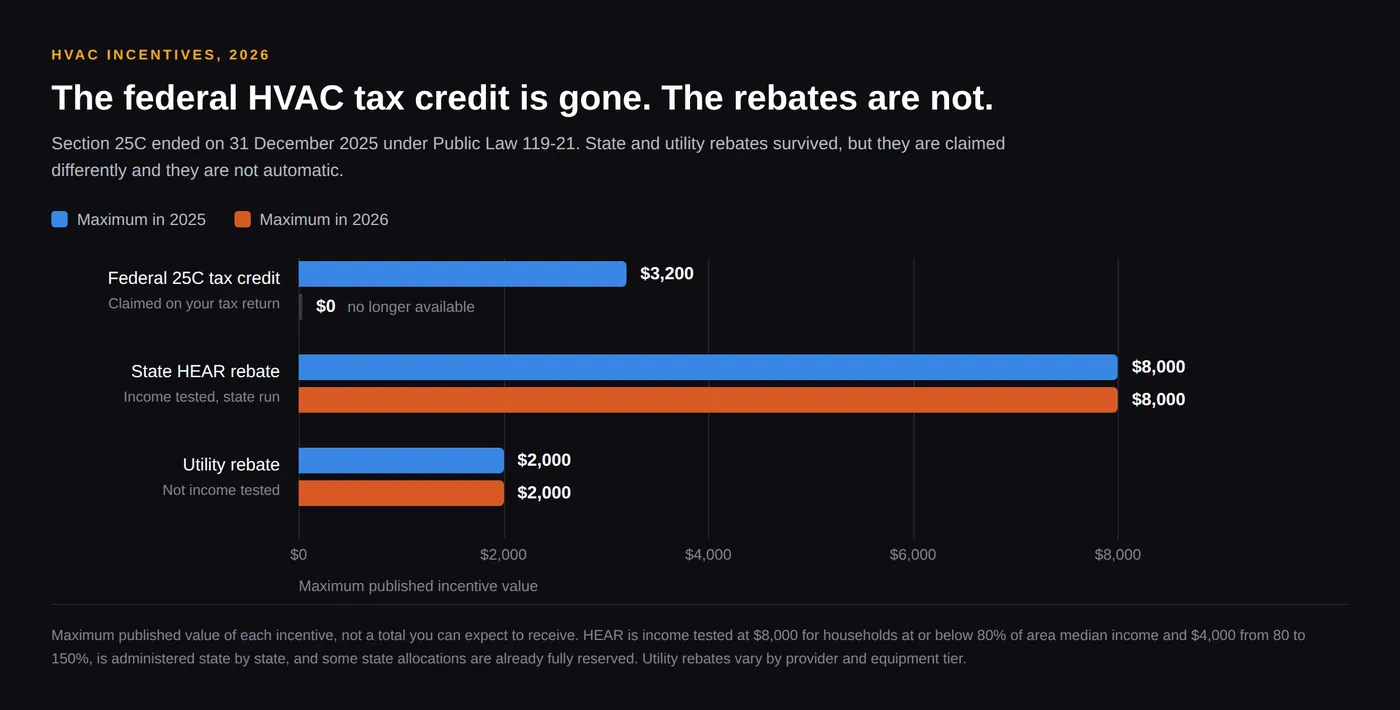
Three things to understand about HEAR rebates before you count on one. They are income tested against your area median income. They are administered state by state, so your neighbour across a state line may have a completely different programme. And the funding is finite and first come first served, which is why California’s allocation was reported fully reserved as early as January 2026.
Utility rebates are the more reliable option for most households because they are not income tested. Check your own utility’s site directly, and check the DSIRE database by zip code, before you accept any quote. Some contractors handle the paperwork for you, which is worth asking about.
Time the purchase, because timing beats haggling
This is the largest lever you actually control, and it costs you nothing to use.
HVAC demand is violently seasonal. In a July heatwave or a January cold snap, contractors are booked solid and quoting emergency replacements to people who have no choice. In the shoulder seasons, the same crews are looking for work to fill the schedule.
- Air conditioning and heat pumps: early spring, roughly March to May, before the first heatwave loads up the calendar.
- Furnaces: late summer to early autumn, roughly August to October, before the first cold snap.
- Whole system replacement: either shoulder window works, since you are buying both halves.
The mechanism is simple: lighter demand means promotional pricing, discounted installation packages and manufacturer rebates that contractors actively push to keep crews working. None of that is on the table in August.
The obvious catch is that a dead system in a heatwave does not let you wait. Which is the real argument for replacing on your terms rather than on the system’s. If your unit is past 15 years, getting quotes during a quiet month costs you nothing and puts you in a far better position than a 6am emergency call.
How an HVAC quote is actually built
You cannot negotiate a number you do not understand. A contractor’s price is three things stacked together.
Equipment is what the contractor pays the distributor. This is the least flexible part. Their buying price is set by distributor agreements and volume, and it is not a number you can talk down.
Labour is the crew’s loaded cost, typically the wage plus around 20% for insurance and payroll costs. Industry guidance puts the target gross margin at around 25%, with 20% treated as the minimum to run a business on. Below that, a contractor is either cutting corners or not going to be around for your warranty claim.
Overhead and margin cover the trucks, the office, the licensing, the quoting time on jobs they do not win, and the profit.
That 25% figure is the useful one. It tells you a quote is not mostly profit, so a demand for 30% off is not a negotiation, it is an exit. It also tells you where the genuine room is.
What is negotiable and what is not
| Line on the quote | Room to move | What to actually ask |
|---|---|---|
| Equipment cost | Almost none | Their distributor price is fixed. Change the model, not the markup. |
| Efficiency tier | Thousands | Price the mid tier as well as the top tier and compare the payback. |
| Labour | Some | Ask for the crew size and day count. Off peak scheduling can help here. |
| Ductwork | Some | Ask which sections are necessary now and which can wait. |
| Thermostat and filtration | Yes | Often padded. You can buy and fit a smart thermostat yourself for far less. |
| UV lights, air purifiers | Remove them | High margin add ons. Decline unless you specifically want one. |
| Permits and electrical | None | Fixed cost. A quote missing these is incomplete, not cheaper. |
| Timing of the job | Biggest lever | Ask what a shoulder season slot would cost against a peak week. |
Industry guidance puts a healthy contractor gross margin near 25%, with 20% as the working minimum. Expect movement in the hundreds, not a third off the total.
The most productive conversation is not “can you do better on the price”. It is going through the quote line by line and asking what each item is for. Some of what inflates a total is genuinely optional, some is padding that quietly disappears when you ask, and some is essential work a cheaper quote left out entirely.
Efficiency tier is the biggest legitimate saving available. Jumping from the SEER2 minimum to a top tier variable speed system can add several thousand dollars, and the energy saving pays it back slowly or not at all depending on your climate and electricity rate. In a mild climate the mid tier is usually the better buy.
Get three quotes, and make them comparable
Three is the number the industry itself recommends, and the reason is not just price. Three quotes tell you whether the outlier is cheap or wrong.
The mistake is collecting three totals. A $9,000 quote and a $13,000 quote are not comparable if one includes ductwork repair and a new line set and the other does not. Ask every contractor for the same itemisation:
- Equipment make, model number and efficiency rating, not just “3 ton system”
- Labour, broken out from equipment
- Ductwork, line set, electrical and permit costs as separate lines
- Thermostat, filtration and any accessories, priced individually
- Warranty terms, both manufacturer and the contractor’s own labour warranty
- Whether a Manual J load calculation was performed, and the result
That last one separates the serious contractors from the rest. Anyone sizing your system by square footage alone is guessing, and an oversized system short cycles, dehumidifies badly and wears out faster.
On choosing between three quotes, the standard advice is to avoid both the highest and the lowest. A quote well below the others usually means something was left out, the equipment is a tier lower, or the margin is too thin for the business to survive your warranty period.
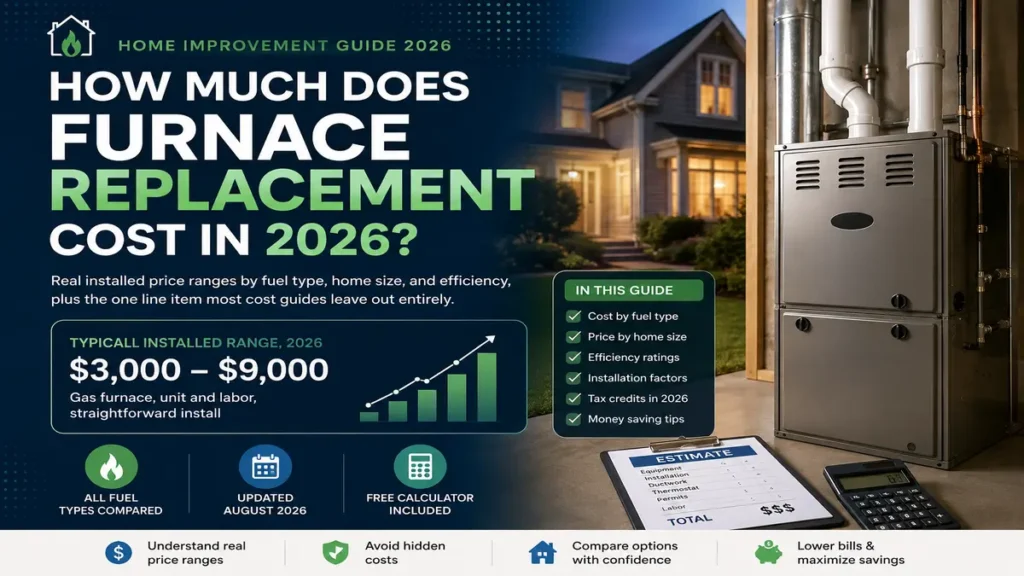
If the heating side is all you are replacing, the numbers are different and smaller. Our breakdown of what furnace replacement costs gives installed pricing by home size, BTU output and fuel type.
Know the number before the first contractor arrives
Everything above works better if you walk in already knowing roughly what the job should cost. A quote is much easier to question when you have a reference point, and contractors quote differently to someone who clearly knows the range.
Free tool
HVAC System Cost Calculator
Installed pricing by system type, efficiency and home size, including the ductwork line that moves the total most. Walk into the first quote already knowing the range.
If you are still deciding between equipment types, our comparison of whether an AC or a heat pump is cheaper to run covers the running cost side, and the answer on how long an AC unit lasts helps you judge whether replacement is due at all.
Frequently asked questions
Is there a federal HVAC tax credit in 2026?
No. The 25C Energy Efficient Home Improvement Credit ended for equipment placed in service after 31 December 2025, under Public Law 119-21. State HEAR rebates and utility rebates still exist, but there is no federal tax credit to claim on your return.
What is the best month to buy an HVAC system?
March to May for air conditioning and heat pumps, August to October for furnaces. Those are the shoulder seasons when contractor demand drops and promotional pricing appears. Avoid the first heatwave and the first cold snap, when emergency replacements fill the schedule.
Are HVAC quotes negotiable?
Partly. Equipment cost is close to fixed, but labour, accessories, the efficiency tier and optional extras all have room. Industry target margin is around 25%, so expect movement in the hundreds rather than a third off the total.
How many HVAC quotes should I get?
Three, itemised the same way so they can actually be compared. Three totals tell you nothing. Three line by line breakdowns tell you what each contractor included and who left something out.
Why are HVAC quotes so different from each other?
Usually scope rather than greed. One quote includes ductwork, permits or a higher efficiency tier that another omitted. Equipment brand, warranty length and whether a Manual J calculation was done also move the number significantly.
Should I buy the highest efficiency system available?
Not automatically. The jump to top tier variable speed equipment can add several thousand dollars, and the payback depends on your climate and electricity rate. In a mild climate the mid efficiency tier is usually the better financial choice.
Can I save money by buying the equipment myself?
Rarely worth it. Most manufacturer warranties require installation by a licensed contractor, and many contractors will not install equipment they did not supply or will not warranty the labour if they do.
Sources
- ENERGY STAR, Federal tax credits for energy efficiency, credits available through the end of 2025
- IRS Fact Sheet FS-2025-05, One Big Beautiful Bill Act provisions, section 25C and 25D termination
- US Department of Energy, Home Energy Rebates, HEAR programme structure and state administration
- DSIRE, Database of State Incentives for Renewables and Efficiency
Incentive programmes change and state funding runs out. Verify anything on this page against your own state energy office and utility before you sign a contract.

Written & verified by
B.Tech Computer Science · 8 years in web development & SEO · Bhilwara, India
About ·
LinkedIn ·
Report an error