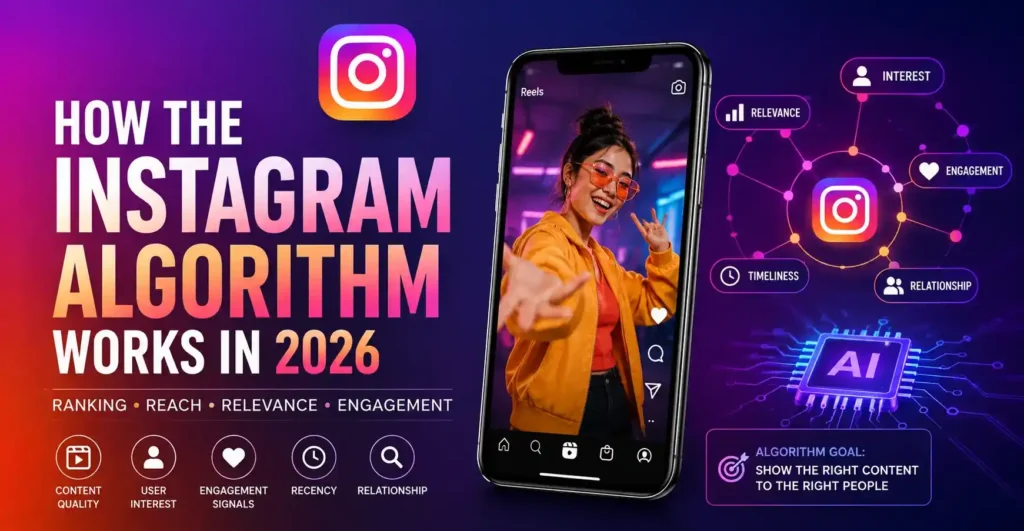
The phrase “the Instagram algorithm” is a little misleading, and understanding why is the fastest way to actually get more reach. Instagram does not run one master formula that decides who sees what. It runs four separate ranking systems, one each for the home feed, Reels, Stories, and Explore, and each one is trained to predict a different kind of enjoyment. A post that performs brilliantly in Reels can underperform in Explore, and that is not a bug. It is the system working exactly as designed.
This guide breaks down what each of those four systems actually looks at, based on Instagram’s own public statements from Head of Instagram Adam Mosseri and Meta’s Transparency Center, plus what changed in 2026 specifically and how to reset the Instagram algorithm if your feed or Explore page has drifted somewhere you did not choose.
We also cover something most algorithm guides skip: how to actually study the content that is winning right now in your niche, frame by frame, rather than just reading a list of tips.
How the Instagram Algorithm Works: The Quick Answer
The Instagram algorithm is really four AI ranking systems working independently, one for each surface of the app. Each system predicts a different outcome and weighs signals differently based on what people actually use that surface for.
| Surface | What It Predicts | Top Signal |
|---|---|---|
| Home Feed | Will you spend time, like, comment, or share? | Relationship history with the poster |
| Reels Feed | Will you watch to the end, rewatch, or send it? | DM sends and watch time |
| Stories Tray | Will you tap in and reply? | Viewing and reply history with the poster |
| Explore Page | Will you follow, watch fully, or engage from a cold start? | Completion rate and post popularity |
Why this reframing matters: Most advice on “beating the algorithm” fails because it treats Instagram as one system. Optimizing a Reel for maximum DM shares and optimizing a feed post for maximum comments are genuinely different jobs. Once you separate them, deciding what to actually change about your content gets a lot more concrete.
Why There Is No Single Instagram Algorithm
According to a public statement from Instagram, the platform relies on “a variety of algorithms, classifiers, and processes, each with its own purpose,” to make sure people see content that interests them. Adam Mosseri has explained the logic behind splitting this into separate systems by pointing to how differently people use each part of the app: people look for close friends in Stories, use Explore to discover something new, and open Reels expecting to be entertained by strangers.
There is also a bigger structural shift underneath all four systems worth understanding before the individual breakdowns. Instagram has moved from being driven mostly by your social graph, meaning the accounts you actively follow, toward being driven increasingly by an interest graph, meaning what you actually watch and engage with regardless of who posted it. This is why Reels, Explore, and even the main feed now show meaningfully more content from accounts you have never followed than they used to.
Social Graph (Older Model)
Content shown is based mostly on who you follow and how often you interact with them directly.
Interest Graph (Current Model)
Content shown is based on what topics and formats you demonstrably engage with, whether or not you follow the poster.
The practical implication is that a small account with a clear topic and strong engagement signals can now reach people who have never heard of it, in a way that was structurally much harder five years ago. It also means vague, unfocused content struggles more than it used to, because the interest graph model depends on the algorithm being able to categorize what your content is actually about.
How the Instagram Feed Algorithm Ranks Content
The home feed is what most people mean when they talk about the Instagram algorithm in casual conversation. It shows photos, videos, and carousels from accounts you follow, mixed with content Instagram thinks you might like and sponsored posts.
According to Meta’s own Transparency Center, the Feed algorithm pulls a pool of candidate posts and then ranks them using signals grouped into four broad categories:
What You Engage With
Posts you have liked, shared, saved, or commented on in the past tell Instagram what resonates with you specifically.
How the Content Is Performing
How many people like a post, how fast engagement is accumulating, plus metadata like posting time and location tags.
Information About the Poster
How many people have interacted with that account recently, used as a general signal of how interesting that person might be.
Your Relationship History
Consistent interactions between two accounts, such as commenting back and forth, signal ongoing mutual interest.
Mosseri has been specific about which predicted actions matter most for Feed ranking: how likely you are to spend a few seconds on a post, comment on it, like it, share it, and tap the poster’s profile photo. The more likely a given action is, and the more heavily Instagram weighs that particular action, the higher the post ranks in your feed.
There is also a negative side to this scoring that is less often discussed. Instagram tracks how often users skip a post entirely, tap “Not interested,” or leave within a second or two of a post appearing. These negative signals actively push content down, not just fail to push it up, which is why a post that gets some engagement can still underperform if a large share of viewers scroll past it instantly.
How the Instagram Reels Algorithm Works in 2026
The Reels algorithm is built around a single core assumption: people open Reels expecting to be entertained by content from accounts they do not necessarily follow. This makes it the most important surface for reaching new people, and also the one where the ranking logic differs most from the Feed algorithm.
The Signals That Drive Reels Distribution
- Watch time and completion rate: Whether you watch to the end and how quickly you engage after the video starts
- Rewatches: Watching a Reel more than once is treated as a strong quality signal
- Shares, especially through direct message: The single most heavily weighted signal for Reels distribution
- Interaction history with the specific creator: Prior likes, comments, or shares involving that account, even from a non-follower
- Follow-up actions: Whether watching the Reel led you to follow the account afterward
DM shares deserve particular attention because Instagram has been explicit about their weight. Mosseri has directly stated that shares carry significant weight for Reels, tying it back to a broader platform priority of connecting people with friends rather than purely maximizing time spent scrolling. A Reel that gets sent from one friend to another is treated as a stronger quality signal than one that only accumulates likes, because a DM send requires a viewer to actively think of a specific person and choose to interact with them.
What Instagram Itself Recommends for Reels
Instagram’s own guidance for Reels, echoed consistently by Mosseri, comes down to a short checklist:
How the Instagram Stories Algorithm Works
Stories only ever come from accounts you already follow, which fundamentally changes what this algorithm optimizes for compared to Reels or Explore. Instagram treats Stories as a place where people look for their closest connections rather than new discovery, so the ranking logic focuses almost entirely on relationship strength.
Viewing History
How often you watch a specific account's Stories determines how high that account appears in your Stories tray.
Engagement History
Sending a DM in response to a Story, or reacting with an emoji, signals genuine interest to the ranking system.
Offline Relationship Signals
Connections such as being Facebook friends or frequent DM contacts are factored in when placing content in the tray.
Mosseri has confirmed directly that Stories are not typically an effective way to reach entirely new people. Their real strength is deepening relationships with an audience you already have. For brands and creators, this means interactive elements like polls, questions, and quizzes matter more here than almost anywhere else on the platform, since they generate the direct engagement that moves an account higher in someone’s tray.
How the Instagram Explore Page Algorithm Works
Explore is designed specifically to help users find new accounts and help new audiences discover creators they have never encountered. Most content here comes from accounts a user does not follow, which makes this the purest discovery-focused surface on the platform, and according to Meta’s Transparency Center, the one with the largest number of individual ranking signals of any surface on Instagram.
Post Popularity
How many people like, comment on, share, or save a post, and how quickly, matters more on Explore than on any other surface.
Your Own Explore Activity
What you have previously liked, saved, and shared while browsing Explore shapes which new content gets tested with you.
Prior Interaction With the Poster
Even a single previous interaction with an account, without following them, signals possible interest in more of their content.
Completion Rate
Watching a video to roughly 95% or more of its length is treated as an especially strong quality signal on this surface specifically.
Instagram has given a genuinely useful illustration of how this cascades. If you like several photos from a specific creator, the system looks at who else likes that creator’s content, and then examines what other accounts those people also engage with. If a meaningful overlap emerges, that related account gets surfaced to you on Explore next, even though you have never interacted with them directly.
This is also the primary home of Instagram’s search function, which means keyword-rich captions and profile bios genuinely help discovery here in a way that goes beyond hashtags.
Instagram Algorithm Changes and Updates for 2026
A handful of specific algorithm updates define what is genuinely different about Instagram in 2026 compared to previous years.
Your Algorithm: User-Controlled Reels Preferences
Launched in December 2025, this feature gives users direct control over their Reels feed. People can review the topics Instagram believes they are interested in, add new topics they want to see, or actively downrank and remove ones they do not. The practical implication for creators is that Reels now need to genuinely match topics an audience has actively chosen rather than topics Instagram is merely guessing at, since a mismatch means reduced surfacing regardless of production quality.
AI Translations for Reels
Rolled out in late 2025, this feature automatically translates both on-screen text and spoken audio in Reels, initially covering Hindi, Portuguese, English, and Spanish, with additional languages continuing to roll out. Mosseri has called this out directly as a reach tactic, since a Reel that can be understood by more people has a structurally larger potential audience even before any ranking signal is considered.
Shares Rising as a Ranking Signal
Instagram has increasingly weighted shares, and DM sends specifically, higher across multiple surfaces in 2026. The stated reasoning is a platform priority to “inspire content that brings people together.” A DM send is treated as a stronger connection signal than a save, because sending content to a specific friend requires actively thinking of that person, which is a more deliberate action than simply bookmarking something for yourself.
Trial Reels for Cold-Audience Testing
This feature lets creators publish a Reel that is shown only to non-followers, functioning as a way to test whether content performs with a cold audience before deciding whether to promote it more broadly to an existing audience. A Trial Reel that performs strongly with non-followers is a genuine signal that a hook or format is working before any risk is taken with an established audience’s engagement rate.
Original, Made-for-Instagram Content Prioritized
Instagram has stated a growing focus on rewarding content that feels genuinely original and made specifically for the platform, rather than recycled content pulled from other apps. In practice this affects pacing, formatting, and storytelling choices as much as it affects whether visible watermarks from other platforms are present, which continues to be actively down-ranked.
How to Reset the Instagram Algorithm
If your feed or Explore page has drifted somewhere you did not intend, whether that is an oversaturation of one content type or topics you have lost interest in, there is no single reset button, but there are several direct ways to retrain what the ranking systems show you.
Use Your Algorithm for Reels
Open Your Algorithm in settings, review the topics Instagram thinks you care about, remove ones that no longer fit, and add specific new topics you actually want more of.
Tap "Not Interested" Deliberately
This is a direct negative training signal. Using it consistently on content that misses the mark teaches the ranking system faster than simply scrolling past.
Actively Engage With What You Want More Of
Liking, commenting, saving, and sharing content in the direction you want your feed to shift is the fastest positive signal across every surface.
Mute or Unfollow Rather Than Just Ignore
Passive ignoring is a much weaker signal than an explicit mute or unfollow action, which the system reads as unambiguous.
For creators specifically wondering how to reset the Instagram algorithm’s read on their own content, the most effective lever is not a settings toggle at all. It is a deliberate change in output: publishing several posts in a row that are clearly and consistently about one topic retrains the system’s read on your account faster than any individual setting change, because the ranking systems are ultimately learning from behavior, both yours and your audience’s, more than from static preferences.
Study What Is Already Winning Before You Post
Reading a list of ranking signals is useful, but the fastest way to actually improve at working with the Instagram algorithm is studying a handful of high-performing Reels in your specific niche, frame by frame. A scroll-through view only lets you experience a Reel once, at platform speed. Slowing it down reveals exactly how the hook lands in the first frame, how quickly cuts happen, where text overlays appear, and how the pacing lines up with the audio.
The Calcxi Instagram Reels Downloader lets you save any public Reel as a clean HD file for exactly this kind of offline review.
Calcxi Instagram Reels Downloader
Paste any public Reel link and download a clean HD MP4, no watermark added, for offline study. Preview the video and creator stats before saving. Also extracts the audio as MP3 if you want to save a trending sound.
For a full breakdown of repeatable content formats you can adapt to your own niche after studying what is winning, see our guide on the best Instagram Reels ideas to go viral.
Best Practices to Grow With the Instagram Algorithm
These practices hold up across all four ranking systems, because they address the underlying thing every version of the Instagram algorithm is actually trying to measure: genuine engagement rather than passive viewing.
Post Consistently, Not Constantly
Regular posting builds a stronger recent-engagement signal, but multiple posts in rapid succession can cause Instagram to suppress some of them to keep a single account from dominating a feed. Spread posts across the day or week instead.
Optimize Captions and Bio for Keywords, Not Just Hashtags
Instagram removed the ability to follow individual hashtags in December 2024, and hashtags carry meaningfully less ranking weight than they once did. Clear, keyword-rich captions and profile bios now do more for discoverability through Instagram's own search function.
Design for Sound-Off Viewing
Roughly half of Instagram video is watched with sound off. A clear visual hook and on-screen text in the opening frame matters as much as the audio itself for holding attention through the critical first few seconds.
Vary Your Post Types
Reels, carousels, single images, and Stories each have distinct ranking logic. Publishing across multiple formats gives an account more independent paths to reach, rather than betting entirely on one algorithm's behavior.
Build on Viral Momentum Quickly
If a post takes off, publishing a follow-up within a day or two capitalizes on the elevated recent-engagement signal Instagram is currently reading for that account, increasing the odds the next post also gets strong initial distribution.
Reply to Comments and DMs
Two-way interaction strengthens the relationship-history signal that every surface, particularly Feed and Stories, weighs heavily. Replying is not just good community management, it is a direct ranking input.
Frequently Asked Questions
What is the Instagram algorithm?
The Instagram algorithm is not one system but four separate AI-powered ranking systems, one each for the home feed, Reels, Stories, and Explore page. Each system predicts a different kind of user behavior, from whether you will comment on a feed post to whether you will send a Reel to a friend, and ranks content accordingly using thousands of individual signals gathered from how people actually interact with the platform.
How do I reset the Instagram algorithm?
There is no single reset button, but you can retrain what Instagram shows you through several direct actions. Use the Your Algorithm feature in settings to review, add, or remove Reels topics directly. Tap “Not Interested” on content that misses the mark rather than just scrolling past it. Actively like, comment, save, and share content in the direction you want your feed to move. And use mute or unfollow rather than passively ignoring accounts you no longer want to see, since explicit actions train the ranking system faster than passive behavior.
What changed with the Instagram algorithm in 2026?
The biggest 2026 changes include Your Algorithm, a feature launched in December 2025 that lets users directly control which topics appear in their Reels feed, AI-powered translations for Reels covering multiple languages, an increased ranking weight on shares and DM sends specifically as connection signals, Trial Reels for testing content with non-followers before wider release, and a stated platform priority toward rewarding original, made-for-Instagram content over recycled cross-platform posts.
Does the Instagram algorithm favor Reels over photos?
Not directly. Instagram ranks content based on how a specific user typically engages, not by giving any format an automatic boost. If someone regularly watches and shares videos, they will naturally see more videos, but that is a reflection of their personal behavior pattern being matched, not the algorithm favoring the video format itself. That said, video content does tend to generate stronger watch time and share signals in aggregate, which is why Reels often appear to outperform static photos at a platform-wide level even without any built-in format preference.
Do hashtags still matter for the Instagram algorithm?
Hashtags carry meaningfully less weight than they once did. Instagram removed the ability to follow individual hashtags in December 2024, and Head of Instagram Adam Mosseri has stated directly that hashtags no longer meaningfully help reach on their own. Keyword-rich captions and profile bios are now the more effective way to help both Instagram’s ranking systems and its search function understand what your content is about. A small number of genuinely relevant hashtags, three to five, is still reasonable practice, but loading a caption with dozens of tags provides little to no additional benefit.
Does posting too often hurt Instagram algorithm ranking?
It can. Publishing multiple posts back to back in a short window can cause Instagram to suppress some of them to keep a single account from crowding a follower’s feed. The recommended approach is spacing posts several hours apart or spreading them across different days, which gives each individual post its own fair chance to accumulate likes, comments, and shares without competing against your own other content for the same audience’s limited attention.
How can I study Reels that are already performing well in my niche?
Use the Calcxi Instagram Reels Downloader to save any public Reel as an HD MP4 file for offline review. Slowing content down frame by frame reveals hook timing, cut frequency, and text overlay pacing far more clearly than a single scroll-through view, which is one of the fastest ways to genuinely improve at working with the algorithm’s ranking signals rather than guessing at them.
The Bottom Line
The Instagram algorithm is really four AI systems, each trained to predict a different outcome for a different surface of the app. Feed rewards relationship history and comments. Reels rewards watch time and DM shares above nearly everything else. Stories rewards closeness and reply behavior. Explore rewards popularity and completion rate from a cold start.
Once you separate the four systems, “beating the algorithm” stops being one vague goal and becomes a concrete set of decisions: which surface a piece of content is actually built for, and which specific signal you are trying to earn on it.
Before your next post, spend ten minutes studying a few high performers in your niche using the Calcxi Instagram Reels Downloader. Seeing exactly how the winners structure their hooks and pacing will sharpen every choice you make from here.
Published on calcxi.com · · Sources: Meta Transparency Center, Instagram official announcements, Adam Mosseri public statements

Written & verified by
B.Tech Computer Science · 8 years in web development & SEO · Bhilwara, India
About ·
LinkedIn ·
Report an error