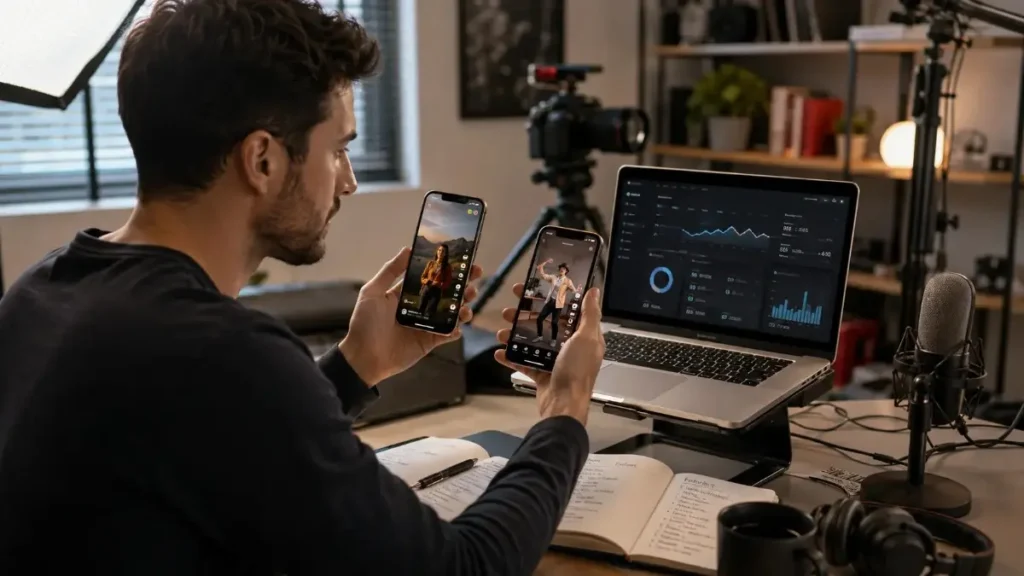
If you’re deciding where to put your production hours, the honest answer is that TikTok still moves accounts up faster from a standing start, and Instagram converts attention into a more durable audience once you have one. That’s not a hedge. It’s what the largest recent dataset on the question actually shows, and the gap between the two is narrower than most creator advice suggests.
Here’s the part that trips people up. Both platforms are handing out less reach per post than they were a year ago. TikTok’s per-video reach fell almost 29% year-over-year while creators published 72% more videos. Instagram Reels reach fell about 35% over the same window. So the question isn’t really “which platform is growing” neither is, per post. It’s “where does a given amount of effort still convert into an audience.”
Quick Answer: Instagram Reels vs TikTok
TikTok grows new accounts faster. In Metricool’s 2026 study of over one million accounts, 16.47% of TikTok accounts moved into a higher follower tier year-over-year, compared with 9% on Instagram. TikTok’s recommendation system ignores follower count, giving unknown creators a genuine cold start. Instagram converts existing audiences better and offers a stronger long-term ecosystem.
Views, Followers, and Growth Are Three Different Things
Most comparisons of these two platforms collapse into a single question: which one gets more views? That’s the wrong metric, and treating it as the answer is why so many creators end up with a hundred thousand views and four hundred followers.
Think about what has to happen for a view to become a follower. Someone has to watch your video, then care enough to tap your handle, then look at your profile, then decide the next video is worth committing to. Every one of those steps is a separate conversion, and platform design affects each one differently.
A useful way to keep them apart:
- Reach is how many distinct people saw the video.
- Views is how many times it was played, including replays by the same person.
- Follows generated is how many of those people committed to seeing more.
- Profile visits is the bridge between the second and third, and it’s the metric almost nobody watches closely enough.
A platform can win decisively on views and lose on follows. That’s not a hypothetical, and understanding why is most of the answer to this question.
What's Actually Different About the Two Platforms
TikTok is a discovery feed with profiles attached. Instagram is a profile network with a discovery feed attached. Nearly every meaningful difference falls out of that.
When someone opens TikTok, they land in the For You feed. Metricool found the For You Page accounts for 72.70% of all TikTok video views, meaning the overwhelming majority of consumption happens in a space where the algorithm, not the user’s follow list, decides what appears. The profile is a destination people visit after something catches them. When someone opens Instagram, they land in a feed shaped substantially by accounts they chose, and Reels sits as a tab inside an app where Stories, DMs, the main feed, Highlights, and the grid all compete for the same session.
Each design is good at something the other isn’t. TikTok is better at putting a stranger’s video in front of you. Instagram is better at turning someone who already noticed you into a recurring part of your day.
Which Platform Gives New Accounts More Reach?
This is where the two platforms diverge most sharply, and unusually for this topic, both companies have said enough publicly that we don’t have to guess.
What TikTok says about follower count
TikTok’s own documentation on the For You feed states it directly: “neither follower count nor whether the account has had previous high-performing videos are direct factors in the recommendation system.”
That’s an unusually clean statement. It doesn’t mean a new account and an established one perform identically, TikTok acknowledges in the same document that larger accounts get more views simply by virtue of having more followers. But it does mean a video from a fifty-follower account enters the same evaluation process as a video from a fifty-thousand-follower account.
TikTok also says it deliberately injects unrelated content into feeds, describing this as a way to “stumble upon new content categories, discover new creators, and experience new perspectives.” For an unknown creator, that deliberate randomness is a real opportunity.
What Instagram says about creator history
Instagram’s published explanation of Reels ranking lists its signals in rough order of importance. The first is your activity which Reels you’ve liked, saved, reshared, and commented on. The second is your history with the person who posted.
Read that in reverse and you can see the cold-start problem. If a viewer’s prior relationship with a creator is the second-strongest input, then a creator with no prior relationship with anyone is starting from a structural deficit on every impression.
Instagram is not a closed system. Its documentation states that in Reels, “the majority of what you see is from accounts you don’t follow,” and that the goal is to “give everyone a chance to find their audience.” Both things are true at once: Instagram does distribute heavily to non-followers, and it also weights creator familiarity in a way TikTok says it doesn’t.
That single documented difference explains most of what follows.
TikTok vs Reels: How the Algorithms Actually Rank Content
A lot of what circulates about these algorithms is invented. You’ll see claims about 65% completion thresholds, 60-minute velocity windows, and precise reach-suppression percentages. None of that comes from either company. Here’s the difference between what’s confirmed and what isn’t.
| Signal | TikTok | Instagram Reels | Status |
|---|---|---|---|
| User’s own past interactions | Confirmed primary factor | Confirmed, listed first | Officially confirmed both |
| History with the creator | Not a direct factor per TikTok | Confirmed, listed second | Officially confirmed difference |
| Follower count | Explicitly not a direct factor | Listed as a creator popularity signal | Officially confirmed difference |
| Completing the video | Confirmed: finishing a longer video “would receive greater weight” | Confirmed as a predicted outcome | Officially confirmed both |
| Reshares / sends | Signal confirmed | Confirmed, listed first among predictions | Officially confirmed both |
| Likes | Confirmed signal | Confirmed, ranked below reshares and completion | Officially confirmed both |
| Captions, sounds, hashtags | Confirmed as “video information” | Audio and visual signals confirmed | Officially confirmed both |
| Content from other apps | No public position | Mosseri: Reels with other apps’ logos are not recommended | Confirmed Instagram only |
| Specific completion-rate thresholds | Never published | Never published | Unverified creator theory |
| First-hour engagement velocity | Never published | Never published | Unverified creator theory |
| Exact reach penalty percentages | Never published | Never published | Unverified creator theory |
Two practical takeaways. First, both platforms confirm that shares and completion outrank likes. If you’re optimizing for anything, optimize for people finishing the video and sending it to someone. Second, the ordering differs in a way that matters: Instagram places creator familiarity near the top, TikTok places it nowhere.
One 2026 development worth noting for US creators specifically. On January 23, 2026, the TikTok USDS Joint Venture assumed US operations, and TikTok stated the recommendation algorithm would be retrained and updated on US user data within Oracle’s US cloud environment. It’s too early for reliable public data on what changed in practice, which is a reason to treat pre-2026 US TikTok performance figures as directional rather than precise.
Which Gets More Views?
TikTok, on average, though by less than it used to and with a large caveat attached.
Metricool’s 2026 TikTok study, covering 2.31 million posts from more than 92,000 accounts, found average views per video fell 31.30% year-over-year, landing near 32,900 per video. Their broader cross-platform study, which sampled differently, reported average TikTok reach around 28,500 per video. The two figures don’t match exactly because they’re different samples, which is itself a useful reminder about how much these numbers move depending on who’s counted. Even after the decline, TikTok posted higher average reach and interactions than any other major platform in that study.
Why Instagram's view counts went up while reach went down
Here’s the finding most creators would benefit from knowing.
Over the same period, Metricool measured Instagram views up 26.56% and interactions up 19.25%. But Reels reach fell about 35%.
Both are correct. In August 2024, Instagram made “views” its primary metric across all formats, replacing plays and impressions — and Instagram’s view count includes rewatches. So a creator can watch their view numbers climb while the number of distinct human beings encountering their work falls sharply.
If you’ve felt like your Reels are performing well on paper but your follower count isn’t moving, this is the most likely explanation. Views went up. Reach went down. Only one of those can turn into a follower.
Check reach, not views, when you’re evaluating whether a video actually found new people. And if you want to compare a video’s real performance across both platforms over time, keeping your own archive helps, since in-app analytics windows expire. If you’re building that habit, CalcXi’s Instagram Reels Downloader lets you save copies of your own published Reels for reference.
Which Grows Followers Faster?
TikTok, and this is the section where the evidence is strongest.
Metricool’s 2026 Social Media Study analyzed 39,762,999 posts from 1,059,949 accounts and measured something more useful than raw follower counts: how many accounts crossed into a higher follower tier year-over-year. Tier advancement is a better proxy for meaningful growth than absolute numbers, because it treats a jump from 800 to 1,200 followers as the real progress it is.
| Platform | Accounts advancing a follower tier |
|---|---|
| TikTok | 16.47% |
| 9% | |
| 7% | |
| YouTube | 4% |
TikTok moved accounts upward at roughly 1.8 times Instagram’s rate. Among smaller creators the effect was more pronounced: 44% of TikTok accounts under 100,000 followers grew during the period.
Two honest caveats, because this is the number the whole article rests on.
Tier advancement is easier from a small base: going from 400 to 1,100 followers crosses a tier, while going from 400,000 to 1,100,000 does not. And the study’s population skews toward accounts managed with a scheduling tool, which are typically brand and creator accounts rather than casual users. It’s a strong signal, not a controlled experiment.
Now, the thing this data does not tell you: how many views it takes to get a follower on either platform. You’ll see confident figures floating around for this. No credible public dataset establishes a reliable views-to-followers conversion rate for either platform, because the ratio varies enormously by niche, video type, profile quality, and account size. Anyone quoting you a precise number is guessing.
What we can reason about is the mechanism. On TikTok, discovery is creator-centric, the handle, the profile tap, and the follow button sit in the viewer’s path while they’re watching. On Instagram, a viewer who taps through lands on a profile that may contain a feed grid, Stories, Highlights, and a bio link, which gives them more reasons to stay but also more ways to get distracted before following.
The practical implication: on TikTok, focus on making the video good enough that people want more of you. On Instagram, focus on the profile they land on, because Instagram gives you more surface area to convert with and it’s usually the underused half of the funnel.
TikTok vs Instagram Reels Engagement
You will see it stated that TikTok’s engagement rate is roughly eight times Instagram’s. That comparison is not valid, and the reason is worth two minutes.
Socialinsider’s 2026 benchmarks, drawn from about 70 million posts published between January 2024 and December 2025, report TikTok engagement by followers at 3.73% and Instagram at 0.48%. Those are real numbers from a real dataset.
But look at how each is calculated. Socialinsider defines TikTok’s rate as likes + comments + shares + saves divided by followers. It defines Instagram’s as likes + comments divided by followers. Shares and saves are counted for TikTok and excluded for Instagram. On a platform where Instagram itself says reshares are among the strongest ranking signals, excluding them isn’t a rounding error.
TikTok almost certainly does have higher engagement per follower. But the honest position is that we don’t know the true multiple, and it is smaller than 7.8x.
Buffer’s analysis of over 45 million posts measured something more comparable engagement as a percentage of reach and found Instagram Reels at 3.3% and TikTok video at 3.39% median. Two very different pictures, from two credible datasets, because they’re measuring different things against different denominators.
Buffer’s Instagram breakdown also complicates the format question:
| Instagram format | Engagement rate by reach |
|---|---|
| Carousels | 6.9% |
| Stories | 5.1% |
| Single images | 4.4% |
| Reels | 3.3% |
Reels earn the lowest engagement rate per person reached on Instagram, while earning 2.25x the reach of single-image posts. Buffer’s own framing captures it well: reach and engagement often point in opposite directions.
The rule to take away: never compare engagement rates across platforms unless you’ve read how each was calculated. Compare a platform against itself over time instead. That’s the only version of the metric that reliably tells you something.
Which Platform Is Better for Going Viral?
TikTok has the better-earned reputation, and the mechanism is real rather than mythological: no follower-count input, 72.70% of views flowing through an algorithmic feed, and deliberate content diversification. A video from an account nobody knows can be evaluated on its own terms.
Two corrections to the folklore, though. TikTok videos don’t run for months; Metricool found posts reach 96% of their total reach within the first 10 days. And more importantly, a viral video and a growing account are different achievements. Pew found that among publicly accessible TikTok videos, 98% came from the most active 25% of users. Visibility concentrates among people who post a lot, consistently. One breakout doesn’t build an audience. A hundred consistent posts might.
Neither platform can be reverse-engineered into guaranteed virality, and anyone selling you a formula for it is selling you something.
TikTok vs Instagram Audience in the US
Instagram reaches more Americans overall. TikTok skews younger but is considerably less youth-only than its reputation.
Pew Research Center’s survey of 5,022 US adults, fielded February 5 to June 18, 2025, found:
| Age group | Use TikTok | Use Instagram |
|---|---|---|
| 18–29 | 63% | 80% |
| 30–49 | 44% | — |
| 50–64 | 30% | — |
| 65+ | 12% | 19% |
| All US adults | 37% | 50% |
The number worth pausing on is 44% of Americans aged 30 to 49. TikTok is not a teen app. It’s a platform where nearly half of people in their thirties and forties have an account, and where 30% of people aged 50 to 64 do. If your niche is personal finance, home improvement, parenting, or career advice, “TikTok skews young” is not a reason to skip it.
Among teens 13 to 17, Pew found 68% use TikTok in a survey fielded September 25 to October 9, 2025, with roughly one in five on it almost constantly. Instagram teen usage climbs steeply with age 44% of 13-to-14-year-olds versus 75% of 15-to-17-year-olds.
Instagram’s US audience skews slightly female (Pew: 55% of women, 44% of men). DataReportal’s figures from Meta’s ad tools show a similar tilt, with TikTok’s US ad audience running slightly male.
Why two credible sources disagree by 18 points
Pew says TikTok reaches 37% of US adults. DataReportal’s Digital 2026 US report, built from TikTok’s own advertising tools, puts it at 153 million adults 55.7% of the 18+ population.
Both are credible. They count different things. Survey data asks people whether they use a platform. Ad-tool data reports how many accounts a platform believes it can serve ads to, which includes duplicate accounts, dormant accounts, and estimation methods the platforms don’t disclose.
Use survey data when you’re reasoning about people is my customer on this platform. Use ad-reach data when you’re reasoning about media buying. Don’t mix them, and be skeptical of any article that quotes one without naming which it’s using. For reference, DataReportal put Instagram’s US figure at 182 million users in late 2025, up 9.7% year-over-year, against TikTok’s 11.0% growth.
Growth Factor Comparison
Pulling the evidence together. “Interpretation” marks conclusions reasoned from documented mechanisms rather than measured directly.
| Growth factor | Instagram Reels | TikTok | Likely advantage |
|---|---|---|---|
| New-account discovery | Creator history is the #2 ranking signal | Follower count explicitly not a direct factor | TikTok (both officially documented) |
| Follower tier advancement | 9% of accounts advanced | 16.47% advanced; 44% of sub-100k accounts grew | TikTok (Metricool, 1.06M accounts) |
| Per-post reach trend | Reels reach down ~35% YoY | Reach down 28.73% YoY | TikTok, narrowly — both declining |
| Average reach per post | Not separately published | ~25,700–28,500 per video, highest of any platform studied | TikTok |
| Engagement per follower | 0.48% (likes + comments only) | 3.73% (likes + comments + shares + saves) | TikTok, but not comparably measured |
| Engagement per reach | 3.3% for Reels | 3.39% for video | Effectively tied (Buffer, 45M posts) |
| Leveraging an existing audience | Creator familiarity weighted highly | Familiarity not a direct input | Instagram (interpretation) |
| Profile conversion surface | Grid, Stories, Highlights, DMs, bio link | Profile, video grid, bio link | Instagram (interpretation) |
| Speed of result | Not published | 96% of reach within 10 days | TikTok for fast feedback |
| Direct commerce | Product tagging; strong in beauty and apparel | TikTok Shop projected $23.41B US sales in 2026, +48% | TikTok for impulse commerce |
| Broader ecosystem | Multiple owned formats and direct messaging | Video-first, plus search and Shop | Instagram (interpretation) |
| US audience size | 50% of US adults (Pew) | 37% of US adults (Pew) |
Which Platform Suits Different Types of Creators?
Starting from zero. TikTok, fairly clearly. The tier-advancement data and TikTok’s own statement about follower count both point the same way, and you’ll learn whether a concept works within about ten days rather than waiting weeks.
Small creators under 10,000 followers. TikTok for reach; Instagram for the relationships that turn into income. The 44% growth figure for sub-100k TikTok accounts is meaningful, but Instagram’s DMs and Stories are where small audiences become paying ones.
Established creators with an existing Instagram audience. Don’t abandon it. Instagram’s ranking explicitly rewards viewer familiarity with you, which means the audience you already built keeps compounding in a way TikTok’s system doesn’t replicate. Add TikTok for reach, keep Instagram for retention.
Personal brands, consultants, and local businesses. Instagram, usually. The profile carries more identity signal, and DMs are a functioning sales channel in a way that’s harder to replicate elsewhere.
Educators and explainer creators. Both work. TikTok’s search behavior is strong for educational content, and its hashtag-driven traffic grew 114% year-over-year per Metricool. Instagram carousels earn 9x the saves of single images, which makes them an unusually good pairing with Reels for teaching content.
Entertainers. TikTok. Shareability is the currency and TikTok’s distribution rewards it most directly.
Which Is Better for Different Niches?
No niche works on only one platform. What differs is which platform’s distribution favors a given content shape.
TikTok’s clearest edge is in comedy, trends, and entertainment, where fast completion and high reshare rates are the currency, and in gaming clips. It’s also stronger than the “young audience” assumption implies for finance, business, and career content, given 44% adoption among 30-to-49-year-olds.
Instagram holds an edge in travel and lifestyle, where the profile grid functions as a portfolio, and in local business, where profile-based discovery matches how people actually find nearby services.
Beauty, fashion, food, fitness, and tutorials are genuinely competitive. In these categories the useful split isn’t platform versus platform but stage versus stage: TikTok tends to win reach, Instagram tends to win the save, the DM, and the sale. Recipe and beauty content in particular depends on saves, which is a behavior Instagram’s format mix supports well.
Instagram Reels vs TikTok for Businesses
Follower count is close to irrelevant here. What matters is whether attention becomes revenue.
For direct product sales, TikTok Shop is difficult to argue with. eMarketer projects TikTok Shop will reach $23.41 billion in US ecommerce sales in 2026, up 48% year-over-year, a figure that would exceed several major national retailers. Over Black Friday and Cyber Monday 2025 it generated more than $500 million across four days. The strength is impulse buying on lower-priced, trend-driven products. TikTok also wins top-of-funnel awareness, given higher average reach and no requirement to build an audience first.
For considered purchases, local businesses, and lead generation, Instagram usually performs better. The profile carries more trust-building surface, DMs support a real sales conversation, and the account functions as a credential a prospect can evaluate.
One demographic note that should shape the decision: an eMarketer-cited survey from September 2025 found a third of adults 18–34 have purchased through social media, versus 23% of those 35–54 and 13% of those 55–65. If your customer is over 55, short-form social commerce is a weak primary channel on either platform.
Before you commit to a two-platform test, save clean copies of the videos you’ve already published, so you can rebuild and compare campaigns without rebuilding from scratch. CalcXi’s Instagram Reels Downloader handles that for your own content, and it’s worth understanding the legal considerations when downloading Instagram content before you archive anything you didn’t create.
Should You Post on Both?
For most creators, yes, but not by pushing the same file to both apps.
The case for both is straightforward. Instagram reaches 50% of US adults and TikTok 37%, with meaningfully different composition. TikTok gives you faster feedback on whether an idea works. Instagram gives you a place for that audience to become durable. And relying on a single platform is a real risk, as the 2026 US ownership transition made concrete.
The case against duplication is equally straightforward. Mosseri put it plainly in October 2024: “What we try to do is not recommend Reels with logos from other apps, but if it’s your own logo, don’t worry about it.” Instagram expanded that stance in April 2026, announcing reduced recommendations for accounts that repeatedly post unoriginal content without new narration, graphics, or commentary. A credit line doesn’t count.
So the workable model is one idea, two native builds. That costs maybe fifteen extra minutes per video, and it’s the difference between distribution and suppression.
How to Repurpose a Reel for TikTok
This applies to your own original content. Downloading someone else’s video and reposting it is a copyright problem regardless of what any tool makes technically possible.
1. Keep the clean master file. Export from your editor before uploading anywhere. This is the single most useful habit in cross-platform work, and it’s the step most people skip. If you’ve already published Reels without keeping originals, you can retrieve your own published videos, there are several Instagram Reel download methods depending on your device, and CalcXi’s Instagram Reels Downloader is the fastest route for building an archive of your own work.
2. Never carry a watermark across. A TikTok-watermarked file uploaded to Reels is asking Instagram not to recommend it. Your own logo is fine; the other app’s is not.
3. Rewrite the hook. Both platforms confirm completion matters, but audiences arrive differently. TikTok viewers are mid-scroll in an algorithmic feed and need the payoff signposted immediately. Instagram viewers more often arrive with some context about who you are.
4. Rewrite the caption. TikTok captions do discovery work — Metricool found TikTok posts with at least one hashtag get nearly 5% more views and over 9% more interactions, with hashtag-driven traffic up 114% year-over-year. Instagram runs the opposite direction: posts including hashtags saw 31.70% fewer views. Hashtag your TikTok. Don’t hashtag your Reel.
5. Adjust length and pacing. Instagram Reels’ average watch time was 8.5 seconds in Metricool’s 2026 data, more than double the prior year but still short. Front-load accordingly.
6. Change the call to action. On TikTok, drive follows. On Instagram, drive the action your ecosystem supports — a DM keyword, a Story reply, a link tap. Instagram Stories replies rose 88% year-over-year, which suggests DM-driven CTAs are working unusually well right now.
7. Upload natively to both. Never share a link from one app to the other.
Which Is Better for Long-Term Growth?
Instagram, for most creators, and the reason isn’t algorithmic.
TikTok’s advantage is discovery: a system that will show your work to strangers regardless of who you are. That’s real, and it’s why a new account should probably start there. But it’s also a permanent dependency. Every video re-enters the same lottery, and TikTok’s own documentation says previous high-performing videos aren’t a direct factor, which means the system compounds less than it feels like it does.
Instagram’s advantage is accumulation. Because viewer familiarity with you is weighted as a top-tier ranking signal, an audience you build there keeps paying forward. Add Stories, DMs, Highlights, the grid, and the bio link, and Instagram gives you more ways to convert an audience into something you actually control.
There’s a durability argument too. TikTok’s US operations transferred to a new joint venture in January 2026, with the algorithm to be retrained on US user data. Nobody knows yet what that means for distribution. That’s not a reason to avoid TikTok. It is a reason not to make it your only asset.
The framing that holds up: TikTok is the best place to be found. Instagram is the better place to be followed. For most creators the sequence is TikTok for discovery, Instagram for the relationship, and something you own for the part no platform can take away.
If Instagram is part of that long-term plan, keeping your published Reels backed up is worth the small effort. You can save Instagram videos without installing an app directly in a browser, which keeps your own content library intact regardless of what changes on either platform.
The Verdict: Choose Based on Your Situation
There isn’t a universal winner, and any article claiming otherwise is overselling its evidence. Here’s how to place yourself.
Choose TikTok if...
- You’re starting from zero or near zero. This is the clearest evidence-backed recommendation here: 16.47% tier advancement versus 9%, plus TikTok’s own confirmation that follower count isn’t a ranking input.
- You have under 100,000 followers and want reach. 44% of TikTok accounts in that range grew year-over-year.
- Your content is entertaining, surprising, or highly shareable.
- You want fast feedback, or you’re testing concepts. 96% of a post’s reach lands within 10 days.
- You sell lower-priced, impulse-friendly products where TikTok Shop is strong.
Choose Instagram Reels if...
- You already have an Instagram audience. Creator familiarity is a top-tier ranking signal there, and abandoning that is throwing away a compounding asset.
- Your business depends on trust, consultation, or considered purchase, or you’re a local business.
- You need DMs as a sales or service channel. Story replies grew 88% year-over-year.
- You’re building a personal brand where the profile itself is the credential.
- Your audience skews over 40. Instagram reaches 50% of US adults versus TikTok’s 37%.
- Your content benefits from mixed formats. Carousels earn 9x the saves of single images and pair well with Reels.
Use both if...
Most creators should, and the split is straightforward: TikTok for discovery, Instagram for depth.
Produce one idea. Build two native versions from the clean master. Hashtag the TikTok, don’t hashtag the Reel. Rewrite the hook for a colder audience on TikTok and a warmer one on Instagram. Drive follows on TikTok and DMs or link taps on Instagram. Never let a watermark cross platforms.
The honest bottom line: both platforms distributed less reach per post in 2026 than the year before, so the creators gaining ground aren’t the ones who picked correctly between two apps. They’re the ones producing consistently enough to survive a saturated feed. Pew’s finding that 98% of public TikTok videos come from the most active quarter of users is the least glamorous and most reliable growth insight available on either platform.
Pick the one that fits where you are. Then post enough that the choice stops being the variable that matters.
Instagram Reels vs TikTok: FAQs
Is TikTok better than Instagram Reels for growth?
For follower growth, yes, on current evidence. Metricool’s 2026 study of over a million accounts found 16.47% of TikTok accounts advanced into a higher follower tier year-over-year versus 9% on Instagram. TikTok also states follower count isn’t a direct ranking factor, which helps unknown accounts. Instagram remains better for converting an existing audience.
Which platform is easier to grow on in 2026?
TikTok, particularly from a standing start. But both platforms delivered less reach per post than the prior year — TikTok’s per-video reach fell 28.73% and Instagram Reels reach fell about 35% — while posting volume rose sharply on both. Consistency matters more than platform choice.
Do TikToks get more views than Instagram Reels?
On average, yes. TikTok posted the highest average reach and interactions of any major platform in Metricool’s 2026 study, around 25,700–28,500 per video depending on the sample. Direct comparison is complicated because Instagram counts rewatches in its view metric, so the two numbers don’t measure quite the same thing.
Which gets more followers, TikTok or Instagram?
TikTok converts short-form video into followers more efficiently for accounts that aren’t established, at roughly 1.8x Instagram’s tier-advancement rate. No credible public dataset establishes a reliable views-to-followers conversion rate for either platform, so treat any precise figure you see with suspicion.
Is Instagram Reels or TikTok better for new creators?
TikTok. Its recommendation system explicitly excludes follower count and prior video performance as direct factors, while Instagram lists a viewer’s history with the creator as its second most important Reels signal. That structural difference favors accounts starting from zero.
Should I post the same video on TikTok and Instagram Reels?
Post the same idea, not the same file. Instagram has stated it doesn’t recommend Reels carrying logos from other apps, and in April 2026 it expanded reduced distribution for repeatedly unoriginal content. Export from your original edit, then adapt the hook, caption, hashtags, and call to action for each platform.
Which platform has better engagement?
TikTok, but the commonly cited 3.73% vs 0.48% figure overstates it. Socialinsider calculates TikTok’s rate using likes, comments, shares and saves, and Instagram’s using only likes and comments. Buffer’s per-reach measurement across 45 million posts found them nearly tied — 3.39% for TikTok video, 3.3% for Reels.
Which platform is easier to go viral on?
TikTok, because 72.70% of its video views come through the algorithmic For You feed and follower count isn’t an input. Two caveats: TikTok posts reach 96% of their total reach within 10 days, so videos don’t run for months, and going viral once doesn’t build an account. Pew found 98% of public TikTok videos come from the most active 25% of users.
Does Instagram Reels help you gain followers?
Yes, but less efficiently than TikTok for accounts without an established audience. Reels earn 2.25x the reach of single-image posts and more than four times the interactions. Instagram’s advantage shows up after the first visit, since the profile offers Stories, Highlights, a grid, and DMs to convert with.
Can I use the same content on TikTok and Instagram Reels?
Content you created, yes, with platform-native adaptation. Content someone else created, no, unless you have permission — that’s a copyright issue regardless of what any tool makes technically possible. Always re-upload natively from a clean master rather than sharing a link between apps.
Which platform is better for businesses?
It depends on the sale. TikTok Shop is projected to reach $23.41 billion in US ecommerce sales in 2026 and is strong for lower-priced impulse purchases. Instagram tends to perform better for considered purchases, local businesses, and lead generation, where the profile and DMs do the conversion work.
Should creators focus on TikTok or Instagram in 2026?
Most should use both: TikTok for discovery, Instagram for depth. If you must choose one, pick TikTok when starting from zero and Instagram when you already have an audience there or your revenue depends on trust and direct conversation.

Written & verified by
B.Tech Computer Science · 8 years in web development & SEO · Bhilwara, India
About ·
LinkedIn ·
Report an error