Ask which is cheaper to run, an AC or a heat pump, and almost every HVAC page gives you a confident answer. Most of those answers compare two things that are not comparable, and a few are simply wrong.
Here is the short version, then the arithmetic behind it.
For cooling there is no difference. A heat pump and an air conditioner are the same machine in cooling mode, and at the same SEER2 rating they cost exactly the same to run. The real question is heating, where a heat pump competes against a furnace rather than against an AC. There, the answer depends almost entirely on which fuel you are replacing.
Key takeaways
- Cooling cost is identical at the same SEER2. Same compressor, same refrigerant, same bill.
- A heat pump needs a seasonal COP of 3.66 to beat a 95% AFUE gas furnace at US average energy prices. Real units rate COP 2.20 to 3.22.
- Against electric baseboard heating a heat pump saves 55% to 70%. Against propane it always wins.
- Against a modern gas furnace it usually costs more to run, unless your electricity is cheap relative to gas.
- Heat pump efficiency in cold weather falls with the outdoor temperature, and electric backup heat is where winter bills get expensive.
AC vs Heat Pump Cooling Cost: Why They Are Identical
An air conditioner and a heat pump cost the same to run in cooling mode. They use the same compressor, refrigerant and outdoor coil. The only real hardware difference is a reversing valve that lets the heat pump run the cycle backwards in winter. In summer that valve sits idle and the machine is an air conditioner.
Two units with the same SEER2 rating draw the same power to remove the same heat. Your July bill does not care which label is on the box. If you are comparing heat pump vs air conditioner electricity usage in summer, the rating is the whole story and the type is irrelevant.
This matters because several widely read comparison pages quote figures like “heat pump $40 to $160 a month, air conditioner $80 to $200 a month”. Read literally, that says the identical machine costs half as much when you call it a heat pump. Those ranges are capturing climate, house size and system age, not a property of the technology.
One exception worth knowing: minimum SEER2 by region
Under the 2023 federal efficiency standards, the minimum for a new split system in the northern region is 13.4 SEER2 for an air conditioner but 14.3 SEER2 for a heat pump. So at the very bottom of the market in the North, the cheapest legal heat pump is required to cool slightly more efficiently than the cheapest legal AC. In the Southeast and Southwest both sit at 14.3 SEER2 and the difference disappears.
Heat Pump vs Gas Furnace Running Cost: The Real Comparison
An air conditioner cannot heat your house. If you have one, something else does the heating: a gas furnace, a propane furnace, an oil boiler, or electric resistance strips. That something is what a heat pump would replace, and that is the comparison worth running.
To compare fuels honestly you convert everything to one unit: dollars per million BTU of delivered heat, after the equipment’s own losses. A furnace rated 95% AFUE turns 95 cents of every gas dollar into heat in your rooms. A heat pump with a seasonal COP of 3.0 delivers three units of heat for every unit of electricity it draws, which is how it can beat a fuel that is cheaper to buy.
Using EIA published US average prices, here is where each option lands.
| How you heat | Efficiency | Cost per million BTU |
|---|---|---|
| Gas furnace, modern | 95% AFUE | $14.67 |
| Heat pump, best in class | COP 3.5 | $15.36 |
| Gas furnace, older | 80% AFUE | $17.42 |
| Heat pump, high efficiency | COP 3.0 | $17.92 |
| Heat pump, mid range | COP 2.5 | $21.50 |
| Heat pump, federal minimum | COP 2.2 | $24.43 |
| Propane furnace | 95% AFUE | $30.76 |
| Electric baseboard or strip heat | COP 1.0 | $53.75 |
Calculated from EIA US averages: electricity 18.34 cents per kWh (June 2026), natural gas $14.45 per thousand cubic feet (January and February 2026 average), propane $2.674 per gallon. Delivered heat, after equipment losses.
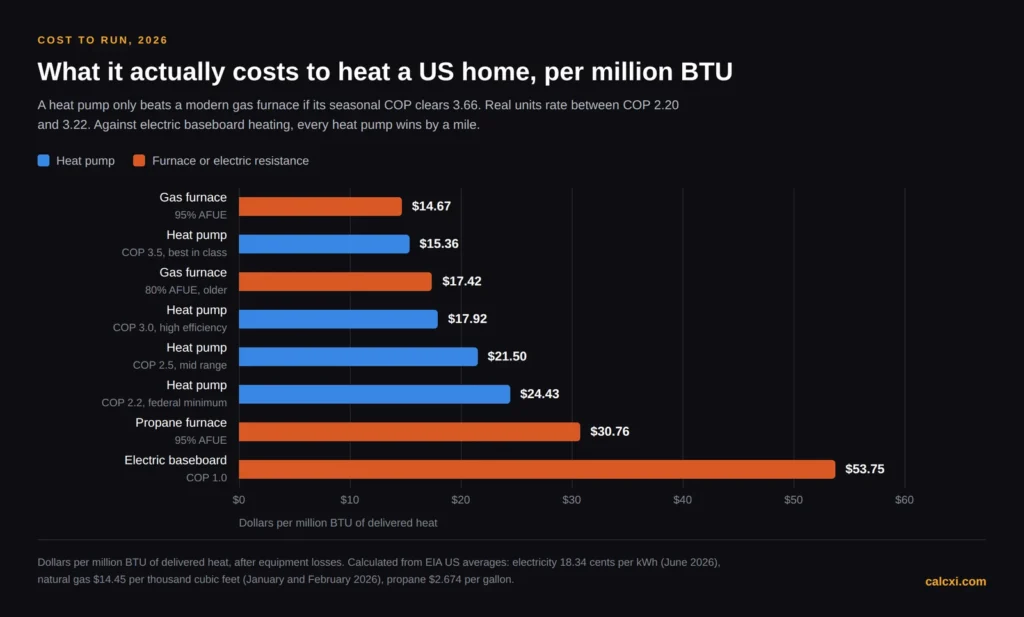
The picture is not the one most articles paint. At national average prices a modern 95% gas furnace, at $14.67 per million BTU, runs cheaper than every heat pump in the list except an exceptional one. Against electric resistance heat at $53.75, the cheapest heat pump on the market is still a landslide win.
How to Work Out Which Is Cheaper to Run in Your Home
You can settle AC vs heat pump running cost for your own house with one number. Work out the seasonal COP a heat pump would need to match whatever you heat with today, then compare it against what real equipment achieves.
The formula is short enough to do on your phone:
breakeven COP = 0.293 x (electricity rate in cents per kWh) x (furnace AFUE) / (gas rate in dollars per therm)
At the US average of 18.34 cents per kWh and $1.39 per therm, against a 95% furnace, that comes out at 3.66. Against an older 80% furnace it drops to 3.09. Against propane it falls to 1.75. Against electric resistance heat it is 1.0, which every heat pump ever built clears.
What is a good COP for a heat pump, and how HSPF2 converts
HSPF2 is the seasonal heating rating printed on the label. Divide it by 3.412 and you get seasonal COP:
- HSPF2 7.5, the federal minimum for split systems: COP 2.20
- HSPF2 8.1, the Energy Star threshold: COP 2.37
- HSPF2 8.9, a good mid range unit: COP 2.61
- HSPF2 10.2, high efficiency inverter: COP 2.99
- HSPF2 11.0, best in class: COP 3.22
Put the two halves together and you get the finding almost nobody states plainly. At US average energy prices, no heat pump on the market runs cheaper than a modern 95% AFUE gas furnace. Even a best in class unit at COP 3.22 falls short of the 3.66 it would need.
That is not an argument against heat pumps. It is an argument for being precise about what they replace.
What You Are Replacing Decides Whether a Heat Pump Is Cheaper
| What you heat with now | COP needed | Does a heat pump win? | Rough saving |
|---|---|---|---|
| Electric baseboard or strip heat | 1.00 | Always | 55% to 70% off your heating bill |
| Propane furnace | 1.75 | Always | 20% to 55% depending on the unit |
| Old gas furnace, 80% AFUE | 3.09 | Only a very good one | Roughly a wash at COP 3.0, small win above it |
| Modern gas furnace, 95% AFUE | 3.66 | No, at average rates | Costs 5% to 65% more, depending on the unit |
COP needed is the seasonal coefficient of performance at which a heat pump exactly matches that fuel, at US average energy prices. Real heat pumps rate between COP 2.20 and 3.22.
The pattern holds across every row. A heat pump wins comfortably against expensive fuels and loses narrowly against the cheapest one. If your house runs on baseboard heaters or a propane tank, the case is straightforward and the savings are large. If you have a newish gas furnace and gas is cheap where you live, running costs alone will not justify switching, and anyone telling you otherwise has not done the division.
What can still justify it: you need to replace the AC anyway and a heat pump adds heating for a small premium, you want to stop maintaining two systems, you are claiming a rebate or tax credit, or you are cutting emissions and accept a small running cost penalty. Those are all reasonable. They are simply not the same claim as “cheaper to run”.
How Much Does It Cost to Run a Heat Pump per Month?
A heat pump costs roughly $145 to $205 a month to heat a home that would burn 100 therms of gas, at US average energy prices. The same heat from a 95% gas furnace costs about $139, and from electric baseboard heaters about $511.
Here is that worked out. Take a house that burns 100 therms of gas in January. You can find your own figure on your gas bill. That is 10 million BTU of fuel, which a 95% AFUE furnace turns into 9.5 million BTU of heat in your rooms.
- Gas furnace, 95% AFUE: 100 therms at $1.393 = $139
- Heat pump at COP 3.5: 9.5 million BTU at $15.36 = $146
- Heat pump at COP 3.0: 9.5 million BTU at $17.92 = $170
- Heat pump at COP 2.5: 9.5 million BTU at $21.50 = $204
- Electric baseboard heating: 9.5 million BTU at $53.75 = $511
For cooling, a house using 1,000 kWh in a hot month pays $183 either way, because the machine is the same. That single line is the clearest statement of heat pump vs AC cost anyone can give you.
Your own numbers will differ, mainly because your utility rates are not the national average and your house is not the example house. The method is what transfers, not the totals.
Heat Pump Efficiency in Cold Weather: When Running Costs Climb
A heat pump’s COP is not fixed. It falls as the outdoor temperature drops, because there is less heat outside to move. Manufacturers publish COP at 47F, which flatters the machine, and the seasonal HSPF2 rating is measured in a moderate climate zone rather than in Minnesota.
Here is roughly what happens to a standard air source heat pump as temperature falls, converted to running cost at the US average electricity rate.
| Outside | Standard heat pump | Cold climate heat pump | 95% gas furnace |
|---|---|---|---|
| 47F | COP 3.3 $16.29 | COP 4.0 $13.44 | $14.67 |
| 35F | COP 2.8 $19.20 | COP 3.6 $14.93 | $14.67 |
| 17F | COP 2.1 $25.60 | COP 2.75 $19.55 | $14.67 |
| 5F | COP 1.75 $30.72 | COP 2.25 $23.89 | $14.67 |
| Below 0F | COP 1.35 $39.82 | COP 1.85 $29.05 | $14.67 |
| Any, on backup | Electric resistance strips, COP 1.0 $53.75 | $14.67 | |
Dollar figures are cost per million BTU of delivered heat at the US average electricity rate of 18.34 cents per kWh. COP values are typical published ranges, not a guarantee for any specific model.
Two things follow. First, a standard heat pump stops being competitive with gas somewhere around 35F to 40F, and by 17F it costs noticeably more per unit of heat. A cold climate model holds on much longer, staying under the gas line until roughly freezing and remaining sensible down to 5F.
Backup heat is where winter bills go wrong
Most heat pump installations include electric resistance backup. When the outdoor unit cannot keep up, those strips switch on at COP 1.0 and $53.75 per million BTU. A system that drops into backup heat too eagerly can produce a winter bill far worse than any figure on this page, and homeowners usually blame the heat pump when the thermostat’s auxiliary heat lockout setting was the real problem.
In a cold climate, two things matter more than the headline HSPF2: whether the unit is a genuine cold climate model with published capacity at 5F, and where your installer sets the auxiliary heat lockout.
Does a Heat Pump Use More Electricity Than an AC?
In summer, no. Over a full year, yes. A heat pump uses the same electricity as an air conditioner for cooling, then uses more across the winter because it is also doing your heating, which the AC never did.
That extra winter electricity is not a new cost, it is a swapped one. It replaces gas, propane or oil that you are no longer buying. The right comparison is your combined energy bill before and after, not your electricity bill alone. People who compare only the electric bill always conclude the heat pump was a mistake, because they are counting the new cost and ignoring the removed one.
The Gas Price Trap That Skews Most Comparisons
If you look up your own gas rate in summer, you will get a misleading number. Residential gas carries a fixed monthly customer charge on top of the commodity, and in summer that fixed charge spreads across very little usage, so the dollars per unit figure balloons.
EIA data shows it clearly. The US residential gas price was $13.96 per thousand cubic feet in January 2026 and $24.09 in June 2026. Same gas, same year, a 73% difference, driven mostly by how much of it people were buying.
Any comparison that grabs a summer rate to argue about heating costs overstates gas by around 40%, which quietly flips the conclusion. Every figure on this page uses the January and February 2026 winter average, because that is when you are actually heating.
Working Out Your Own Numbers
Everything above uses national averages, and your utility rates are not the national average. Two houses on opposite sides of a state line can get opposite answers from identical equipment.
Pull your electricity rate in cents per kWh and your gas rate in dollars per therm off a recent bill, using the total including delivery charges rather than just the supply line, and run the breakeven formula. If the result sits below your unit’s COP, the heat pump is cheaper. If it sits above, the furnace is.
For the other half of the decision, the upfront cost, our AC replacement cost calculator works out installed pricing by tonnage, efficiency and home size, so you can see the equipment difference before weighing it against the running cost difference.
Free tool
AC Replacement Cost Calculator
Installed pricing by tonnage, SEER2 and home size, so you can put a real number on the equipment difference before you weigh it against the running cost difference.
If you are replacing the heating side too, the furnace replacement cost calculator and the whole HVAC system cost calculator cover those cases.
AC vs Heat Pump Running Cost FAQs
Is it cheaper to run an AC or a heat pump in summer?
Neither. In cooling mode they are the same machine doing the same job, so at the same SEER2 rating the running cost is identical. Any difference between two specific units comes from the efficiency rating, not from whether it is called a heat pump or an air conditioner.
Is a heat pump cheaper to run than a gas furnace?
At US average energy prices, usually not. A heat pump needs a seasonal COP of about 3.66 to match a 95% AFUE gas furnace, and real units rate between COP 2.20 and 3.22. Where electricity is cheap relative to gas the answer flips, so run your own rates rather than trusting an average.
Is a heat pump cheaper than electric baseboard heating?
Yes, dramatically. Electric resistance heat runs at COP 1.0, so a heat pump at COP 2.5 costs roughly 60% less to deliver the same heat. This is the single strongest case for switching and it is not close.
Does a heat pump use more electricity than an AC?
In summer no, over a year yes. The extra electricity is doing your heating, which the air conditioner never did. Compare it against the gas, propane or oil bill that disappears, not against your old electricity bill on its own.
How much does it cost to run a heat pump per month?
Around $145 to $205 a month to heat a home that would otherwise burn 100 therms of gas, at US average energy prices, depending on the unit’s COP. Cooling costs roughly $183 for 1,000 kWh, identical to an air conditioner.
Do heat pumps work in cold weather?
They work, but heat pump efficiency in cold weather falls with the outdoor temperature. A standard unit drops from about COP 3.3 at 47F to roughly 2.0 at 17F. Cold climate models hold near COP 2.5 at 17F and still work below zero. The bigger cost risk is electric backup heat switching on at COP 1.0.
What is a good COP for a heat pump?
Seasonal COP above 2.6, which is HSPF2 8.9 or higher, is a genuinely good unit. Above 3.0, which is HSPF2 10.2, is high efficiency. The federal minimum of HSPF2 7.5 works out at COP 2.20 and is worth paying to improve on if you heat with it often.
Should I get a heat pump or keep my furnace?
If your furnace is gas, fairly new and your gas is cheap, running costs alone do not make the case. If you heat with propane, oil or electric resistance, or the furnace is near end of life and you need a new AC anyway, the case is strong. A dual fuel setup, heat pump above the balance point and furnace below it, captures most of the saving either way.
Is a heat pump cheaper to run than an air conditioner over a whole year?
No, it will use more energy over a year, because it heats as well as cools. Whether your total energy spend goes up or down depends on the fuel it replaced. Replacing electric baseboards, your total falls sharply. Replacing a modern gas furnace, it usually rises slightly.
Sources
- US Energy Information Administration, Electric Power Monthly, residential electricity price, June 2026
- US Energy Information Administration, Price of natural gas delivered to residential consumers, January and February 2026
- US Energy Information Administration, Residential propane prices
- AHRI, 2023 energy efficiency standards, SEER2, EER2 and HSPF2
Every cost per million BTU figure on this page is calculated from those published prices using the conversions shown in the text, so you can reproduce any of them yourself.

Written & verified by
B.Tech Computer Science · 8 years in web development & SEO · Bhilwara, India
About ·
LinkedIn ·
Report an error