
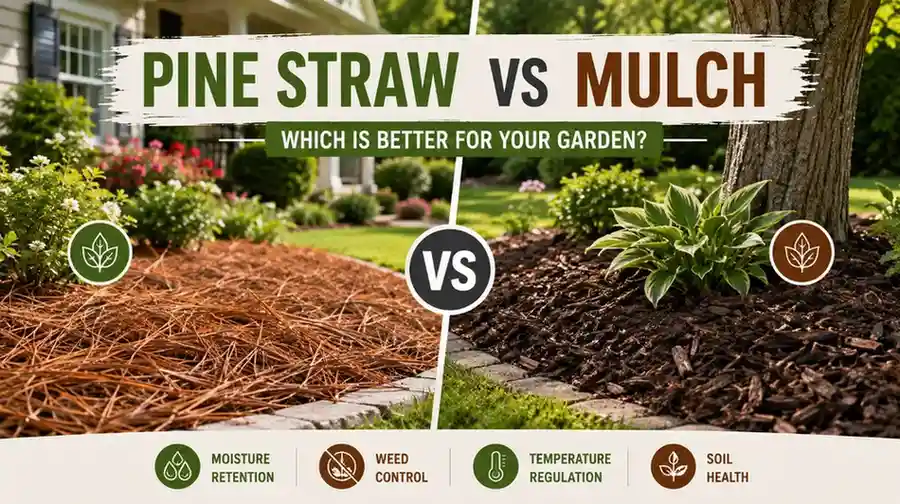
Standing in the garden center parking lot with a truck bed that needs filling, the pine straw vs mulch decision feels harder than it should. Both products cover bare soil, both suppress weeds, and both make a garden bed look finished. But they behave very differently once they are actually down on the ground, and picking the wrong one for your specific yard means redoing the work within a year.
This guide breaks down the real differences between pine straw and wood mulch across the factors that actually matter: cost per square foot, how each performs on slopes, what each one does to your soil over time, how often you will be back at the garden center buying more, and which one looks better for your specific landscaping style.
By the end, you will know exactly which material fits your yard, and you will be able to calculate precisely how much of it to buy.
Pine Straw vs Mulch: The Quick Answer
There is no universal winner in the pine straw vs mulch debate. The right choice depends entirely on your specific yard conditions. Here is the short version before we get into the details.
Choose Pine Straw If...
- Your beds are on slopes or hillsides
- You want the lowest upfront material cost
- You need to cover large areas quickly and cheaply
- You want a natural, informal, woodland look
- You live in the Southeast where pine straw is locally abundant
Choose Wood Mulch If...
- Your beds are flat and soil enrichment matters
- You want fewer replacement cycles per year
- You prefer a polished, formal, colored look
- Your budget allows for a higher upfront cost
- You are planting in beds with heavy feeder plants
The Honest Reality: Many experienced landscapers use both in the same yard. Pine straw on slopes and erosion-prone edges, wood mulch on flat formal beds near the front entrance. There is no rule that says a whole property has to use one material.
What Is Pine Straw?
Pine straw is simply the fallen needles from pine trees, collected, baled, and sold as a landscaping ground cover. It is not a manufactured product. It is a byproduct of pine forestry, most commonly harvested in the Southeastern United States where pine plantations are common.
Two main types dominate the market, and the difference between them matters for both appearance and how often you will need to replace it.
Longleaf Pine Straw
Long, golden needles measuring 10 to 13 inches that interlock naturally to form a dense, tight-knit mat. This interlocking structure means it resists washing away and holds its color for 12 to 14 months before significant fading.
Premium choice for front-of-home, high-visibility beds
Slash Pine Straw
Shorter needles at 5 to 7 inches, costs noticeably less per bale, but fades and breaks down faster, typically within 6 to 8 months. A common budget-conscious choice for larger properties or lower-visibility areas.
Budget choice for large areas or backyard beds
What Is Wood Mulch?
Wood mulch, in the context of this comparison, refers to shredded bark and wood chip products, the most common and widely used mulch types for residential landscaping. These are typically made from tree bark, recycled pallet wood, or byproducts of the lumber industry, shredded to a consistent size.
Wood mulch comes in a wider variety of forms than pine straw, which affects both cost and appearance:
Shredded Hardwood Bark
The most common type, breaks down slower than chips, tends to knit together and resist washing away in moderate rain.
Dyed Mulch (Red, Black, Brown)
Color-enhanced wood mulch popular for high-visibility beds. Color typically holds for 6 to 12 months depending on sun exposure.
Cedar Mulch
Naturally insect-repellent and slow to decompose, commanding a higher price point than standard hardwood mulch.
Wood Chips
Larger, chunkier pieces that break down more slowly than shredded bark, often used in pathways and low-maintenance areas.
Pine Straw vs Mulch Cost Comparison
Cost is usually the first question people ask, and the honest answer requires looking beyond the upfront sticker price. Pine straw typically costs less per bale, but because it decomposes faster and needs more frequent replenishment, the total cost over several years can end up closer to mulch than the initial price suggests.
| Material | Cost Range | Replacement Frequency | 3-Year Total (1,000 sq ft) |
|---|---|---|---|
| Slash Pine Straw | $3 to $5 / bale | Every 6 to 8 months | $450 to $840 |
| Longleaf Pine Straw | $8 to $12 / bale | Every 12 to 14 months | $480 to $756 |
| Standard Wood Mulch | $30 to $60 / cubic yard | Every 12 to 18 months | $300 to $650 |
| Premium Dyed / Cedar Mulch | $60 to $110 / cubic yard | Every 18 to 24 months | $400 to $850 |
Notice that over a 3-year window, the total cost gap narrows considerably. Slash pine straw’s low upfront price gets eaten up by replacing it four to six times over three years, while standard wood mulch’s higher initial cost is offset by needing replacement only twice in the same period. Longleaf pine straw actually lands in a similar total cost range to standard wood mulch once you account for its longer 12 to 14 month lifespan.
Pine Straw for Erosion Control
This is the category where pine straw has a clear, decisive advantage. The long needles of pine straw naturally interlock with each other as they settle, forming a mat-like structure that resists sliding downhill even in heavy rain. This makes pine straw for erosion control the standard recommendation among landscapers working on sloped properties.
Wood mulch, by contrast, is made of individual loose pieces that are not interconnected in the same way. On a slope, heavy rain can wash wood mulch downhill, leaving bare patches at the top of a bed and mulch pileups at the bottom. This is a well-documented problem in landscaping literature and one of the main reasons pine straw dominates in hilly regions of the Southeast.
This erosion pattern is well documented in landscaping research, including guidance from Colorado State University Extension, which outlines mulch performance across different slope and soil conditions.
On Slopes
Pine straw is the strong recommendation. The interlocking needle structure holds in place far better than loose wood chips or bark.
On Flat Ground
Erosion is not a factor either way, so this consideration becomes irrelevant and other factors like soil health and appearance take priority.
Near Water Features
Pine straw’s lighter weight is actually a downside near ponds or heavy irrigation, since it can float and drift. Shredded bark mulch tends to stay put better in consistently wet conditions.
Practical Tip: For steep slopes exceeding a 20 to 25 degree grade, even pine straw may need reinforcement with erosion control netting or staking on the first application while root systems and ground cover establish. Once established plantings take hold, pine straw alone is usually sufficient going forward.
Soil Health: Wood Mulch vs Pine Needles
Both materials return organic matter to the soil as they decompose, but they do it at different rates and with slightly different effects. This comparison of wood mulch vs pine needles matters most for people planting heavy feeder plants like roses, vegetables, or flowering shrubs that benefit from nutrient-rich soil.
Wood mulch breaks down more slowly than pine straw, which means it releases organic matter into the soil gradually over a longer period. As it decomposes, it can temporarily tie up nitrogen at the soil surface, though this effect is generally minimal for established plants and mostly a consideration for very young transplants.
Pine straw decomposes faster and contributes organic matter more quickly, though in smaller total quantity per application since the needles are lighter and thinner than wood chips. One persistent myth worth addressing directly:
Myth Busted: Does Pine Straw Acidify Soil? This is one of the most common misconceptions in landscaping. While fresh pine needles are mildly acidic while still on the tree, once they fall and begin decomposing as mulch, they do not meaningfully change the surrounding soil’s pH level. Multiple university extension studies, including research from NC State University, have confirmed pine straw mulch has negligible long-term effect on soil pH. You can safely use pine straw around a wide variety of plants without worrying about acidification.
Multiple university extension studies, including research from NC State University Extension, have confirmed pine straw mulch has negligible long-term effect on soil pH.
Durability and How Often You Need to Replace Each
Replacement frequency is where the long-term maintenance burden of each material becomes clear. Wood mulch generally requires less frequent full replacement because it breaks down more slowly, though most landscapers still recommend an annual topdress layer to maintain appearance and depth.
| Material | Full Replacement | Topdress Refresh |
|---|---|---|
| Slash Pine Straw | Every 6 to 8 months | Light topdress every 3 to 4 months for appearance |
| Longleaf Pine Straw | Every 12 to 14 months | Optional light refresh in fall |
| Standard Wood Mulch | Every 12 to 18 months | Annual topdress, spring recommended |
| Cedar / Premium Mulch | Every 18 to 24 months | Rarely needed within first 12 months |
In terms of labor, pine straw is generally easier and faster to spread because bales break apart into manageable flakes that can be laid by hand quickly. Wood mulch, especially in bulk cubic yard deliveries, typically requires a wheelbarrow and more physical effort to move and spread evenly across a bed.
Appearance and Curb Appeal
Appearance is genuinely subjective, but the two materials do create distinctly different visual effects that suit different landscaping styles.
Pine Straw Aesthetic
Creates a natural, informal, woodland-style look with a warm golden-brown color. Fits well with native plant gardens, wooded properties, and cottage-style landscaping. Less suited to formal or highly manicured designs where a uniform, saturated color is desired.
Wood Mulch Aesthetic
Available in multiple colors including natural brown, rich black, and vibrant red, giving more design control. Dyed mulches in particular create a polished, formal look popular for front-entrance beds and commercial landscaping.
Weed Control Comparison
Both materials suppress weeds effectively when applied at the correct depth, working through the same basic mechanism: blocking sunlight from reaching weed seeds at the soil surface. Neither material has a meaningfully stronger weed-blocking effect than the other when applied properly.
What matters more than the material choice is depth. A 2 to 3 inch layer is the standard recommendation for both pine straw and wood mulch to effectively suppress most annual weeds. Thinner applications allow more light through and let weed seeds germinate. Excessively thick applications (over 4 inches) can actually harm plant roots by restricting oxygen and water penetration.
Getting the Depth Right: Since pine straw is lighter and less dense than wood mulch, you typically need a slightly deeper visual layer to achieve the same weed-blocking effectiveness. This is already factored into supplier coverage rates, which is why pine straw coverage per bale is expressed at a 2 to 3 inch depth just like mulch.
When Pine Straw Is the Better Choice
- Sloped beds or hillside landscaping where erosion control is the top priority
- Large properties where covering more square footage at lower upfront cost matters most
- Natural or woodland-style gardens where an informal, rustic look is desired
- Around acid-loving plants such as azaleas, camellias, and rhododendrons (the myth about acidification is false, but pine straw’s natural association with these plants remains a popular pairing)
- DIY projects where ease of spreading and lighter physical labor matters
- Properties in the Southeast where pine straw is locally produced and more affordable due to shorter supply chains
When Wood Mulch Is the Better Choice for Garden Beds
When people search for the best mulch for garden beds, wood mulch tends to be the answer for these specific situations:
- Flat, formal garden beds where a uniform, polished color is the design goal
- Heavy feeder plants like roses and vegetables that benefit from the slower, steady nutrient release as wood mulch decomposes
- Beds requiring fewer replacement cycles since wood mulch generally lasts longer per application than slash pine straw
- Properties without slope where erosion is not a concern, removing pine straw’s main structural advantage
- Areas prone to standing water where pine straw’s lighter weight can cause it to float or drift
- Commercial or HOA landscaping where consistent, dyed color is often a requirement
How Much Pine Straw Do I Need?
Once you have decided pine straw is the right material for your project, the next question is how much to buy. A common rule of thumb is that one square bale of pine straw covers about 35 to 40 square feet when spread at the recommended 2 to 3 inch depth. Coverage varies depending on whether you choose longleaf or slash pine straw, how thick you spread it, and whether your bed has slopes or irregular edges that require extra material.
Rather than estimating by hand, the calculator below handles the math for rectangular, circular, and triangular beds, adjusts for overage on slopes, and gives you a total cost estimate based on your local bale price.
Quick Reference: Bales Needed by Bed Size
| Bed Size | Bales Needed (40 sq ft/bale) | With 10% Slope Overage |
|---|---|---|
| 200 sq ft | 5 bales | 6 bales |
| 500 sq ft | 13 bales | 14 bales |
| 1,000 sq ft | 25 bales | 28 bales |
| 2,000 sq ft | 50 bales | 55 bales |
Based on standard 40 sq ft per bale coverage at 2 to 3 inch depth. Use the calculator above for exact figures based on your bed shape and pine straw type.
Calculate Exactly How Much Pine Straw to Buy
Enter your bed dimensions and get bales needed, total cost, and delivery loads instantly. Free, no login required.
Open Free Pine Straw CalculatorFrequently Asked Questions
Is pine straw or mulch better overall?
Neither material is universally better. Pine straw wins decisively for erosion control on slopes and has a lower upfront cost. Wood mulch wins for soil enrichment, longer replacement cycles, and design flexibility with color options. The right choice depends on your specific yard conditions, budget, and aesthetic preference. Many landscapers use pine straw on sloped areas and wood mulch on flat, formal beds within the same property.
Does pine straw really cost less than mulch over time?
The upfront cost is lower, but the total 3-year cost is closer than most people expect. Slash pine straw at $3 to $5 per bale needs replacing every 6 to 8 months, while standard wood mulch at $30 to $60 per cubic yard typically lasts 12 to 18 months. When you factor in replacement frequency, the total cost over several years for slash pine straw and standard wood mulch often lands within a similar range. Longleaf pine straw, which lasts longer per application, tends to offer the best value among pine straw options.
Does pine straw acidify the soil?
No, this is a common myth. While fresh pine needles are mildly acidic on the tree, once they fall and decompose as mulch, university extension research has found they do not meaningfully change the surrounding soil’s pH level over time. You can safely use pine straw around most plant types without worrying about soil acidification, regardless of what plants you are growing nearby.
How much pine straw do I need for a 1,000 square foot area?
For 1,000 square feet at the standard 2 to 3 inch depth, you need approximately 24 to 28 bales of longleaf pine straw (covering roughly 40 to 45 sq ft per bale) or 29 to 33 bales of slash pine straw (covering roughly 35 sq ft per bale). Always add 5 to 10% extra for settling, irregular edges, and measurement variation, or 15 to 20% extra if the area includes slopes. Use the Pine Straw Calculator for a precise figure based on your exact bed shape and pine straw type.
Is pine straw better than mulch for slopes and hills?
Yes, pine straw is significantly better than wood mulch for slopes and hillside landscaping. The long needles naturally interlock as they settle, forming a mat-like structure that resists sliding downhill even during heavy rain. Wood mulch pieces are loose and individual, making them prone to washing downhill on sloped ground, leaving bare patches at the top of a bed and pile-ups at the bottom. For any landscaping project on a grade, pine straw is the standard recommendation among professional landscapers.
Can I mix pine straw and mulch in the same yard?
Yes, and many experienced landscapers do exactly this. It is common to use pine straw on sloped or erosion-prone areas where its interlocking structure provides the most benefit, while using wood mulch on flat, formal beds near the front entrance where color and appearance matter most. There is no landscaping rule requiring a single material across an entire property, and mixing based on each area’s specific needs often produces the best overall result.
Which is easier to install, pine straw or mulch?
Pine straw is generally easier and faster to install for DIY projects. Bales break apart into manageable flakes that can be spread by hand quickly without special equipment. Wood mulch, particularly when delivered in bulk cubic yard quantities, typically requires a wheelbarrow, shovel, and more physical effort to distribute evenly across a bed. For larger properties or beds with significant square footage, this labor difference becomes a meaningful factor in the overall decision.
The Bottom Line
The pine straw vs mulch decision comes down to your specific yard, not a universal winner. Pine straw dominates on slopes, costs less upfront, and is easier to spread by hand. Wood mulch enriches soil more steadily, lasts longer between replacements, and offers more design flexibility with color.
If erosion control is your top concern, pine straw is the clear answer. If you want a formal, colored, low-maintenance bed on flat ground, wood mulch is usually the better long-term investment. And if your property has both hillside and flat areas, using both materials where each performs best is a completely reasonable approach.
Once you have decided pine straw is right for your project, the Pine Straw Calculator gives you an exact bale count, cost estimate, and delivery load count based on your specific bed dimensions and shape, so you can order exactly what you need without guessing.
Published on calcxi.com · · Sources: NC State University Extension, Washington State University, Colorado State University Extension

Written & verified by
B.Tech Computer Science · 8 years in web development & SEO · Bhilwara, India
About ·
LinkedIn ·
Report an error