
Bitumen Calculator
Work out bitumen quantity four ways: the binder and mix in an asphalt layer, the binder in a prime or tack coat, the weight in a drum or tanker with temperature correction, and the rolls for a modified bitumen roof. Metric and imperial, with cost if you want it.
Area to surface
Layer and mix
Cost, optional
Enter a mix price for a supplied and laid estimate, or a bitumen price if you buy the binder separately.
Quantities are an estimate for ordering and checking a quote. Densities, application rates and roll coverage vary by supplier and by specification, so confirm the figures on your delivery notes and data sheets.
How to use this bitumen calculator
Four jobs go by the same name, and this bitumen calculator covers all four. Pick the tab that matches what you are ordering, fill in what you know, and the quantities update as you type. Everything works in metric or imperial, and the numbers are the ones a supplier asks for: tonnes, litres, drums, truck loads and rolls.
Asphalt layer, for a road, driveway or car park
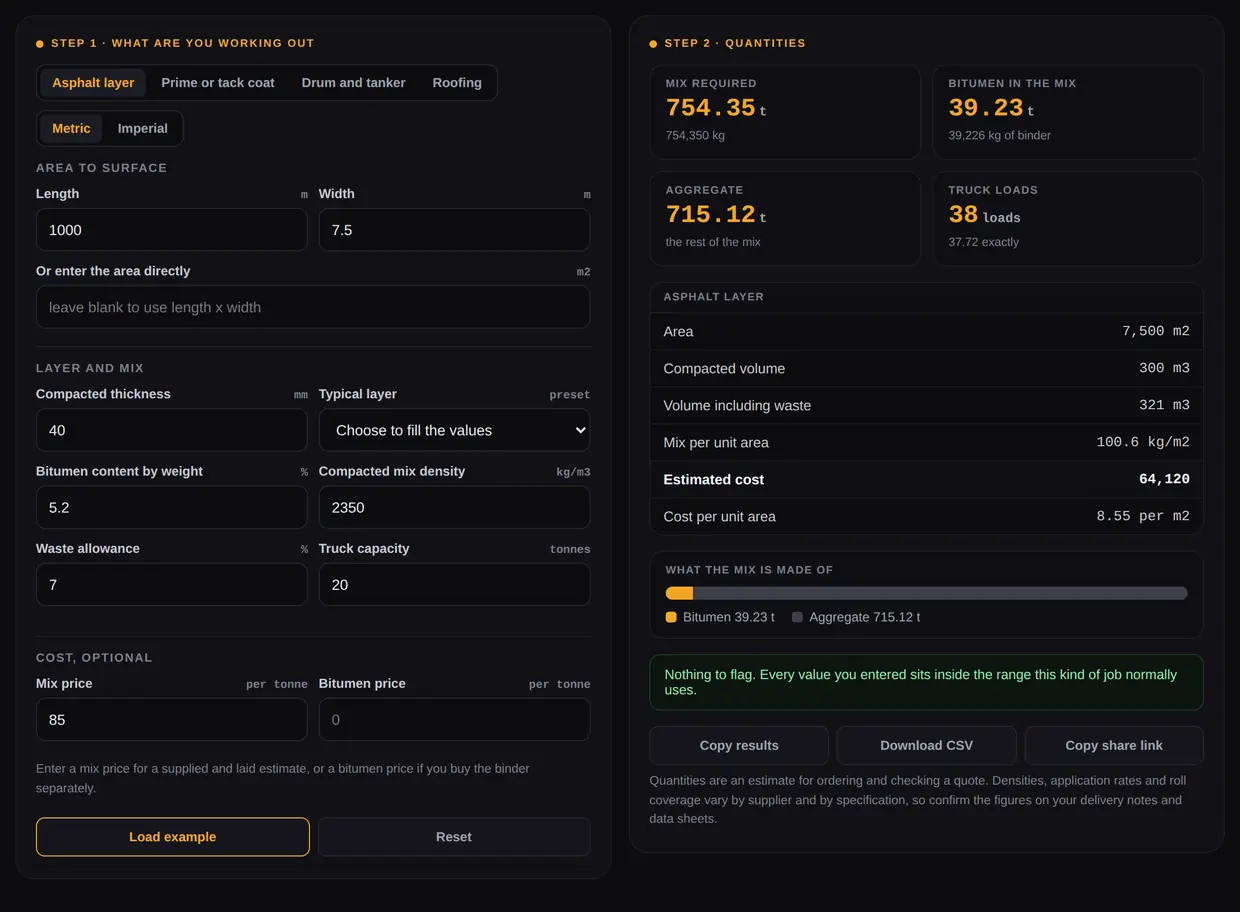
Area, compacted thickness, mix density and bitumen content. You get the mix tonnage, the bitumen inside it, the aggregate, the number of truck loads and the cost if you enter a price. This is the answer to how to calculate bitumen quantity for road work.
Prime coat, tack coat and surface dressing
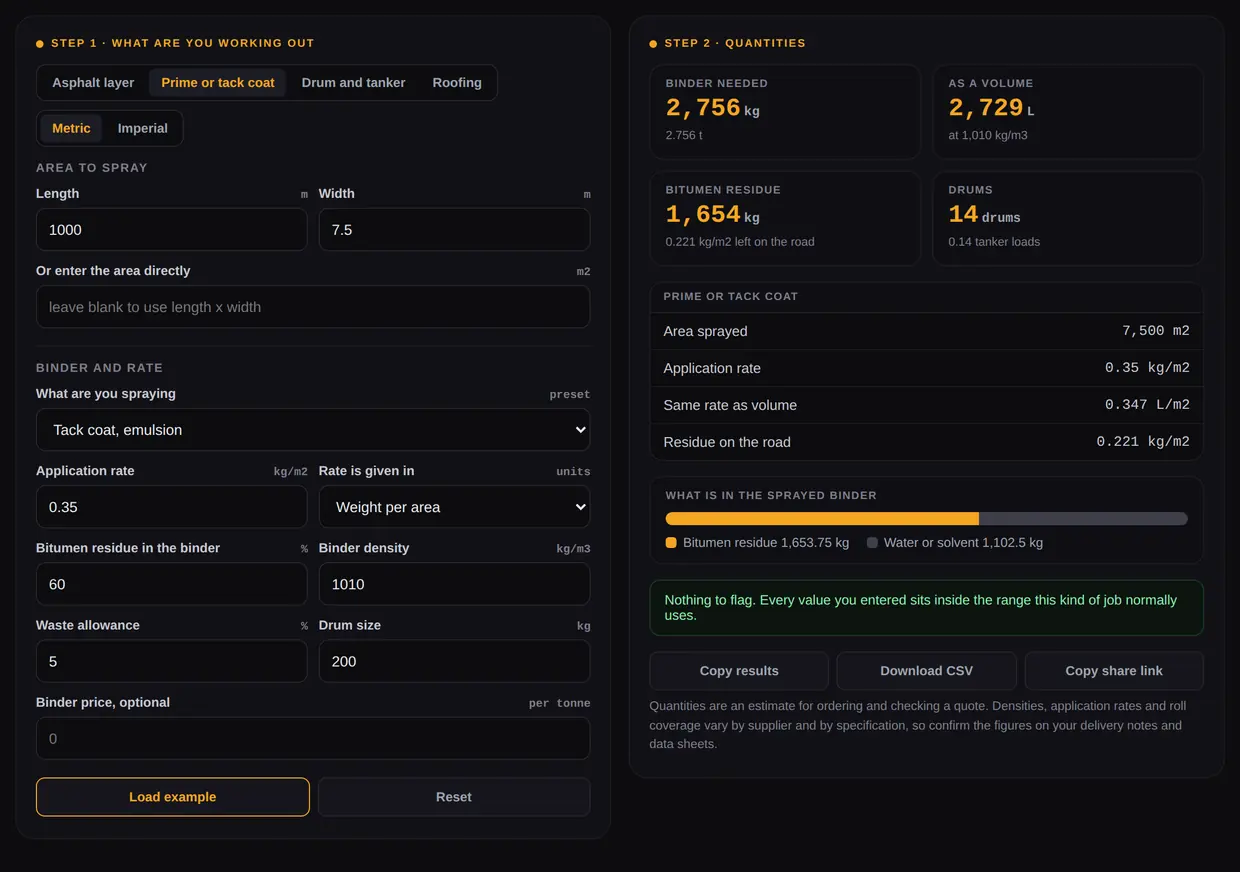
Area and application rate, in kg per square metre or litres per square metre. It returns the binder to order, the drums it fills, and the bitumen that actually stays on the road once the water in an emulsion has gone.
Drums and tankers, with temperature correction
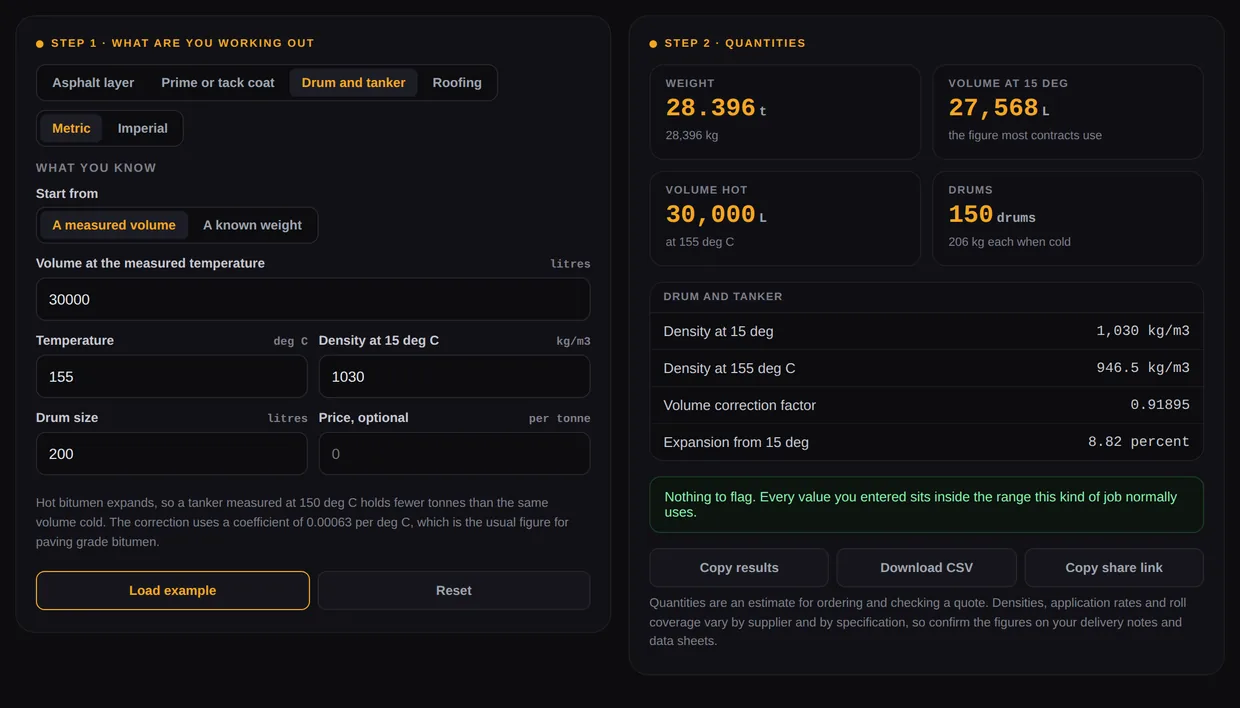
Hot bitumen expands, so a tanker measured at 150 degC carries fewer tonnes than the same volume cold. Enter the volume and the temperature and you get the weight, the volume corrected to 15 degC and the drum count.
Modified bitumen roofing
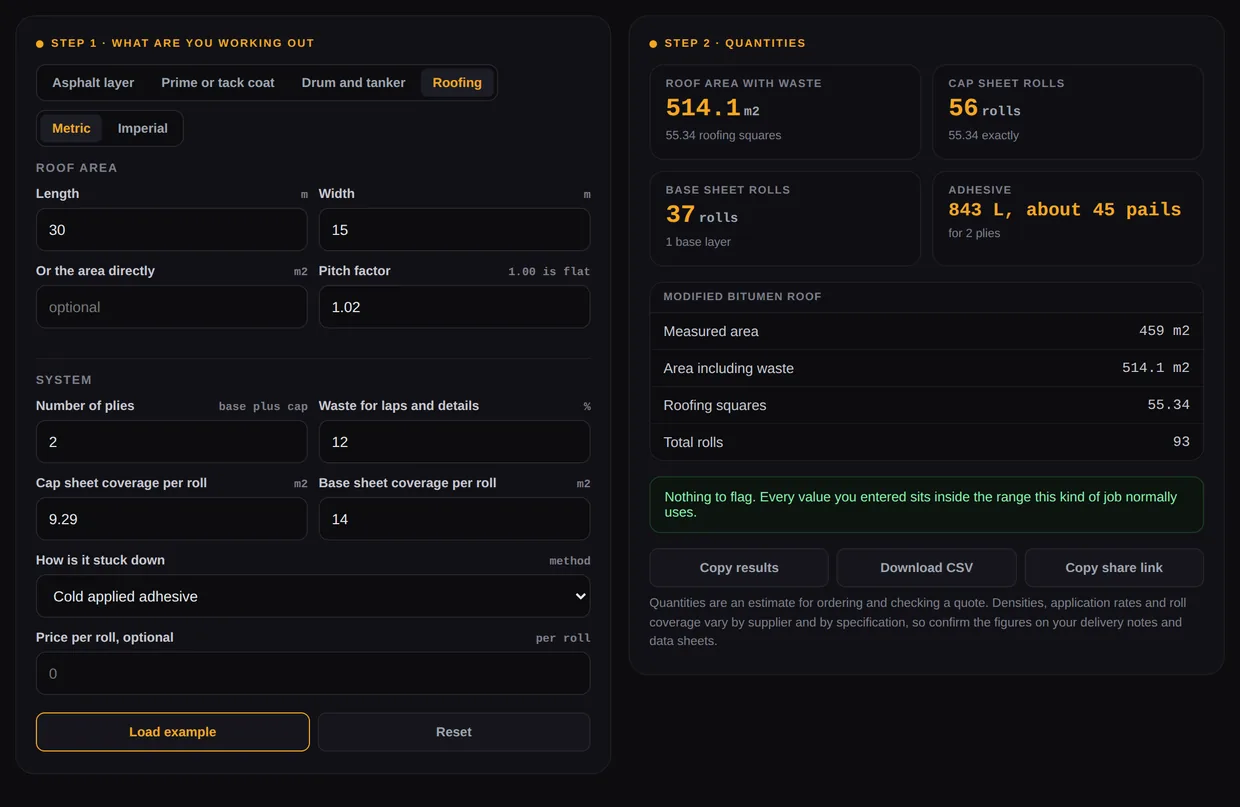
Roof area, plies, roll coverage and waste, and the calculator gives you cap sheet rolls, base sheet rolls, roofing squares and the hot or cold adhesive to go with them.
The bitumen quantity formula, and where each number comes from
The whole bitumen calculation for a paved layer is three lines of arithmetic. What makes estimates differ is not the formula, it is the density and the binder content people put into it.
Volume  = area x compacted thickness
Mix     = volume x compacted density x (1 + waste)
Bitumen = mix x bitumen content percentage
Aggregate = mix - bitumen
A worked example, in the numbers the tool uses by default. A 1,000 m by 7.5 m road with a 40 mm wearing course at 2,350 kg/m3 and 5.2 percent binder, with 7 percent waste:
| Step | Working | Result |
|---|---|---|
| Area | 1,000 x 7.5 | 7,500 m2 |
| Compacted volume | 7,500 x 0.040 | 300 m3 |
| Mix with waste | 300 x 1.07 x 2,350 | 754.4 tonnes |
| Bitumen | 754.4 x 5.2 percent | 39.2 tonnes |
| Aggregate | 754.4 minus 39.2 | 715.2 tonnes |
| Truck loads at 20 t | 754.4 / 20 | 38 loads |
Notice how little bitumen there is by weight and how much it matters by cost. Binder is a few percent of the mix and often a third of the price, which is why getting the bitumen content right is worth more than arguing about the aggregate.
Bitumen content and density: the two numbers that decide your answer
How much bitumen is in asphalt?
Between about 4 and 6.5 percent by weight of the total mix for normal dense graded asphalt, which works out around 40 to 65 kg of binder per tonne. Thin surfacings and porous mixes carry more, base layers less. If you have a mix design sheet, use the figure on it, because that is the number the plant actually runs.
| Mix type | Typical bitumen content | Compacted density |
|---|---|---|
| Dense graded wearing course | 5.0 to 5.8 percent | 2,320 to 2,400 kg/m3 |
| Binder course | 4.5 to 5.2 percent | 2,340 to 2,420 kg/m3 |
| Base course | 3.8 to 4.6 percent | 2,350 to 2,450 kg/m3 |
| Open graded friction course | 5.5 to 7.0 percent | 2,000 to 2,200 kg/m3 |
| Stone mastic asphalt | 6.0 to 7.0 percent | 2,350 to 2,450 kg/m3 |
| Cold mix patching | 4.0 to 6.0 percent | 1,900 to 2,150 kg/m3 |
These are ranges for a first estimate, not specification values. Use the mix design if you have one.
Compacted density, not loose density
The most common mistake in a bitumen calculation is using loose density. Mix in a truck is around 1,500 to 1,700 kg/m3, and the same material compacted in the road is 2,300 to 2,400. Use the loose figure and you will underorder by roughly a third. The calculator warns you when the density you type looks like loose mix.
Bitumen density itself
Paving grade bitumen sits at roughly 1,010 to 1,050 kg/m3 at 15 degC, which is why one litre weighs just over a kilogram. Emulsions are near 1,000 to 1,030. That is the figure the bitumen density calculator in the drum and tanker tab starts from, and it is the one printed on a delivery certificate.
Prime coat and tack coat: rates that work in practice
Sprayed binder is sold by weight but specified by rate, and the rate is where most of the argument happens on site. These are the ranges the tool presets use.
| Application | Rate | Binder | What it does |
|---|---|---|---|
| Tack coat | 0.2 to 0.5 kg/m2 | emulsion, 55 to 67 percent bitumen | bonds a new layer to the one below |
| Prime coat | 0.7 to 1.2 kg/m2 | cutback or slow setting emulsion | seals and binds an unbound base |
| Surface dressing, single | 1.0 to 1.6 kg/m2 | emulsion or hot bitumen | holds the chippings |
| Bond coat, polymer modified | 0.2 to 0.4 kg/m2 | hot modified binder | thin surfacing systems |
Why the residue percentage matters
Spray 0.35 kg/m2 of a 60 percent emulsion and only 0.21 kg/m2 of bitumen stays on the road once the water has broken away. Specifications are usually written in residual binder, while your delivery note is in emulsion, and that is exactly where quantities get muddled. The calculator shows both, so you can order in one and check against the other. Bitumen consumption is usually recorded per square metre on site, and that is the figure the residue line gives you.
Drums, tankers and hot bitumen: the volume correction nobody else does
Bitumen is bought by weight and measured by volume, and it expands as it heats. A tanker dipped at 150 degC holds around 8.5 percent more volume than the same bitumen at 15 degC, so a volume reading taken hot overstates what you received by that much if nobody corrects it.
Volume correction factor = 1 / (1 + 0.00063 x (T - 15))
Density at T = density at 15 degC x correction factor
Weight = volume at T x density at T
The coefficient of 0.00063 per degC, the same as 0.00035 per degF, is the figure used for paving grade bitumen in the standard petroleum measurement tables. Enter your loading temperature and the density from the certificate, and the bitumen cargo calculation is done. For drums, the tool also shows what one 200 litre drum holds by weight, which is roughly 200 kg rather than the 180 kg many people assume.
| Temperature | Correction factor | Density from 1,030 kg/m3 | 30,000 litres weighs |
|---|---|---|---|
| 15 degC | 1.0000 | 1,030 | 30.90 t |
| 100 degC | 0.9492 | 977.6 | 29.33 t |
| 140 degC | 0.9270 | 954.8 | 28.64 t |
| 160 degC | 0.9163 | 943.8 | 28.31 t |
| 180 degC | 0.9058 | 933.0 | 27.99 t |
Modified bitumen roof calculator
On a low slope roof, bitumen means membrane rather than pavement, and the units change to squares and rolls. One roofing square is 100 square feet, or 9.29 m2. A cap sheet roll usually covers about one square after the side and end laps are taken off, and a base sheet roll covers more because the laps are smaller.
What to enter
Roof area, a pitch factor if the deck is not flat, the number of plies and the waste. Twelve percent is a fair starting point for laps and details, and a roof with plenty of penetrations, curbs and corners will use more. The result gives the rolls for each layer and the adhesive that goes with the method you pick.
| Method | Typical quantity | Notes |
|---|---|---|
| Torch applied | no separate adhesive | the sheet carries its own bitumen, melted on site |
| Hot mopped asphalt | about 25 lb per square per ply | roughly 1.2 kg/m2 for each layer |
| Cold applied adhesive | about 2 gallons per square per ply | roughly 0.8 litres per m2, check the data sheet |
| Self adhered | none | primer only, at about 0.15 to 0.25 litres per m2 |
Roll sizes differ between manufacturers, so the coverage fields are editable. Put the figure from the product data sheet in and the roll count matches what you will actually be delivered.
Bitumen and asphalt are not the same thing
Bitumen is the black binder, the heavy residue left at the bottom of the refining column. Asphalt, in most of the world, is the finished mix of aggregate plus that binder. In the United States the word asphalt is used for both, which is why an asphalt calculator and a bitumen calculator often mean the same job, and why one search turns up pages about driveways, tankers and roofs in the same list.
| You want | Use this mode | You get |
|---|---|---|
| Tonnes of asphalt for a driveway | Asphalt layer | mix tonnage, truck loads, cost |
| Bitumen quantity for a road | Asphalt layer | binder tonnes inside the mix |
| Binder for a prime or tack coat | Prime or tack coat | kg, litres, drums, residue |
| Weight in a hot tanker | Drum and tanker | corrected volume and tonnes |
| Rolls for a flat roof | Roofing | squares, rolls, adhesive |
Mistakes this bitumen calculator is built to catch
- Loose density instead of compacted. The single biggest source of short deliveries on a paving job.
- Forgetting waste. Joints, the paver hopper, the last bit in the truck and the bit that goes cold. Five to ten percent is normal.
- Ordering emulsion as if it were bitumen. Sixty percent of what you spray is binder, the rest is water.
- Reading a hot tanker as if it were cold. At 150 degC that is an 8 percent error in your favour or against you, depending on which side of the invoice you are on.
- Mixing units halfway. Tonnes against short tons is a 10 percent difference, and gallons against litres is nearly four times.
- Using a bitumen price where a mix price belongs. Binder is a few percent of the weight and a large slice of the cost, so the two prices are nowhere near each other.
- Counting the roof area flat. Even a shallow slope adds a couple of percent, and the laps add far more.
What this tool does that other bitumen calculators do not
Four calculators, one page
Layer quantity, sprayed binder, tanker correction and roofing. The others do one of the four and leave the rest of the search to somebody else.
Emulsion residue
The only one that separates what you buy from what stays on the road, which is how specifications are actually written.
Temperature correction
Hot volume to weight with the standard coefficient, for tanker measurement and drum counts.
Ordering units
Truck loads, drums, rolls and pails, not just a raw tonnage figure that still has to be turned into a delivery.
Metric and imperial
Tonnes, m2 and litres, or tons, square feet and gallons, with everything converted properly, including rates in lb per square yard.
Sanity checks
Warnings when thickness, density, binder content or spray rate falls outside the range that job normally uses.
Related calculators on Calcxi
Boiler Feed Pump Calculation
Flow, head, NPSH and motor size for feedwater pumps, with the same level of detail as this page.
Pine Straw Calculator
Coverage and bale count for landscaping, the same area and coverage maths in a different material.
Construction calculators
The full construction and materials set on one page.
Markup Calculator
For turning a material cost into a quoted price once the quantities are settled.
Bitumen calculator: FAQs
How do you calculate bitumen quantity?
Multiply the area by the compacted thickness to get the volume, multiply that by the compacted mix density to get the tonnage, then multiply by the bitumen content to get the binder. For 7,500 m2 at 40 mm, 2,350 kg/m3 and 5.2 percent binder, that is 300 m3, 705 tonnes of mix and 36.7 tonnes of bitumen before any waste allowance.
How do I calculate bitumen quantity for a road?
Work layer by layer. Take the length and width of the surfacing, the compacted thickness of that layer and the binder content from the mix design, then repeat for the base and binder courses because each one has a different thickness and a different bitumen content. Add a waste allowance of 5 to 10 percent, and the calculator above gives the tonnes and the truck loads for each layer.
What is the formula for a bitumen calculation?
Bitumen weight equals area times thickness times compacted density times bitumen content percentage. In one line: B = A x t x rho x p, with area in m2, thickness in metres, density in kg/m3 and p as a decimal. Divide by 1,000 for tonnes and add waste on top.
How much bitumen is in one tonne of asphalt?
Usually 40 to 65 kg, because dense graded asphalt carries roughly 4 to 6.5 percent binder by weight. A tonne of a typical 5 percent wearing course mix contains 50 kg of bitumen and 950 kg of aggregate and filler.
What density should I use in a bitumen calculator?
For compacted asphalt, 2,300 to 2,400 kg/m3, with 2,350 as a safe middle. For loose mix in a truck, around 1,600. For bitumen binder itself, 1,010 to 1,050 kg/m3 at 15 degC. Using loose density where compacted density belongs is the most common reason an order comes up short.
What is the typical bitumen application rate for a tack coat?
Between 0.2 and 0.5 kg/m2 of emulsion, which leaves roughly 0.15 to 0.3 kg/m2 of residual bitumen once the water has gone. A prime coat on an unbound base is heavier, about 0.7 to 1.2 kg/m2, and a surface dressing heavier still.
How many 200 litre drums of bitumen do I need?
Divide the binder weight by about 200 kg per drum, since a 200 litre drum filled with bitumen at a density near 1,030 kg/m3 holds roughly 206 kg when cold. The spray mode does this for you, and the drum and tanker mode shows what a drum holds at your own density.
How do you convert bitumen volume to weight?
Multiply the volume by the density at the temperature the volume was measured at. Because bitumen expands about 0.063 percent per degC, the density at 150 degC is roughly 8 percent lower than at 15 degC. The drum and tanker mode applies the correction factor for you, so a hot dip reading turns into the right number of tonnes.
What is the difference between bitumen and asphalt?
Bitumen is the binder, a heavy residue from crude oil refining. Asphalt is the mixture of that binder with aggregate, filler and sometimes additives. In the United States asphalt often means the binder as well, so read the context. The first mode of this calculator gives you both: the mix tonnage and the bitumen inside it.
How much does bitumen cost per tonne?
It moves with crude oil and differs by country, grade and delivery, so no honest calculator will print a fixed figure. Put your supplier's current rate into the price field and the tool applies it. What it can tell you is how many tonnes you need, which is the part that does not change with the market.
How many rolls do I need for a modified bitumen roof?
Divide the roof area plus waste by the net coverage of each roll. A cap sheet roll normally covers about one roofing square, which is 100 square feet or 9.29 m2, and a base sheet roll covers more. For a 30 m by 15 m roof with 12 percent waste and a two ply system, that is about 55 cap rolls and 36 base rolls, and the roofing mode works it out with your own roll sizes.
Does the calculator account for compaction?
Yes, as long as you enter a compacted density, which is what the defaults use. The thickness you type is the finished compacted thickness, and the tonnage that comes out is what needs to be delivered loose to achieve it. That is why the density field carries a warning when the value looks like loose mix.
Is this bitumen calculator free?
Yes, free with no sign-up, no email and no limit. Everything runs in your browser, so the dimensions and prices you type stay on your device.
How accurate is the result?
The arithmetic is exact and the conversions are exact. The accuracy of the answer depends on your density, binder content and rate, which is why the tool shows every assumption instead of hiding it. Order against a supplier's mix design and delivery certificate, and treat this as the check that the numbers on both add up.
Quantities here are for ordering and for checking a quotation. Mix designs, spray rates and roll coverage are set by your specification and your supplier, and site conditions change what actually gets used. Confirm the figures on the delivery note and the product data sheet before a final order.

Written & verified by
B.Tech Computer Science · 8 years in web development & SEO · Bhilwara, India
About ·
LinkedIn ·
Report an error