
Boiler Feed Pump Calculation
Size a boiler feed pump properly: feedwater flow with blowdown and margin, total dynamic head broken into its parts, NPSH available against the pump's requirement, shaft power and a motor size. Steam properties come from the IAPWS steam tables, not a fixed density.
Duty
Feed pumps are normally sized 10 to 25 percent above the boiler's maximum continuous rating, so the pump still holds the level during load swings.
Feedwater and suction side
Boiler and discharge side
Pipe, valves, non-return valve and the flow element between the pump and the drum. Tick the box below to work it out from pipe sizes instead.
Suction line
Discharge line
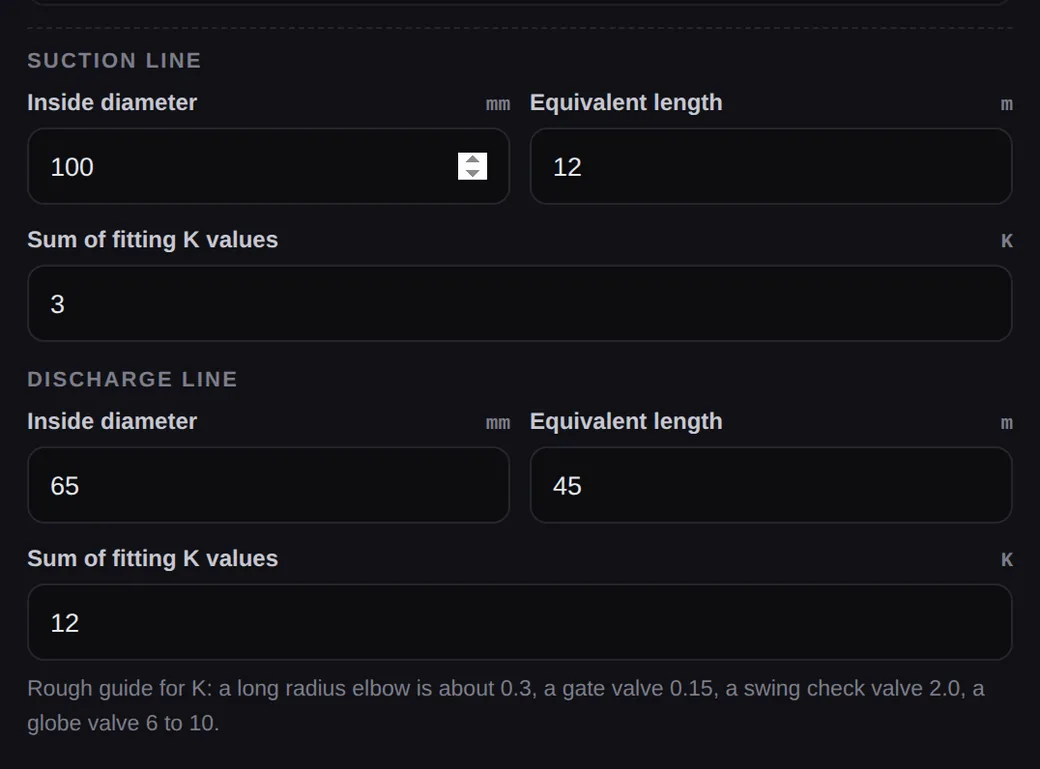
Rough guide for K: a long radius elbow is about 0.3, a gate valve 0.15, a swing check valve 2.0, a globe valve 6 to 10.
Pump and motor
This is a sizing estimate for a preliminary selection and a sanity check on a vendor proposal. The final pump choice belongs on a manufacturer's curve, with the real NPSHr at your duty point.
How to use this boiler feed pump calculation tool
Type what you know about the boiler and the layout, and the sizing updates as you go. The calculator does not assume a fixed water density or a single rule of thumb: density, vapour pressure and enthalpy come from the IAPWS steam tables at your actual feedwater temperature, which is what makes the difference between a number that looks right and a pump that works.
Start from boiler capacity or from a known flow
Enter the boiler's maximum continuous rating in kg/h or lb/h, add your blowdown percentage and a design margin, and the feedwater flow is worked out for you. If the flow is already fixed by a data sheet, switch to the second mode and type it straight in.
Describe the suction side honestly
Feedwater temperature, deaerator pressure, the height of the water level above the pump centreline and the suction line loss. These four numbers decide your NPSH, and NPSH is what kills feed pumps.
Add the discharge side
Drum pressure, the margin you want above it, the feed control valve drop, the drum height and the discharge line loss. Tick the pipe box and the tool works the friction out from diameter, length and fitting K values instead of an allowance.
Read the head breakdown, not just the total
The result splits total dynamic head into pressure, static lift and friction, so you can see which part is driving the pump size. Copy the results, download the CSV or share the link with whoever signs off the selection.
The boiler feed pump calculation, step by step
Four numbers come out of a feed pump sizing: flow, head, NPSH available and power. Everything else is detail around those four. Here is what the tool does, in the order it does it, so you can repeat the same boiler feed pump calculation by hand or in a spreadsheet.
Step 1: feedwater flow, with blowdown and margin
A feed pump never moves only the steam rate. It also replaces continuous blowdown, and it needs headroom for level swings, startup and the day the boiler runs above its nameplate. The flow used for sizing is:
Feedwater mass flow = steam rate x (1 + blowdown) x (1 + design margin)
Volume flow = mass flow / density at the feedwater temperature
Blowdown is usually 2 to 10 percent depending on water quality, and the design margin is typically 10 to 25 percent above the maximum continuous rating. That density term matters more than people expect: water at 105 degC is about 955 kg/m3 rather than 1000, which is roughly 5 percent more volume for the same mass. Get it wrong and the pump is undersized before you start.
Step 2: total dynamic head
Total dynamic head is the energy the pump has to add, expressed in metres or feet of the liquid being pumped. For a boiler feed pump head calculation it splits into three parts:
TDH = (discharge pressure - suction pressure) x 10^5 / (density x 9.81)
      + (drum inlet height - water level height)
      + friction losses, suction and discharge
The pressure term nearly always dominates. The discharge pressure is not the drum operating pressure: it is the drum pressure plus a margin that covers the safety valve setting and control, plus the pressure dropped across the feed control valve, which is commonly 1 to 3 bar. The static term can even be negative when the deaerator sits above the drum connection, and the calculator shows it that way rather than hiding it.
Step 3: NPSH available, the part most calculators skip
Feedwater leaves a deaerator at its saturation temperature, so the water is already on the edge of boiling. The pressure above it does nothing for you, because the vapour pressure cancels it out. What is left is height:
NPSHa = (suction pressure - vapour pressure) x 10^5 / (density x 9.81)
        + water level above the pump centreline
        - suction line friction loss
For a saturated deaerator the first term is zero, which is why the rule on plant is simple: NPSH available is the height of the deaerator water level above the pump, minus the suction losses. The tool compares that with the pump's NPSH required and tells you the minimum height you need for the margin you asked for.
Step 4: shaft power and boiler feed pump motor size
Hydraulic power (kW) = density x 9.81 x flow (m3/s) x head (m) / 1000
Shaft power = hydraulic power / pump efficiency
Motor rating = shaft power x (1 + margin), rounded up to a standard size
Pump efficiency for a small multistage feed pump is often 55 to 70 percent, and 70 to 80 percent on larger units. The calculator rounds the motor up to the next IEC kW size in metric or the next NEMA horsepower in imperial, using the margin you set, so the number you get is one you can actually order.
| What you are working out | Formula used here | Typical range |
|---|---|---|
| Feedwater flow | steam x (1 + blowdown) x (1 + margin) / density | margin 10 to 25 percent |
| Pressure head | (Pd - Ps) x 10^5 / (rho x g) | drum pressure plus 10 to 20 percent |
| Control valve drop | entered directly | 1 to 3 bar |
| NPSH available | static height minus suction loss, for saturated water | margin 0.5 to 2 m over NPSHr |
| Shaft power | rho x g x Q x H / efficiency | efficiency 55 to 80 percent |
| Minimum flow | percentage of design flow | 10 to 30 percent |
Worked example: a 45 t/h boiler at 42 bar
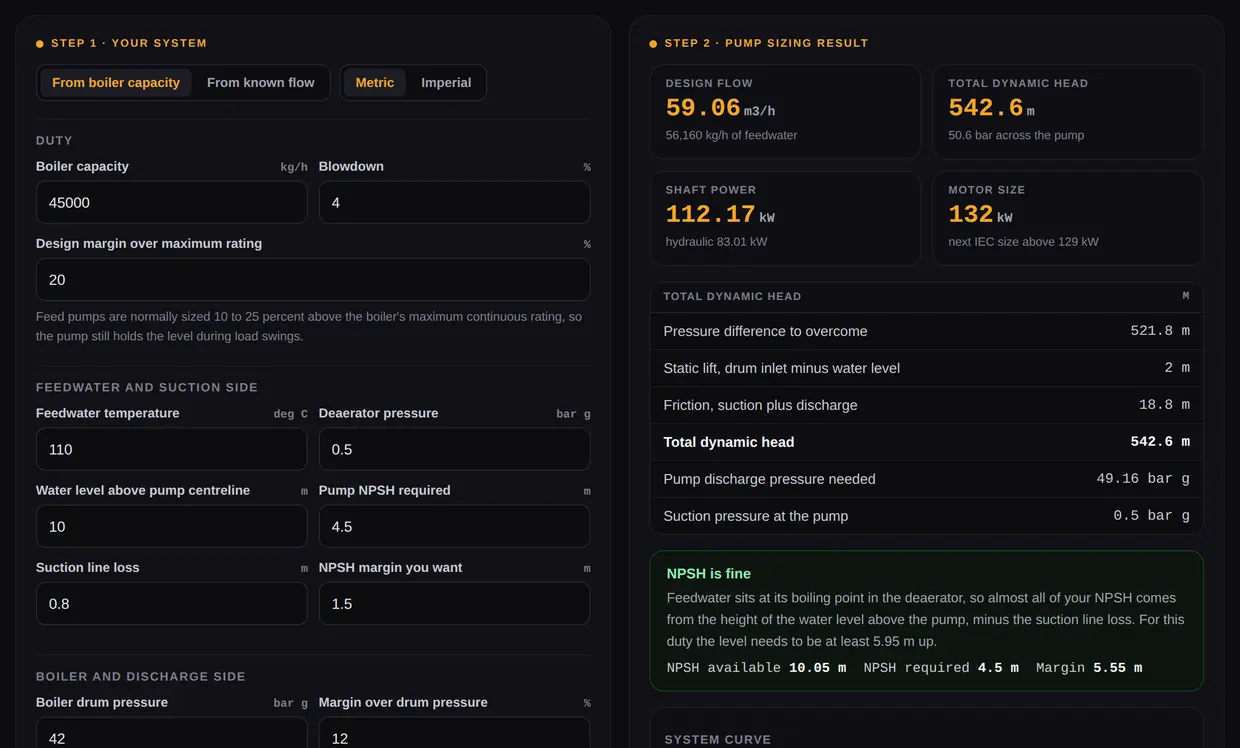
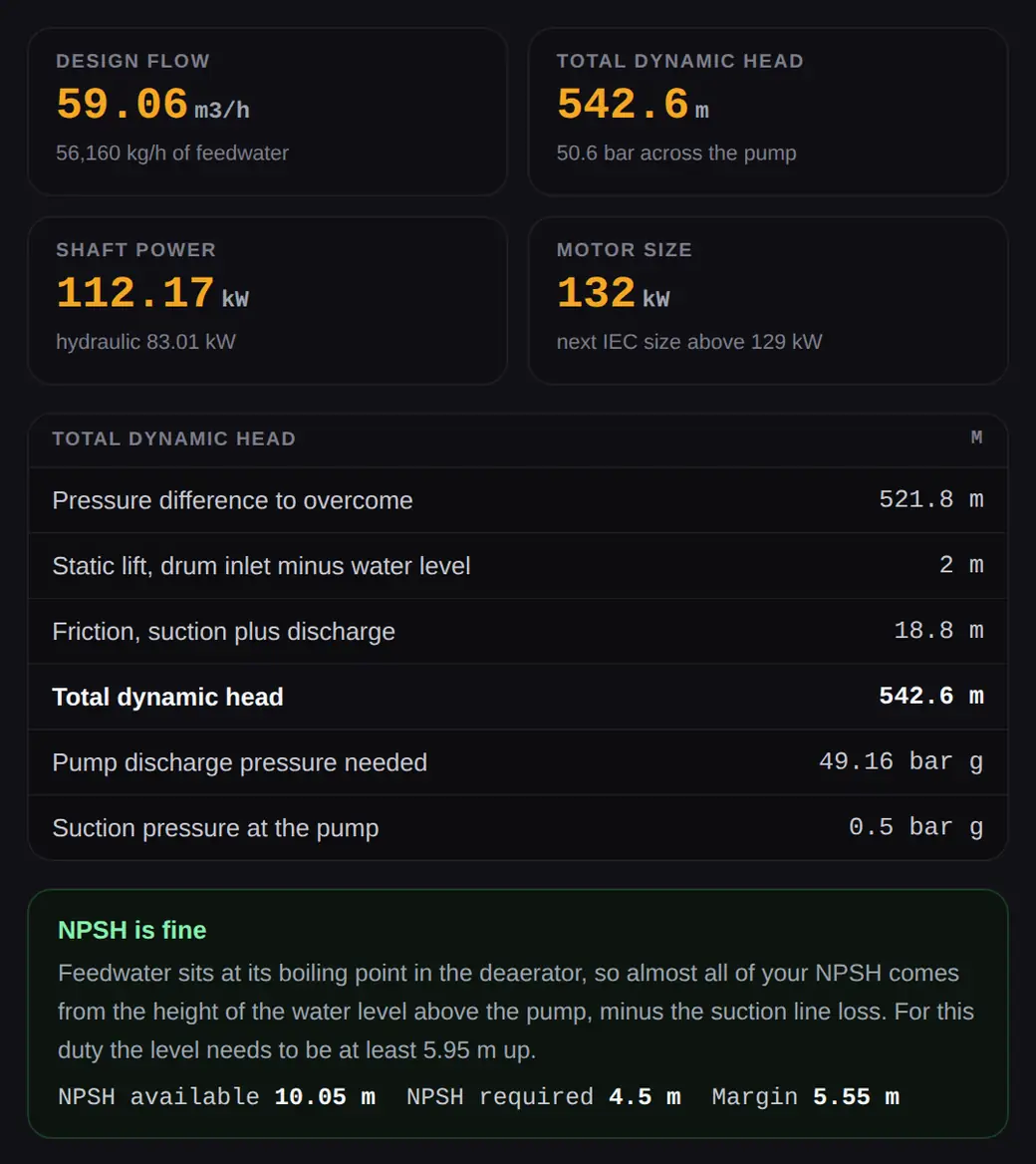
Press Load example in the tool and these are the numbers. A 45,000 kg/h boiler, 4 percent blowdown, 20 percent design margin, feedwater at 110 degC from a deaerator at 0.5 bar g with the water level 10 m above the pump, drum at 42 bar g, 12 percent margin over drum pressure, 2 bar across the control valve, drum inlet 12 m up, 18 m of discharge friction, pump efficiency 74 percent.
| Result | Value | Where it comes from |
|---|---|---|
| Feedwater flow | 56,160 kg/h, 59.1 m3/h | 45,000 x 1.04 x 1.20, divided by 951 kg/m3 |
| Pressure head | 521.8 m | 49.16 bar g discharge against 0.5 bar g suction |
| Static lift | 2.0 m | drum inlet 12 m, water level 10 m |
| Friction | 18.8 m | suction 0.8 m plus discharge 18 m |
| Total dynamic head | 542.6 m | the three lines above |
| NPSH available | 10.05 m against 4.5 m required | 10 m level, minus 0.8 m suction loss, plus a little because the water is below the boiling point at 0.5 bar g |
| Shaft power | 112.2 kW | 83.0 kW hydraulic at 74 percent efficiency |
| Motor | 132 kW | next IEC size above 112.2 x 1.15 |
| Boiler duty | 29,247 kW, 2,981 BHP | steam enthalpy minus feedwater enthalpy |
Notice how little of the head is static. People argue about a metre of pipe routing while 96 percent of the pump's work is pushing water into a pressurised drum. That is the value of seeing the breakdown instead of one total.
Boiler feed pump sizing rules that matter more than the arithmetic
Size the flow above the boiler's maximum rating
A pump sized exactly at the steam rate has nothing left for blowdown, for a cold start when the drum is being filled or for the hour when production pushes the boiler hard. Most specifications land between 110 and 125 percent of the maximum continuous rating once blowdown is included, and the tool keeps those two allowances visible instead of burying them in one factor.
Discharge pressure is set by the safety valve, not by today's operating pressure
The pump has to keep feeding while the drum pressure is rising towards the safety valve set point, otherwise the level falls exactly when you least want it to. That is why a margin over drum pressure is standard, and why the default here is 15 percent. On top of that sits the feed control valve, which needs a real pressure drop to control anything at all.
NPSH is where feed pumps actually fail
The most common reason a feed pump is noisy, loses flow, chews impellers or trips on vibration is that the water flashes on the suction side. The fix is almost never a bigger motor. It is a higher deaerator, a shorter and fatter suction line, or a pump with a lower NPSHr, and this calculator tells you which one buys you the most.
Minimum flow is a protection device, not a detail
Run a multistage pump near shutoff and the water heats up, then flashes inside the pump. Every feed pump needs a recirculation path back to the deaerator, sized around 10 to 30 percent of design flow. The tool shows the flow and the temperature rise it implies, so you can sanity check an automatic recirculation valve rather than trust the drawing.
NPSH for boiler feed pumps, in plain numbers
Because feedwater is saturated, the useful form of the NPSH available equation is short: height minus losses. This table shows what that means in practice for a pump needing 3 m NPSHr with a 1 m margin.
| Water level above pump | Suction loss | NPSH available | Verdict against 3 m NPSHr |
|---|---|---|---|
| 3 m | 0.5 m | 2.5 m | Cavitates |
| 5 m | 0.5 m | 4.5 m | Works, thin margin |
| 8 m | 0.5 m | 7.5 m | Comfortable |
| 8 m | 3.0 m | 5.0 m | The suction line is eating the margin |
| 12 m | 1.0 m | 11.0 m | Comfortable |
Two things follow from that table. Height is cheap when the plant is being designed and expensive afterwards, and a suction line that is one size too small can wipe out several metres of hard won elevation. Keep suction velocity near or below 1.5 m/s and the loss stays small.
Boiler horsepower, lb/h, EDR and kW without the confusion
Half the difficulty in a boiler feed water pump capacity calculation is that everyone states the boiler in a different unit. These are the conversions the calculator uses internally.
| Unit | Equals | Where you see it |
|---|---|---|
| 1 boiler horsepower | 34.5 lb/h of steam from and at 212 degF, about 9.81 kW | US packaged boilers |
| 1 boiler horsepower | about 15.65 kg/h of steam | same, in metric plants |
| 1 kg/h of steam | 2.205 lb/h | data sheets from different regions |
| 1 m3/h | 4.403 US gpm | pump curves |
| 1 bar | 14.50 psi, about 10.2 m of cold water | pressure to head conversion |
| 1 EDR sq ft | 240 BTU/h, about 0.25 lb/h of steam | US heating systems |
A common US rule of thumb is to size feed pump capacity at roughly twice the boiler's steaming rate in gpm terms for intermittent feed systems, and near 1.2 times for continuous modulating feed. The tool lets you set that margin directly rather than hiding it inside a factor, which is what you need when a specification asks why you picked it.
Pipe friction, velocity and line sizing
Tick the pipe box and friction is calculated properly rather than guessed: Darcy friction factor from the Reynolds number and pipe roughness, plus the fitting K values you enter. It also gives you the velocity, which is the number that catches bad line sizing fastest.
| Line | Sensible velocity | Why |
|---|---|---|
| Feed pump suction | 1.0 to 1.5 m/s | every loss here comes straight off NPSH |
| Feed pump discharge | 2.0 to 3.5 m/s | balance of pipe cost against friction |
| Long transfer lines | under 2.5 m/s | friction grows with the square of velocity |
Rough K values for the fittings box: a long radius elbow is about 0.3, a gate valve 0.15, a swing check valve 2.0 and a globe valve 6 to 10. Add them up for the line and enter the total.
Mistakes this calculator is built to catch
- Using 1000 kg/m3 for hot feedwater. At 105 degC water is about 955 kg/m3, and at 150 degC about 917. The volume flow and the head in metres both move.
- Sizing head on operating pressure. Without a margin over drum pressure and a real control valve drop, the pump cannot hold level when pressure rises.
- Forgetting blowdown. Continuous blowdown is feedwater the pump has to deliver and the steam rate never shows.
- Ignoring NPSH. The single most common cause of feed pump damage, and the one number none of the quick calculators online will give you.
- No minimum flow path. A closed discharge and no recirculation line is how a feed pump destroys itself in minutes.
- Confusing motor size with shaft power. Shaft power is what the pump absorbs at the duty point. The motor needs a margin on top, and end of curve power can be higher still.
- Mixing units halfway through. lb/h with bar, or gpm with metres, is how a sizing ends up out by a factor no one can find later.
What this tool gives you that a quick calculator does not
Real steam properties
Density, vapour pressure, saturation temperature and enthalpy come from the IAPWS-IF97 equations at your conditions, not from a single assumed value.
The NPSH answer
NPSH available, the margin against the pump's requirement, and the deaerator height that would fix it. No other free boiler feed pump calculator online returns this.
Head you can defend
Pressure, static and friction listed separately, with the discharge pressure in bar g or psig, so a reviewer can follow every number.
Both unit systems
kg/h, m3/h, bar, metres and kW, or lb/h, gpm, psi, feet and horsepower, with IEC and NEMA motor sizes to match.
Checks, not just numbers
Warnings for cavitation risk, flashing feedwater, high velocity, optimistic efficiency and a temperature rise at minimum flow that would boil the pump.
Output you can hand over
Copy the full sizing as text, download it as CSV for your calculation file, or share a link that reopens the same inputs.
Related calculators on Calcxi
HVAC System Cost Calculator
Installed cost for heating and cooling equipment, useful when the feedwater system is part of a wider plant budget.
Furnace Replacement Cost Calculator
Replacement pricing for heating plant, by type and capacity.
Construction calculators
The full construction and mechanical set, including material and cost tools.
Break-Even Calculator
For the other half of a pump decision: how long a more efficient unit takes to pay for itself.
Boiler feed pump calculation: FAQs
How do you calculate boiler feed pump capacity?
Take the boiler's maximum continuous steam rate, add continuous blowdown, then add a design margin of 10 to 25 percent. That gives the mass flow. Divide by the density of water at the feedwater temperature to get the volume flow the pump curve is read at. For a 10,000 kg/h boiler with 5 percent blowdown and a 15 percent margin, the pump handles about 12,075 kg/h, which at 105 degC is roughly 12.6 m3/h rather than 12.1.
What is the formula for boiler feed pump head calculation?
Total dynamic head equals the pressure difference between discharge and suction converted to head, plus the static height difference, plus friction losses. In symbols, TDH = (Pd - Ps) x 10^5 / (rho x g) + (Zd - Zs) + hf, with pressures in bar absolute, density in kg/m3 and the result in metres. Discharge pressure includes a margin over drum pressure and the feed control valve drop, not just the operating pressure.
How much margin should a boiler feed pump have?
Two separate margins. On flow, 10 to 25 percent above the maximum continuous rating, after blowdown is added. On pressure, typically 10 to 20 percent above drum pressure so the pump keeps feeding while pressure rises towards the safety valve setting, plus a real drop across the feed control valve. Adding them into one vague factor is how pumps end up either starved or badly oversized.
What is NPSH in boiler feed pump sizing?
NPSH available is the margin between the pressure at the pump suction and the pressure at which the water would boil. Because feedwater leaves a deaerator at saturation, the pressure term cancels out and NPSH available becomes the height of the water level above the pump centreline minus the suction line loss. It must stay above the pump's NPSH required, with a margin of roughly 0.5 to 2 m for a feed pump, and this calculator reports all three numbers.
How do I calculate boiler feed pump power and motor size?
Hydraulic power in kW is density x 9.81 x flow in m3/s x head in metres, divided by 1000. Divide by pump efficiency to get shaft power, then add a margin, usually 10 to 20 percent, and round up to the next standard motor. For 59 m3/h at 543 m and 74 percent efficiency, hydraulic power is about 83 kW, shaft power about 112 kW and the motor lands at 132 kW.
Why does feedwater temperature change the answer?
Because head is measured in metres of the liquid being pumped and density falls as water gets hotter. Hot water gives more volume per kilogram, so the volume flow rises, while the same pressure needs more metres of head. Hot water also sits closer to boiling, which is why the feedwater temperature and the deaerator pressure together decide whether the pump has any NPSH at all.
What pump efficiency should I use if I do not know it yet?
For a first pass, 55 to 65 percent for a small multistage pump under about 20 m3/h, 65 to 75 percent in the middle, and 75 to 82 percent for large feed pumps. Anything above 85 percent is optimistic for a multistage machine, and the calculator says so. Replace the guess with the vendor's figure at your duty point as soon as you have it.
What is minimum flow and why does a feed pump need it?
Minimum continuous flow is the lowest flow the pump can run at without overheating, usually 10 to 30 percent of design. Near shutoff nearly all the absorbed power turns into heat in a small mass of water, the water flashes inside the pump and the pump is damaged quickly. A recirculation line back to the deaerator, controlled by an automatic recirculation valve or an orifice, is what protects it.
Can I use this as a boiler feed water pump sizing calculator for a US plant?
Yes. Switch the units to imperial and everything changes over: lb/h, US gpm, psig, feet of head and horsepower, with the motor rounded to the next NEMA size. The boiler duty is also reported in boiler horsepower, which is what most US packaged boiler data sheets use.
How many stages will the pump need?
As a rough guide a two pole pump at around 2950 or 3550 rpm develops something like 40 to 60 m of head per stage, and a four pole pump roughly a quarter of that. The tool divides total head by that guide to estimate stages, which is enough to tell whether you are looking at a three stage pump or a ten stage machine. The manufacturer's selection decides the real number.
Is the boiler feed pump calculation different for a steam boiler and a hot water boiler?
Yes. A hot water boiler runs a closed circulating loop, so the pump sees mostly friction and very little static or pressure difference, and flow comes from the heat load and the temperature drop across the system. The calculation on this page is for steam boiler feedwater, where the pump has to push against drum pressure.
Should I include a standby feed pump in the calculation?
Size each pump for the full duty and install a standby, which is normal practice on steam plant. Two pumps sharing the load only helps if both run continuously, and most feed systems are set up as duty and standby with automatic changeover. The sizing here is per pump.
How accurate is this boiler feed pump calculator?
The water properties are accurate: saturation pressure and temperature use the IAPWS-IF97 equations, and density, specific heat and enthalpy are fitted to steam table values to within about 0.3 kg/m3 and 0.4 kJ/kg up to 240 degC. The uncertainty is in your inputs, particularly the friction allowance and the pump efficiency. Treat the output as a sound preliminary sizing and confirm the selection on a manufacturer's curve.
Is this tool free and does it need an account?
It is free with no sign-up, no email and no limit. Everything runs inside your browser, so the numbers you type never leave your device, which matters when the inputs describe a client's plant.
This calculator is an engineering aid for preliminary sizing and for checking a proposal, not a substitute for a manufacturer's selection or for the codes that apply to your plant. Confirm the final duty, the NPSH required at that duty and the minimum flow requirement with the pump vendor before anything is ordered.

Written & verified by
B.Tech Computer Science · 8 years in web development & SEO · Bhilwara, India
About ·
LinkedIn ·
Report an error