
Peptide Calculator
Work out peptide doses three ways: the units to draw on an insulin syringe, the bacteriostatic water that makes a dose land on a round number, and a converter between mcg, mg, IU, mL and syringe units. With the barrel drawn so you can see the mark.
The vial
The vial holds the same peptide whatever the water volume. More water does not change your dose, it only moves where that dose sits on the syringe.
Your dose
This calculator does not choose a dose. Enter the one your prescriber gave you.
Syringe and schedule
Check the printing on the barrel. U-100 and U-40 are not interchangeable, one unit is 0.01 mL on the first and 0.025 mL on the second.
Frequency turns doses per vial into days. The price is your own figure in your own currency, nothing is assumed.
This is an arithmetic tool. It converts the numbers you type and does not decide whether a peptide, a dose or a schedule is right for anyone. Peptides intended for people should come from a licensed prescriber, and the dose should come from them too.
How to use this peptide calculator
A vial of peptide arrives as a dry powder. The label gives you milligrams and nothing else. Once you add bacteriostatic water you have a liquid, and how strong that liquid is depends entirely on how much water went in. The calculator turns that into the number you need while you are holding the syringe.
It works as a peptide dosage calculator, a peptide reconstitution calculator and a unit converter, because those are the three questions people turn up with.
Units to draw
Enter the vial strength, the water you are adding, your dose and your syringe. You get the mark to pull to, the concentration, what one unit carries, how many doses are in the vial and roughly how long it lasts.
How much water
The same sum run backwards. Tell it the dose and the number of units you would rather draw, and it returns the water volume that makes those two meet. Useful when the first mode hands you something like 6.7 units.
Unit converter
One figure in, every equivalent out. Micrograms, milligrams, international units, and once you add the vial and water, milliliters and syringe units as well.
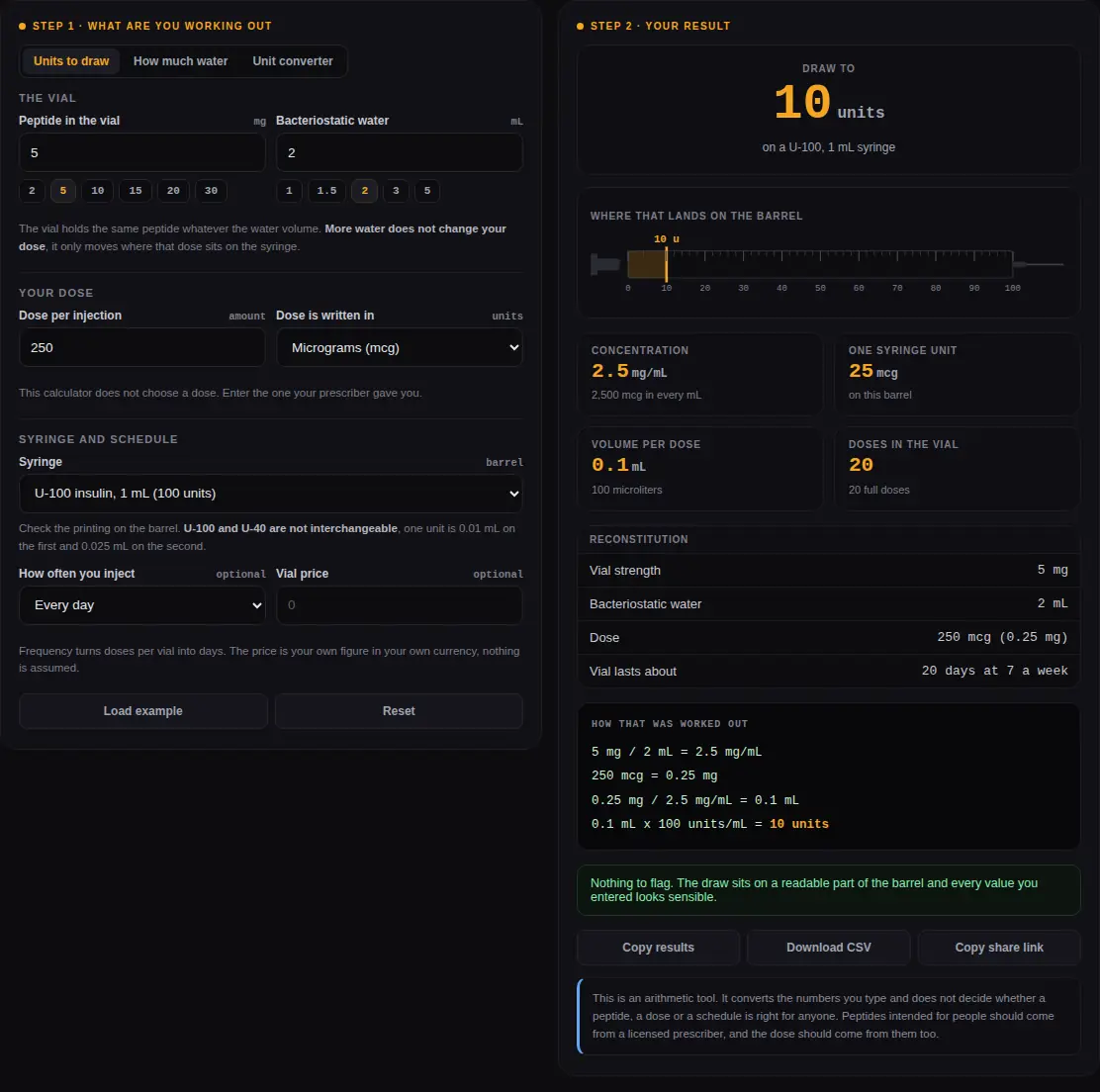
How to calculate a peptide dose
Divide the milligrams in the vial by the milliliters of water. That gives the concentration. Divide your dose by the concentration to get a volume. Multiply the volume by 100 and you have the units to draw on a U-100 syringe.
Concentration (mg/mL) = vial mg / water mL
Dose volume (mL)      = dose mg / concentration
Units to draw         = dose volume x 100
The only trap is the units. Doses are usually written in micrograms and vials are labeled in milligrams, so convert first: divide micrograms by a thousand.
Worked through
A 5 mg vial, 2 mL of water, a 250 mcg dose.
| Step | Working | Result |
|---|---|---|
| Concentration | 5 mg / 2 mL | 2.5 mg/mL |
| Dose in mg | 250 mcg / 1,000 | 0.25 mg |
| Dose volume | 0.25 / 2.5 | 0.1 mL |
| Units to draw | 0.1 x 100 | 10 units |
| Doses per vial | 5 / 0.25 | 20 |
The same sum in reverse
Rearranged, it answers the more practical question. You know the dose. You know you would rather draw a round number. How much water?
Water (mL) = units x vial mg / (dose mg x 100)Doing it on a phone versus doing it here
The sums are not hard, and plenty of people do them on a phone without incident. The risk is not complexity, it is scale. Every quantity is small, the weight units sit a thousand apart, and the syringe adds a third scale on top. A misplaced decimal does not give you an answer that looks obviously wrong. It gives you one that looks completely reasonable and is ten times out. Every result here shows its working line by line so you can check it against what you expected.
How to read the units on an insulin syringe
On a U-100 syringe there are 100 units in one milliliter, so one unit is 0.01 mL. The scale was built for insulin, where a unit measures activity. Drawing anything else, it is just a volume scale with the decimal point moved.
| Barrel | Holds | One unit | Suits |
|---|---|---|---|
| 1 mL, U-100 | 100 units | 0.01 mL | Draws of roughly 20 units and up |
| 0.5 mL, U-100 | 50 units | 0.01 mL | Mid range draws, easier to read |
| 0.3 mL, U-100 | 30 units | 0.01 mL | Small draws, often half unit marks |
| 1 mL, U-40 | 40 units | 0.025 mL | Veterinary insulin, not peptide instructions |
The first three are all U-100. What changes is the length of the scale, not the meaning of a unit. Thirty units spread across the same barrel length that a 1 mL uses for a hundred puts the marks much further apart, which is why a smaller barrel is the better tool whenever the draw is small.
The U-40 problem
A U-40 syringe has 40 units per milliliter, so one unit is 0.025 mL. The barrel looks much the same and the printed numbers look much the same. Follow a U-100 instruction holding a U-40 syringe and you draw two and a half times what was intended. They are mostly sold for veterinary insulin and they do end up in the wrong hands. The calculator includes U-40 as an option for one reason: selecting it produces a warning instead of a confident wrong number.
How much bacteriostatic water should you add?
Enough that your dose lands somewhere you can read. That is the whole answer, and it surprises most people, because the water does not change the dose at all.
| Water in a 5 mg vial | Concentration | One unit | 250 mcg is | Doses per vial |
|---|---|---|---|---|
| 1 mL | 5 mg/mL | 50 mcg | 5 units | 20 |
| 2 mL | 2.5 mg/mL | 25 mcg | 10 units | 20 |
| 3 mL | 1.667 mg/mL | 16.7 mcg | 15 units | 20 |
| 5 mL | 1 mg/mL | 10 mcg | 25 units | 20 |
Watch the last column. It does not move. The vial holds 5 mg in every row, and 250 mcg is 250 mcg in every row. All that changed is how far up the barrel it sits.
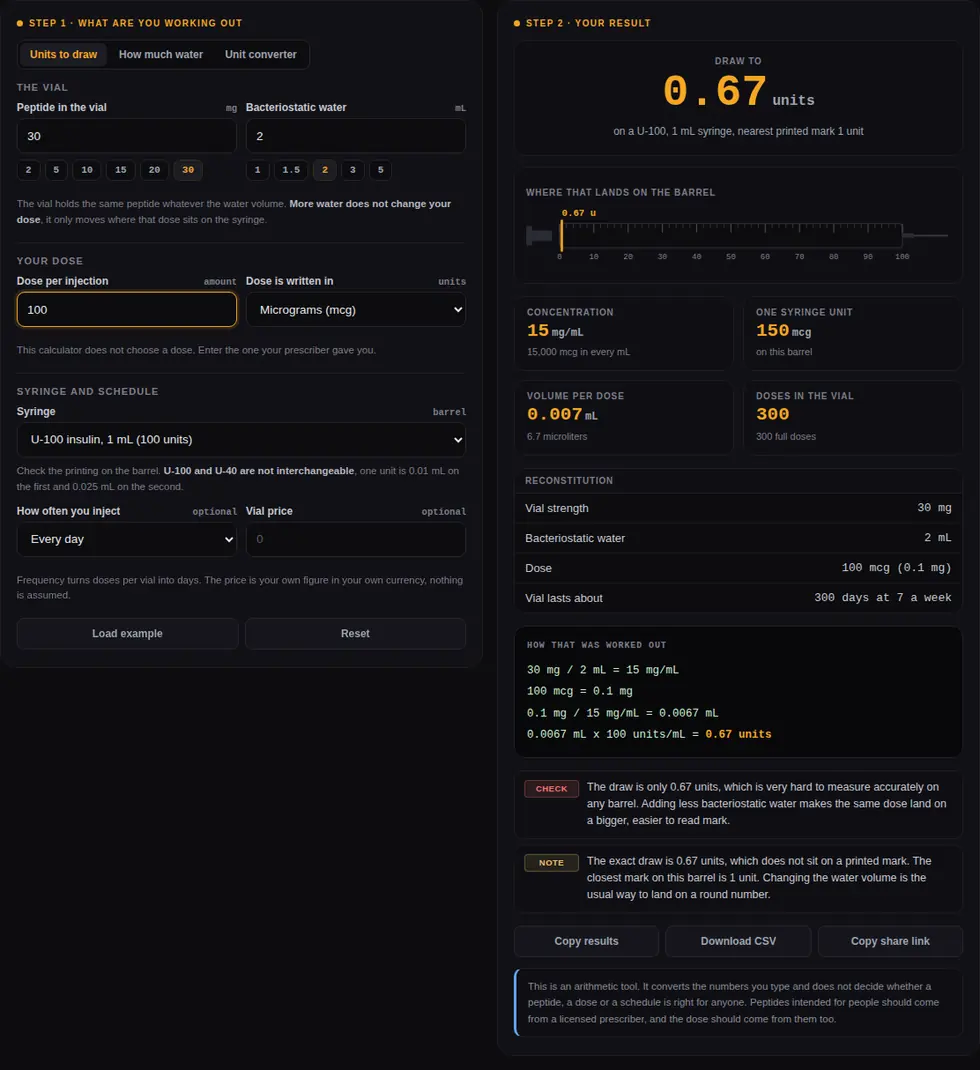
So pick for readability. A draw of one or two units is close to unmeasurable, because the difference between right and badly wrong is a fraction of a millimetre. A draw that fills the barrel leaves no margin the other way. Somewhere between ten and fifty units is comfortable, and the calculator flags anything under five.
Landing on a round number
If the first mode hands you 6.7 units, switch to the second one. Give it the dose and the number of units you want to see, and it tells you the water volume that produces exactly that. It is easier to design the vial around a readable draw than to squint at the plunger every time.
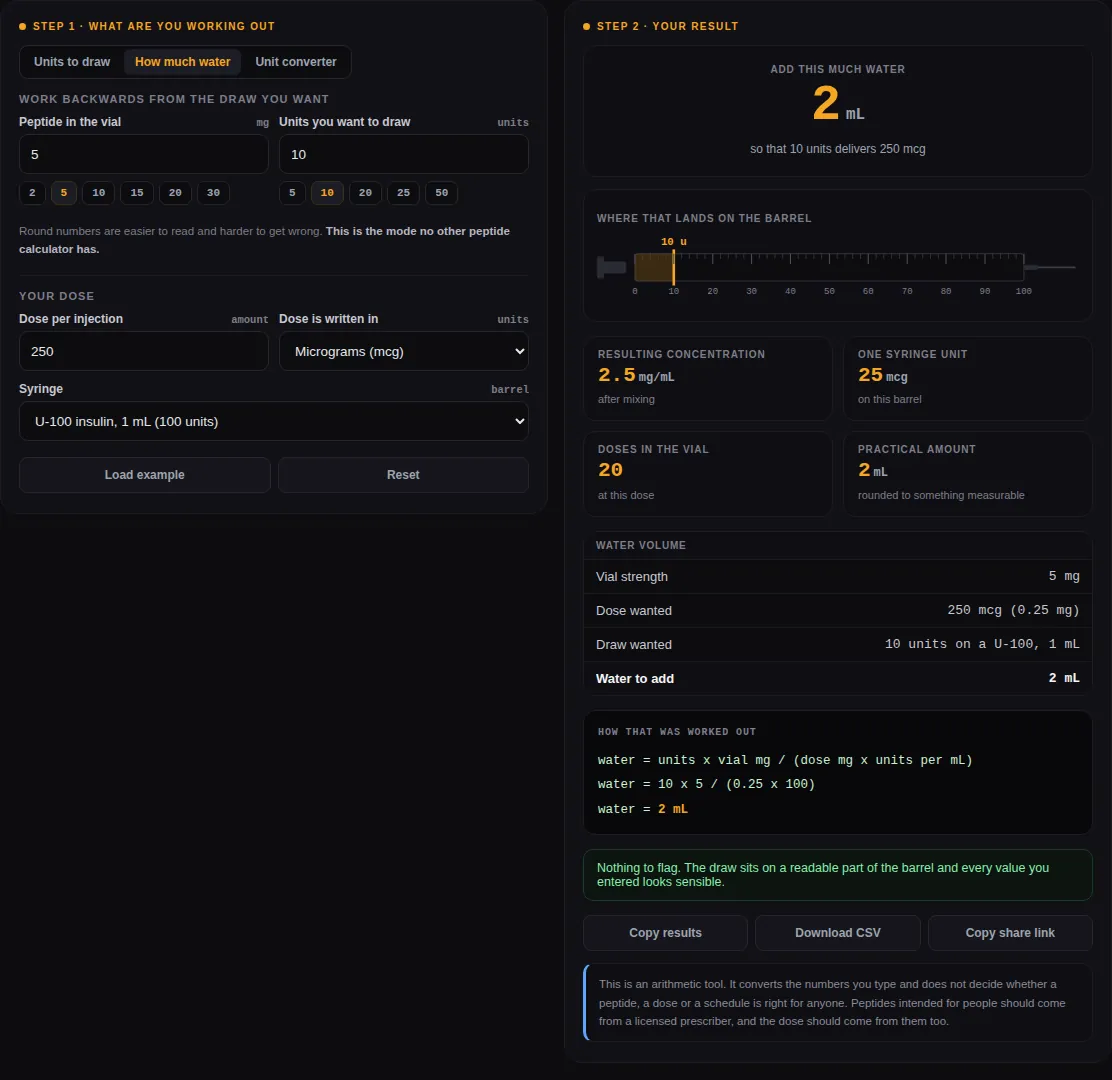
How much the vial can actually hold
Arithmetic will happily tell you to add 8 mL to a vial that holds 3. Most peptide vials are small, so check the glass before you commit, and take the warning seriously when the number climbs past what a normal vial takes.
How to reconstitute a peptide vial
Reconstituting means turning the freeze dried powder back into a liquid. The calculator handles the arithmetic of it, but the handling matters just as much.
- Aim the water at the wall of the vial, not straight down onto the powder.
- Let it sit, then roll or swirl the vial gently until the liquid is clear.
- Do not shake it. Shaking means shear and foam, and peptides are more fragile than a glass vial makes them look.
- Measure the water properly. Drawing it with the same syringe you inject with is the easiest way, since 1 mL is 100 units on the same scale.
- Stop if it stays cloudy. Visible particles after the powder has had time to dissolve mean something is wrong.
Bacteriostatic water, sterile water and saline
Bacteriostatic water is sterile water with about 0.9 percent benzyl alcohol in it. The benzyl alcohol is a preservative, and it is the reason a vial can be entered more than once across days or weeks. Plain sterile water and saline have no preservative, which makes them single use in practice. If your vial is going to supply more than one injection, that difference is the whole point.
What the numbers assume
That the water you typed is the water that went in, and that the vial contains what the label says. Neither is checked, and neither can be. Add 2.5 mL when you meant 2 mL and every figure on this page is twenty percent out with nothing to indicate it.
Converting mcg, mg and IU
One milligram is one thousand micrograms. Doses come in micrograms, vials come in milligrams, so almost every calculation crosses that line once. It is also where the worst mistakes happen, because the two are a thousand apart and 250 of one looks a lot like 250 of the other on a screen.
Why IU is different
An international unit measures biological activity, not weight. The conversion is set separately for each substance against its own reference standard, so there is no general IU to mg factor for peptides. The figure you see quoted everywhere, 3 IU per milligram, belongs to somatropin. It is the standard reference value on approved somatropin labels and it does not transfer to anything else. The converter uses it and says so on screen rather than letting you assume it is universal.
| From | To | How |
|---|---|---|
| mcg | mg | divide by 1,000 |
| mg | mcg | multiply by 1,000 |
| mL | units, U-100 | multiply by 100 |
| units, U-100 | mL | divide by 100 |
| mL | units, U-40 | multiply by 40 |
| mg somatropin | IU | multiply by 3 |
| IU somatropin | mg | divide by 3 |
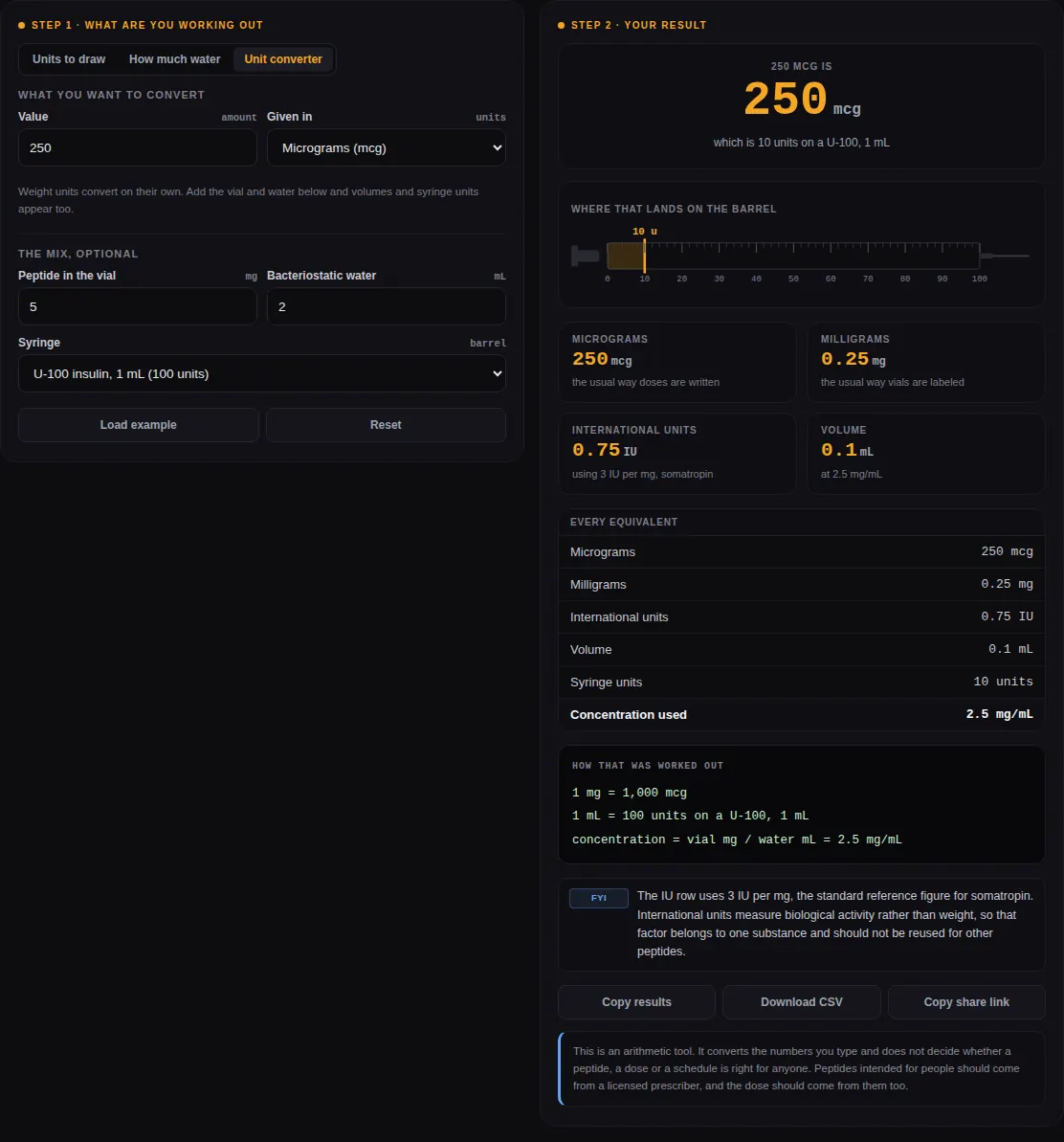
Concentration and units by vial size
Common combinations on a U-100 barrel, for when you want to check a number without opening the tool.
| Vial | Water | Concentration | One unit holds |
|---|---|---|---|
| 2 mg | 1 mL | 2 mg/mL | 20 mcg |
| 2 mg | 2 mL | 1 mg/mL | 10 mcg |
| 5 mg | 1 mL | 5 mg/mL | 50 mcg |
| 5 mg | 2 mL | 2.5 mg/mL | 25 mcg |
| 5 mg | 3 mL | 1.667 mg/mL | 16.7 mcg |
| 5 mg | 5 mL | 1 mg/mL | 10 mcg |
| 10 mg | 1 mL | 10 mg/mL | 100 mcg |
| 10 mg | 2 mL | 5 mg/mL | 50 mcg |
| 10 mg | 3 mL | 3.333 mg/mL | 33.3 mcg |
| 10 mg | 5 mL | 2 mg/mL | 20 mcg |
| 15 mg | 3 mL | 5 mg/mL | 50 mcg |
| 20 mg | 2 mL | 10 mg/mL | 100 mcg |
| 20 mg | 5 mL | 4 mg/mL | 40 mcg |
| 30 mg | 3 mL | 10 mg/mL | 100 mcg |
| 30 mg | 5 mL | 6 mg/mL | 60 mcg |
Find your row, read the last column, then divide your dose in micrograms by it. A 250 mcg dose from a 5 mg vial in 2 mL is 250 divided by 25, so 10 units.
Why the draw sometimes comes out unusable
The same 250 mcg dose, across different vials and water volumes:
| Vial and water | Draw | Doses per vial | Workable? |
|---|---|---|---|
| 2 mg in 1 mL | 12.5 units | 8 | Yes |
| 5 mg in 2 mL | 10 units | 20 | Yes |
| 5 mg in 3 mL | 15 units | 20 | Yes |
| 10 mg in 2 mL | 5 units | 40 | Borderline |
| 20 mg in 2 mL | 2.5 units | 80 | No |
| 30 mg in 2 mL | 1.67 units | 120 | No |
The bottom two rows are the argument for adding more water, not less.
What the calculator checks for you
Getting the arithmetic right is the easy part. A calculator that returns a confident wrong number is worse than no calculator, so this one watches for six things and says something when it sees them.
- A dose in milligrams that should have been micrograms. If the dose you typed is larger than most whole vials, or larger than the vial you entered, it says so instead of quietly asking you to draw 100 mL.
- A U-40 syringe. Selecting it always produces a warning, because almost every instruction out there assumes U-100.
- A draw too small to measure. Under two units is flagged firmly, under five as worth reconsidering, and both point at the fix.
- A draw that misses the marks. If the answer is 6.7 units it names the nearest printed mark on your barrel and suggests changing the water instead of guessing.
- A water volume the vial cannot hold. Correct arithmetic, useless in the hand.
- IU treated as universal. Choosing IU brings up a note about which substance the factor belongs to.
Storing a reconstituted vial
Powder is the stable form, which is why peptides ship that way, and the storage instructions for the powder come from whoever supplied it. Once it is in solution it starts to degrade. Refrigeration is the norm, light and heat are not friendly, and freezing a mixed vial is generally discouraged because freeze and thaw cycles do damage of their own.
How long a particular peptide lasts once mixed varies by peptide and by supplier, so there is no figure quoted here rather than one invented to look authoritative. It is worth thinking about before you mix, though: if the vial holds eighty doses and you inject twice a week, that is most of a year, and no solution stays good that long. Sometimes the right answer is a smaller vial.
What this calculator will not do
It does not pick a dose
There is no table here telling you how many micrograms of anything to take. That is deliberate. The right dose depends on why you are taking something, your health, what else you take and what is actually in the vial, and a web page knows none of that.
It cannot see inside the vial
The arithmetic trusts the label. If the vial holds less than it claims, or something other than what it claims, no calculation will reveal that. Products sold for research use are not made to the standards that apply to medicines, and a perfect calculation on a wrong label is still wrong.
It is not medical advice
It converts numbers and warns you when a combination looks unsafe to measure. Anything meant to go into a person should come from a licensed prescriber, and so should the dose and the schedule.
Related calculators on Calcxi
Health & Fitness calculators
The rest of the health and fitness set, including body composition and nutrition tools.
All Calcxi calculators
Every category in one place, from construction and finance to mathematics.
Peptide calculator FAQs
How do you calculate a peptide dose?
Divide the milligrams in the vial by the milliliters of bacteriostatic water to get the concentration. Divide your dose in milligrams by that concentration to get a volume in milliliters. Multiply by 100 for a U-100 syringe. A 5 mg vial in 2 mL of water gives 2.5 mg/mL, so a 250 mcg dose is 0.1 mL, which is 10 units.
How many units is 250 mcg on an insulin syringe?
There is no single answer, because it depends on the concentration. From a 5 mg vial mixed with 2 mL of water, 250 mcg is 10 units. From the same vial mixed with 3 mL, the same 250 mcg is 15 units. Identical dose, different volume.
How much bacteriostatic water should I add to a 5 mg vial?
Whatever puts your dose on a mark you can read. With 2 mL the concentration is 2.5 mg/mL and one unit carries 25 mcg. With 1 mL each unit carries 50 mcg and the draw halves. If you want a specific number of units, the second mode of the calculator works out the water for you.
Does adding more water change my dose?
No. The vial holds the same peptide whatever you add. More water spreads it through a larger volume, so the dose occupies more milliliters and sits further up the syringe. The amount going into you is unchanged, and so is the number of doses in the vial.
What is the difference between a U-100 and a U-40 syringe?
A U-100 has 100 units per milliliter, so one unit is 0.01 mL. A U-40 has 40 units per milliliter, so one unit is 0.025 mL. Following a U-100 instruction on a U-40 barrel means drawing two and a half times the intended volume. Check the printing on the barrel.
How do I convert mcg to mg?
Divide by 1,000. So 250 mcg is 0.25 mg, 500 mcg is 0.5 mg, 1,000 mcg is 1 mg. Multiply by 1,000 to go the other way.
How do I convert mg to IU?
Only with a factor specific to the substance, because an international unit measures activity rather than weight. For somatropin the standard reference figure is 3 IU per milligram, so 1 mg is 3 IU and 1 IU is about 0.33 mg. That factor is somatropin's own and does not apply to peptides generally.
What does reconstitution mean?
Turning freeze dried powder back into a liquid by adding a sterile diluent, usually bacteriostatic water. Until a vial is reconstituted there is nothing to measure and nothing to draw.
Can I use sterile water or saline instead of bacteriostatic water?
They differ in one respect that matters. Bacteriostatic water contains about 0.9 percent benzyl alcohol as a preservative, which is what lets a vial be entered repeatedly over days or weeks. Sterile water and saline have no preservative, so in practice they are single use. Which one is appropriate is a question for whoever prescribed or supplied the peptide.
How many doses are in my vial?
Divide the milligrams in the vial by your dose in milligrams. A 5 mg vial at 250 mcg a dose gives 20, because 250 mcg is 0.25 mg and 5 divided by 0.25 is 20. The water volume makes no difference to this.
What if the number of units is not a whole number?
Either use a barrel with finer markings, since many 0.3 mL syringes are printed in half units, or change the water volume so the dose lands on a whole number. The second mode exists for that, and either way the tool names the nearest printed mark on the barrel you selected.
How long does a reconstituted peptide last?
It varies by peptide and by supplier, so no single figure applies. Once in solution it begins to degrade, refrigeration is standard, and repeated freezing and thawing is discouraged. Go by the storage guidance that came with your product rather than a general rule found online.
Is this peptide calculator free?
Yes, with no sign up and no limit. It runs in your browser, so the numbers you type stay on your device. Use the copy, CSV or share link buttons if you want to keep a result.
Is this peptide calculator medical advice?
No. It converts the numbers you enter and warns you when something looks unsafe to measure. It does not choose a dose, confirm that a peptide is right for you, or replace a prescriber.
General education, not medical advice. The arithmetic is exact, but a correct calculation on the wrong label, the wrong syringe or the wrong dose is still wrong. Anything intended for use in a person should come from a licensed prescriber, and so should the dose and the schedule.

Written & verified by
B.Tech Computer Science · 8 years in web development & SEO · Bhilwara, India
About ·
LinkedIn ·
Report an error