
Running Pace Calculator
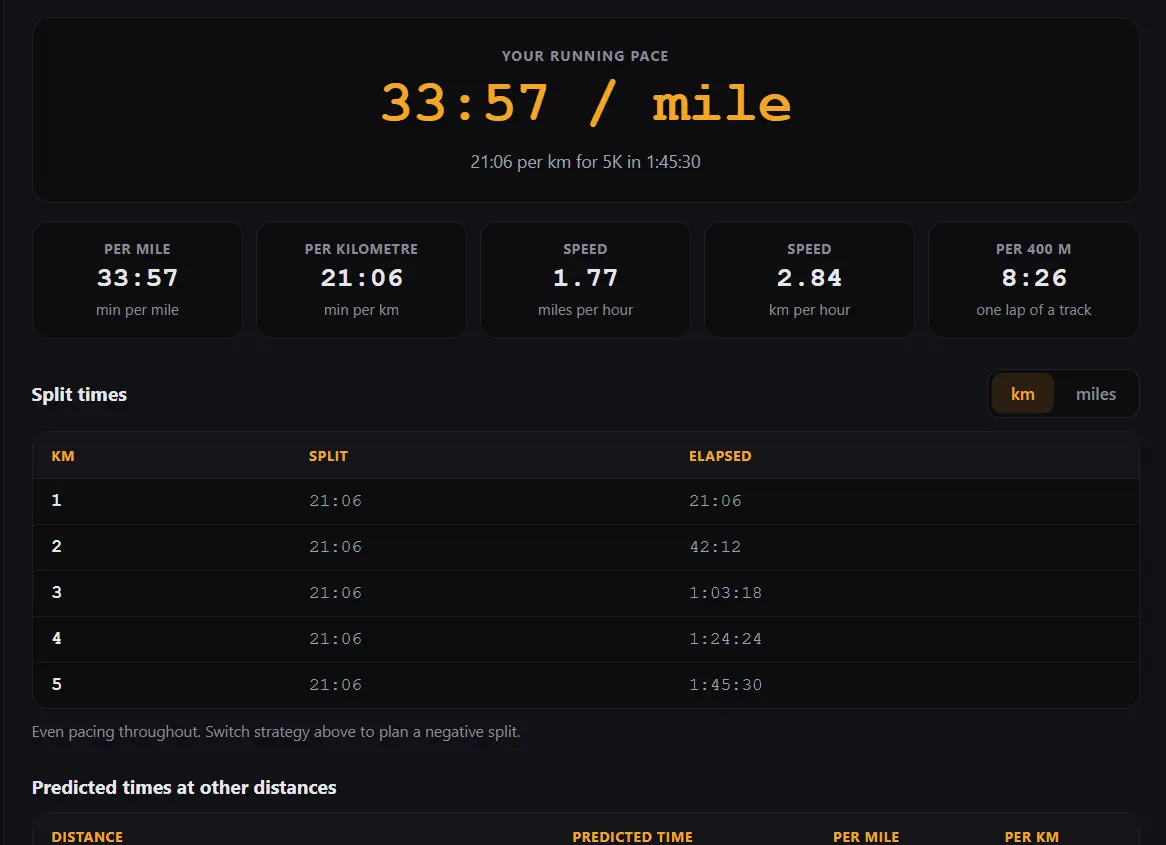
Work out your running pace, finish time or distance from any two of the three. Results come back in minutes per mile and minutes per kilometre at the same time, with a full split table and predicted times at other race distances.
Type 45 for 45 minutes, 45:00 for 45 minutes, or 1:45:30 for one hour 45 minutes 30 seconds.
Leave this empty if you want the calculator to tell you what pace you need.
| Km | Split | Elapsed |
|---|
| Distance | Predicted time | Per mile | Per km |
|---|
Riegel's formula, from the effort you entered. It assumes you are trained for the distance you are predicting, which is the assumption it most often gets wrong.
Magic Mile: predict race pace from one hard mile
Run one mile as hard as you can hold evenly, then enter the time. The multipliers are Jeff Galloway's published ones.
| Race | Pace per mile | Pace per km | Finish time |
|---|
How to use this running pace calculator
A running pace calculator turns any two of distance, time and pace into the third. That is the whole idea. What you do with it depends on which box you leave empty, and the three ways people use it are quite different from each other.
Leave pace blank to find the pace you need
Pick your race distance, type the finish time you are chasing, and the calculator gives you the pace to hold. This is the goal-setting direction, and it is the one most runners want.
Leave time blank to find your finish time
Enter the distance and the pace you can actually sustain, and you get a realistic finish time instead of a hopeful one. Useful when you already know what a comfortable mile feels like.
Leave distance blank to find how far you went
If you ran for a set time at a known pace, this tells you the distance. It answers questions like how many miles you cover in an hour, or in forty minutes.
Every result comes back in minutes per mile and minutes per kilometre at the same time, plus miles per hour and kilometres per hour for treadmill work, plus a 400 metre lap time for track sessions. You never have to pick a unit system and then convert by hand.
How running pace is calculated
Pace is simply time divided by distance, expressed as how long one unit of distance takes. Speed is the same relationship the other way up, distance divided by time. Both describe the identical run.
Pace per mile = Total time in seconds ÷ Distance in miles
Pace per kilometre = Total time in seconds ÷ Distance in kilometres
A worked example. A four hour marathon covers 42.195 km, which is 26.22 miles. Four hours is 14,400 seconds. Divide by 26.22 and you get 549 seconds per mile, which is 9:09 per mile. Divide 14,400 by 42.195 instead and you get 341 seconds, or 5:41 per kilometre. Both are the same run described in different units.
Two details make this less tidy in practice than it looks. First, the mile is defined as exactly 1,609.344 metres, so a marathon is 26.2188 miles rather than a round 26.2, and rounding early moves your pace by a couple of seconds. This calculator does all the arithmetic in metres per second and rounds only at the very end. Second, the official marathon distance has been 42.195 km since it was standardised in 1921, and the half marathon is exactly half that at 21.0975 km, so those are the figures used here rather than approximations.
Marathon pace chart
This marathon pace chart shows the pace you need to hold for common finish time targets, in both units, with the halfway split you should hit if you are running even splits. Find your goal in the left column and the rest of the row is your race plan.
| Marathon finish time | Per mile | Per km | Halfway split |
|---|---|---|---|
| 2:30:00 | 5:43 | 3:33 | 1:15:00 |
| 2:45:00 | 6:18 | 3:55 | 1:22:30 |
| 3:00:00 | 6:52 | 4:16 | 1:30:00 |
| 3:15:00 | 7:26 | 4:37 | 1:37:30 |
| 3:30:00 | 8:01 | 4:59 | 1:45:00 |
| 3:45:00 | 8:35 | 5:20 | 1:52:30 |
| 4:00:00 | 9:09 | 5:41 | 2:00:00 |
| 4:15:00 | 9:44 | 6:03 | 2:07:30 |
| 4:30:00 | 10:18 | 6:24 | 2:15:00 |
| 4:45:00 | 10:52 | 6:45 | 2:22:30 |
| 5:00:00 | 11:27 | 7:07 | 2:30:00 |
| 5:15:00 | 12:01 | 7:28 | 2:37:30 |
| 5:30:00 | 12:35 | 7:49 | 2:45:00 |
| 6:00:00 | 13:44 | 8:32 | 3:00:00 |
| 6:30:00 | 14:52 | 9:15 | 3:15:00 |
Two of these come up constantly. A four hour marathon needs 9:09 per mile or 5:41 per kilometre. A 3:30 marathon needs 8:01 per mile or 4:59 per kilometre, which is why so many training plans talk about breaking five minutes per kilometre. At the sharp end, a two hour marathon requires 4:35 per mile held for the whole distance.
Half marathon pace chart
The same idea over 21.0975 km. Half marathon pace is usually a little quicker per mile than marathon pace for the same runner, because the distance is short enough to hold a harder effort.
| Half marathon finish time | Per mile | Per km | Halfway split |
|---|---|---|---|
| 1:20:00 | 6:06 | 3:48 | 40:00 |
| 1:30:00 | 6:52 | 4:16 | 45:00 |
| 1:40:00 | 7:38 | 4:44 | 50:00 |
| 1:45:00 | 8:01 | 4:59 | 52:30 |
| 1:50:00 | 8:23 | 5:13 | 55:00 |
| 2:00:00 | 9:09 | 5:41 | 1:00:00 |
| 2:10:00 | 9:55 | 6:10 | 1:05:00 |
| 2:15:00 | 10:18 | 6:24 | 1:07:30 |
| 2:20:00 | 10:41 | 6:38 | 1:10:00 |
| 2:30:00 | 11:27 | 7:07 | 1:15:00 |
| 2:40:00 | 12:12 | 7:35 | 1:20:00 |
| 2:50:00 | 12:58 | 8:03 | 1:25:00 |
| 3:00:00 | 13:44 | 8:32 | 1:30:00 |
A two hour half marathon works out at 9:09 per mile, exactly the same pace as a four hour marathon. That is not a coincidence: the marathon is twice the distance and four hours is twice two hours, so the pace has to match. It is also a useful sanity check on any goal. If holding 9:09 for thirteen miles feels like a hard race day effort, a four hour marathon at that same pace is probably not realistic yet.
10K and 5K pace charts
Shorter races are where pace discipline matters most, because there is no time to recover from going out too hard. These two charts cover the usual range of finish times.
10K pace chart
| 10K finish time | Per mile | Per km | 5K split |
|---|---|---|---|
| 35:00 | 5:38 | 3:30 | 17:30 |
| 40:00 | 6:26 | 4:00 | 20:00 |
| 45:00 | 7:15 | 4:30 | 22:30 |
| 50:00 | 8:03 | 5:00 | 25:00 |
| 55:00 | 8:51 | 5:30 | 27:30 |
| 1:00:00 | 9:39 | 6:00 | 30:00 |
| 1:05:00 | 10:28 | 6:30 | 32:30 |
| 1:10:00 | 11:16 | 7:00 | 35:00 |
| 1:15:00 | 12:04 | 7:30 | 37:30 |
| 1:20:00 | 12:52 | 8:00 | 40:00 |
5K pace chart
| 5K finish time | Per mile | Per km | 2.5K split |
|---|---|---|---|
| 17:30 | 5:38 | 3:30 | 8:45 |
| 20:00 | 6:26 | 4:00 | 10:00 |
| 22:30 | 7:15 | 4:30 | 11:15 |
| 25:00 | 8:03 | 5:00 | 12:30 |
| 27:30 | 8:51 | 5:30 | 13:45 |
| 30:00 | 9:39 | 6:00 | 15:00 |
| 32:30 | 10:28 | 6:30 | 16:15 |
| 35:00 | 11:16 | 7:00 | 17:30 |
| 37:30 | 12:04 | 7:30 | 18:45 |
| 40:00 | 12:52 | 8:00 | 20:00 |
A fifty minute 10K is 8:03 per mile or 5:00 per kilometre. A thirty minute 5K is 9:39 per mile or 6:00 per kilometre. Those two round kilometre numbers, five minutes and six minutes, are the mental anchors most runners outside the United States actually use.
Race pace calculator: predicting your times at other distances
If you know one recent race result, you can estimate what you would run at other distances. The standard method is Riegel's formula, published by Peter Riegel in American Scientist in 1981:
What the 1.06 exponent actually means
If pace held perfectly steady as distance grew, the exponent would be 1.0 and doubling the distance would exactly double your time. It does not. The 1.06 exponent says that doubling the distance multiplies your time by about 2.085, so you lose roughly four percent of pace each time the distance doubles. That single number is the entire model of human endurance decline in this formula.
A worked race prediction
Take a 25:00 5K. Feeding that into the formula gives these predictions:
| Distance | Predicted time | Per mile | Per km |
|---|---|---|---|
| 10K | 52:07 | 8:23 | 5:13 |
| Half marathon | 1:55:00 | 8:46 | 5:27 |
| Marathon | 3:59:47 | 9:09 | 5:41 |
Where race predictions go wrong
Riegel himself scoped the formula to efforts lasting roughly 3.5 to 230 minutes, which covers about 1500 metres up to the marathon. Outside that window it drifts. The calculator above flags any prediction that falls outside the range rather than presenting it as if it were as reliable as the rest.
The bigger limitation is not mathematical. The formula assumes you are equally well trained for every distance it predicts. A runner who races 5K every weekend and has never run beyond ten miles will not hit the marathon time it produces, because the prediction describes a version of them that did the long runs. Treat a marathon predicted from a 5K as a ceiling, not a target.
The Magic Mile: predicting race pace from one hard mile
The Magic Mile is Jeff Galloway's field test. You warm up, run one mile as hard as you can hold evenly, and then apply his published conversions to get your race paces. It is the cheapest fitness test in running: no lab, no race entry, about fifteen minutes including the warm up.
How the Magic Mile conversions work
Galloway's conversions are applied to the mile time to give a race pace per mile. For a 5K you add 33 seconds. For everything else you multiply: 1.15 for a 10K, 1.175 for ten miles, 1.2 for a half marathon and 1.3 for a marathon.
| Magic Mile | 5K pace | 10K pace | Half pace | Marathon pace | Marathon time |
|---|---|---|---|---|---|
| 7:00 | 7:33 | 8:03 | 8:24 | 9:06 | 3:58:35 |
| 8:00 | 8:33 | 9:12 | 9:36 | 10:24 | 4:32:41 |
| 9:00 | 9:33 | 10:21 | 10:48 | 11:42 | 5:06:46 |
| 10:00 | 10:33 | 11:30 | 12:00 | 13:00 | 5:40:51 |
| 11:00 | 11:33 | 12:39 | 13:12 | 14:18 | 6:14:56 |
| 12:00 | 12:33 | 13:48 | 14:24 | 15:36 | 6:49:01 |
Magic Mile compared with Riegel
The two methods answer the same question from different data. Riegel needs a recent race at a real distance and extrapolates from it. The Magic Mile needs only a mile, which almost anyone can do on a track next week, but it is calibrated for Galloway's run walk approach and it assumes cool conditions, around 60°F or below. Where they disagree, trust the one built on the effort closest in length to the race you are planning.
Pace, speed and distance conversions
Half the questions people bring to a running pace calculator are really unit conversions. These two tables answer the common ones without any input at all.
Race distances in kilometres and miles
| Race | Kilometres | Miles |
|---|---|---|
| 3K | 3 km | 1.86 miles |
| 5K | 5 km | 3.11 miles |
| 8K | 8 km | 4.97 miles |
| 10K | 10 km | 6.21 miles |
| 12K | 12 km | 7.46 miles |
| 15K | 15 km | 9.32 miles |
| 20K | 20 km | 12.43 miles |
| Half marathon | 21.0975 km | 13.11 miles |
| 25K | 25 km | 15.53 miles |
| 30K | 30 km | 18.64 miles |
| Marathon | 42.195 km | 26.22 miles |
| 50K | 50 km | 31.07 miles |
The two that get searched most are the 8K, which is 4.97 miles, and the 3K, which is 1.86 miles. Both are close enough to five miles and two miles that people assume they are the same and then wonder why their pace maths does not work out.
Treadmill speed to running pace
Treadmills show speed, races are run at a pace, and the two are the same thing expressed differently. This table converts between them, including how far you cover in one hour at each setting.
| Speed | Per mile | Speed | Per km | Miles in one hour |
|---|---|---|---|---|
| 4 mph | 15:00 | 6.4 km/h | 9:19 | 4.00 |
| 5 mph | 12:00 | 8.0 km/h | 7:27 | 5.00 |
| 6 mph | 10:00 | 9.7 km/h | 6:13 | 6.00 |
| 7 mph | 8:34 | 11.3 km/h | 5:20 | 7.00 |
| 8 mph | 7:30 | 12.9 km/h | 4:40 | 8.00 |
| 9 mph | 6:40 | 14.5 km/h | 4:09 | 9.00 |
| 10 mph | 6:00 | 16.1 km/h | 3:44 | 10.00 |
| 11 mph | 5:27 | 17.7 km/h | 3:23 | 11.00 |
| 12 mph | 5:00 | 19.3 km/h | 3:06 | 12.00 |
So 5 mph is a 12:00 mile, and 7 mph is an 8:34 mile or 5:20 per kilometre. One caveat that most treadmill charts skip: a treadmill belt moves under you and there is no air resistance, so the same displayed speed is slightly easier than running that pace outdoors. Setting the incline to one percent is the usual correction for that difference.
What is a good running pace?
There is no single good running pace, and any page that gives you one number is guessing. Pace depends on age, training history, body size, terrain, heat, altitude and what the run is for. A pace that is a comfortable warm up for one runner is a hard race effort for another, and both are correct.
A more useful question is whether your pace matches the purpose of the run. That has an answer you can check without any data at all.
Easy runs
You can hold a full conversation in complete sentences. If you cannot, you are running your easy days too fast, which is the most common pacing mistake in distance running.
Tempo or threshold
Short sentences only, breathing clearly audible, sustainable for around an hour if you had to. Often close to your half marathon race pace.
Race pace
A few words at a time. For most people this sits somewhere between their 10K and marathon pace depending on the event, and the charts above turn it into a number.
Intervals
Talking is not happening. Held for minutes, not hours, with recovery between. Pace here is set by the session, not by a target finish time.
If you want a concrete benchmark rather than a feeling, use the charts on this page in reverse. Pick a finish time that would genuinely please you, read off the pace, then go and run one mile at it. Whether that mile felt like a jog or like a race tells you more about whether the goal is right than any average pace figure could.
Even splits, negative splits and how to pace a race
The split table in the calculator above defaults to even pacing, where every kilometre or mile takes the same time. You can switch it to a negative split, where the second half is deliberately run quicker than the first. The total time stays identical either way, which is the point: it is the same race, distributed differently.
Why the second half is the one that decides your time
Almost every finish time that disappoints its owner was lost in the second half, not the first. Going out thirty seconds a mile too quick feels effortless for four miles and costs several minutes over the last six. A negative split plan protects against that by making the first half feel slightly too easy on purpose.
How much of a negative split is realistic
One to three percent is a reasonable planning range, which is what the calculator offers. On a 4:00 marathon plan, a two percent negative split means starting at 9:15 per mile instead of 9:09 and finishing at 9:04. Those are small enough numbers to actually execute. Plans that call for a ten percent negative split usually just mean the first half was run too slowly.
When even splits are the better plan
On a flat course in cool weather, even pacing is hard to beat and much easier to hold. Save the negative split plan for a hot day, a hilly first half, or a distance you have not raced before, where starting conservatively buys you information about how the day is going.
When a pace calculator gets it wrong
A running pace calculator does exact arithmetic on the numbers you give it. It knows nothing about the day you will actually have. These are the factors that move real finish times away from the calculated one.
Heat and humidity
Warm, humid conditions slow distance runners noticeably, and the effect grows with race length. A marathon target set in winter often needs revising on a warm race morning.
Hills
Time lost climbing is not fully recovered descending. A hilly course is slower than a flat one at the same effort, so pace per mile is the wrong thing to hold on rolling terrain.
Altitude
Less oxygen available means slower paces at the same effort for anyone not acclimatised. Sea level paces do not transfer to a race in the mountains.
GPS drift
Watches under trees, between tall buildings or on winding trails can misread distance, which makes the pace it shows you wrong in the same proportion.
Running the tangents
Courses are measured along the shortest legal line. Running wide on bends means covering more than the official distance, so your watch pace can be right while your finish time is slower than planned.
Training for the distance
Predicted times assume appropriate training. This is the assumption that fails most often, and it fails hardest at marathon distance.
Running pace calculator FAQ
How do I calculate my running pace?
Divide your total time by the distance you covered. For pace per mile, divide the time in seconds by the distance in miles; for pace per kilometre, divide by the distance in kilometres. A 30 minute 5K is 1,800 seconds divided by 5 km, which is 360 seconds or 6:00 per kilometre. The running pace calculator on this page does the same arithmetic and gives you both units at once.
What pace is a 4 hour marathon?
A 4 hour marathon is 9:09 per mile or 5:41 per kilometre, held for the full 42.195 km. The halfway split is 2:00:00. That pace is the same one needed for a two hour half marathon, which makes a half marathon a useful test of whether the marathon goal is realistic.
What pace is a 2 hour marathon?
A 2 hour marathon requires 4:35 per mile or 2:51 per kilometre for the entire distance. That is elite territory and has only been achieved in exhibition conditions rather than an officially ratified race.
What pace is a 3:30 marathon?
A 3:30 marathon needs 8:01 per mile or 4:59 per kilometre, with a 1:45:00 halfway split. Because it sits just under five minutes per kilometre, it is one of the most common goal times outside the United States.
What is a good running pace?
There is no universal good running pace, because it depends on age, training, terrain and conditions. A better test is whether the pace suits the purpose of the run: you should be able to talk in full sentences on an easy run, in short sentences at tempo, and only a few words at race pace. Use the pace charts above to convert a goal finish time into the number you need.
How many miles is an 8K?
An 8K is 4.97 miles, since one mile is exactly 1,609.344 metres. A 3K is 1.86 miles, a 5K is 3.11 miles and a 10K is 6.21 miles. The conversion table above lists every standard road distance in both units.
What pace is 7 mph on a treadmill?
7 mph is an 8:34 mile, or 5:20 per kilometre, and covers 7 miles in an hour. For comparison, 5 mph is a 12:00 mile and 10 mph is a 6:00 mile. Because a treadmill belt removes air resistance, many runners set a one percent incline so the effort matches the same pace run outdoors.
How long will it take me to run a half marathon?
Multiply your sustainable pace by 13.11 miles or 21.0975 km. At 10:00 per mile a half marathon takes about 2:11, and at 9:09 per mile it takes 2:00:00. If you have a recent race at another distance, the race prediction table in the calculator gives a better answer than guessing from training pace.
What is a pace run?
A pace run is a training session run at your goal race pace rather than at easy effort. The point is rehearsal: it teaches you what the pace feels like so you do not have to guess on race day, and it shows you honestly whether the goal is currently within reach.
What is the Magic Mile?
The Magic Mile is Jeff Galloway's one mile time trial used to predict race paces. You run one mile as hard as you can hold evenly, then add 33 seconds for 5K pace, or multiply by 1.15 for 10K, 1.2 for a half marathon and 1.3 for a marathon. The Magic Mile section of this running pace calculator does those conversions for you.
How accurate is a race pace calculator?
The arithmetic is exact, but the predictions are estimates. Riegel's formula was scoped to efforts of roughly 3.5 to 230 minutes and assumes you are trained for the distance being predicted. Heat, hills, altitude and inadequate long runs all push real finish times slower than the prediction, and the marathon is where the gap is usually widest.
Does this running pace calculator work in kilometres and miles?
Yes. Every result is shown in minutes per mile and minutes per kilometre at the same time, along with miles per hour, kilometres per hour and a 400 metre lap time. You can enter a custom distance in kilometres, miles, metres or yards, and the split table can be switched between kilometre and mile splits.
Sources and limits
The race prediction model is Peter Riegel's endurance formula, published in American Scientist in 1981, using the 1.06 exponent and the stated validity window of roughly 3.5 to 230 minutes. The Magic Mile conversions are the ones published on Jeff Galloway's own site. Official race distances follow World Athletics, which puts the marathon at 42.195 km, standardised in 1921. The mile and the yard are used at their exact international definitions of 1,609.344 metres and 0.9144 metres.
Everything here is arithmetic and estimation, not coaching advice specific to you. Predicted times assume appropriate training for the distance and reasonable conditions on the day. See our calculator accuracy policy for how these formulas were checked.

Written & verified by
B.Tech Computer Science · 8 years in web development & SEO · Bhilwara, India
About ·
LinkedIn ·
Report an error