
Calcxi · Business
Markup Calculator
Work out your selling price from cost and markup, find the markup percentage hiding in a price you already charge, price a whole job with materials and labour, and convert between markup and margin. Everything runs in your browser and nothing you type is sent anywhere.
Selling price
·
Profit per unit
·
Profit margin
·
Same deal, measured on price
Multiplier
·
Cost times this
Markup
·
Profit per unit
·
Profit margin
·
Multiplier
·
Give each cost line its own markup, then add the overhead your business carries as a percentage of direct cost. This is the part most markup tools leave out, and it is where quotes quietly turn into losses.
Quote total
·
Gross profit
·
Overhead
·
Net profit
·
Type into either box. The other one follows. Markup is measured against your cost, margin against your selling price, which is why the same deal gives two different percentages.
Price multiplier
·
Multiply cost by this to get the price
On a cost of 100
·
Selling price
How to use this markup calculator
Markup is the amount you add to what something costs you in order to arrive at what you charge. This calculator handles it in four directions, because in real pricing you rarely know the same two things twice.
Price from cost and markup
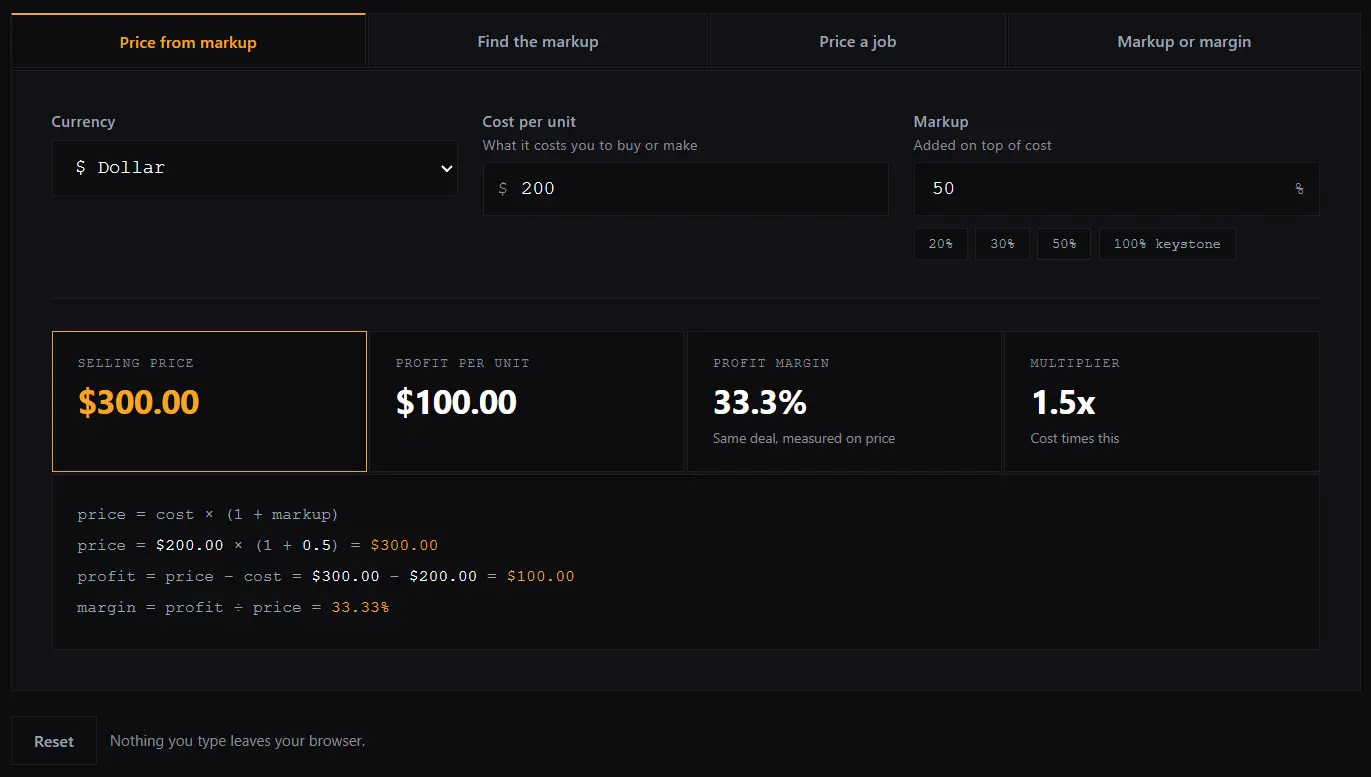
The most common use. Put in what the item costs you and the percentage you want to apply, and it returns the selling price, the profit per unit, the equivalent profit margin and the multiplier. If a widget costs you 100 and you apply a 50% markup, you charge 150, you keep 50, and that same deal is a 33.3% margin.
Find the markup in a price you already charge
Work backwards. Enter your cost and the price on your own price list, and the calculator tells you what markup percentage you have actually been running. Plenty of businesses discover here that a price set years ago on a round number has drifted into a much thinner markup than they assumed.
Price a whole job, not one item
This is the tab most such tools do not have. A quote is usually several cost lines, and they do not all deserve the same markup. Materials you buy and hand over might carry 15%, while your own labour carries considerably more. Give each line its own rate, tell the calculator what overhead your business carries as a percentage of direct cost, and it shows you what you actually keep rather than what the quote total looks like.
Convert markup to margin, or margin to markup
Type into either box and the other follows. A 50% markup is a 33.3% margin, and a 50% margin needs a 100% markup. These two numbers describe the same transaction and are almost never equal, which is the single most expensive confusion in small-business pricing.
What is markup?
The one-sentence definition
Markup is the difference between what something costs you and what you sell it for, expressed as a percentage of the cost. Corporate Finance Institute defines it as "the difference between the selling price of a good or service and its cost", calculated as (Selling Price minus Cost) divided by Cost, times 100.
The word "of the cost" is doing all the work in that sentence. It always measures against cost. Its close cousin, margin, measures the same profit against the selling price instead. Same money, different denominator, different percentage.
Profit, percentage and multiplier are one fact stated three ways
If you buy for 40 and sell for 80, you can describe that transaction as a 40 profit, a 100% uplift, or a 2x multiplier. All three are correct and all three are the same event. Retailers think in multipliers because it is faster in your head. Accountants think in percentages because it compares across products of different sizes. Your pricing spreadsheet should be explicit about which one it is using, because a column headed just "markup" containing the number 2 is genuinely ambiguous.
The markup formula
The percentage formula
The selling price formula
A worked example you can check by hand
Corporate Finance Institute's own example: a product costs 10 and sells for 15. That is (15 minus 10) divided by 10, which is 0.50, or 50%. A second example from the same source: cost 100, price 125, giving 25 divided by 100, or 25%. The gross margin on that identical sale is 25 divided by 125, which is 20%.
Notice what just happened. One transaction, two entirely reasonable percentages, 25% and 20%. Neither is wrong. They answer different questions.
The quick check
It is always the larger of the two numbers on any profitable sale, and the gap widens as you go up. At a 10% markup the margin is 9.1%, barely different. At a 200% markup the margin is 66.7%, a world apart. If someone quotes you 50% and you mentally book a 50% margin, you have overestimated your profit by half.
How to calculate markup, step by step
Step 1: get your cost right first
Everything downstream is built on this number, and it is where most markup calculations go wrong before any arithmetic happens. Your cost is not just the invoice from your supplier. It includes freight in, import duty, payment processing on the purchase, and any preparation or assembly you do before it is sellable. When pricing your own labour, use your fully loaded hourly cost, not your take-home rate.
Step 2: subtract cost from selling price
That difference is your gross profit per unit. If it is negative you are selling below cost, which the calculator shows as a negative figure rather than refusing to answer, because selling at a loss is a real decision people sometimes make deliberately.
Step 3: divide by cost and multiply by 100
Divide the profit by the cost, not by the price. This is the step people get wrong: dividing by the price gives you margin, which is a perfectly good number but a different one.
How to find markup percentage when you only know the price
If you know the cost and the price, you already have everything. Use the second tab. If you know the cost and the margin you want, convert it with the fourth tab first, then apply the result. If you know only the price and the margin, your cost is price times (1 minus margin).
Markup vs margin: the conversion you should memorise
These two get swapped constantly, and unlike most pricing mistakes this one is invisible. Your prices look sensible, your customers do not complain, and your profit is quietly a third smaller than you think.
Markup to margin
| Markup | Margin | Multiplier |
|---|---|---|
| 10% | 9.1% | 1.1x |
| 15% | 13.0% | 1.15x |
| 20% | 16.7% | 1.2x |
| 25% | 20.0% | 1.25x |
| 30% | 23.1% | 1.3x |
| 33.33% | 25.0% | 1.333x |
| 40% | 28.6% | 1.4x |
| 50% | 33.3% | 1.5x |
| 60% | 37.5% | 1.6x |
| 66.67% | 40.0% | 1.667x |
| 75% | 42.9% | 1.75x |
| 100% | 50.0% | 2x |
| 150% | 60.0% | 2.5x |
| 200% | 66.7% | 3x |
| 300% | 75.0% | 4x |
Every row generated by the same engine that powers the calculator above. The 25% markup row matching a 20% margin is the exact pairing Corporate Finance Institute publishes as its worked example.
Margin to markup
| Margin you want | Markup you must apply | Multiplier |
|---|---|---|
| 5% | 5.3% | 1.053x |
| 10% | 11.1% | 1.111x |
| 15% | 17.6% | 1.176x |
| 20% | 25.0% | 1.25x |
| 25% | 33.3% | 1.333x |
| 30% | 42.9% | 1.429x |
| 33.33% | 50.0% | 1.5x |
| 40% | 66.7% | 1.667x |
| 50% | 100.0% | 2x |
| 60% | 150.0% | 2.5x |
| 70% | 233.3% | 3.333x |
| 75% | 300.0% | 4x |
| 80% | 400.0% | 5x |
| 90% | 900.0% | 10x |
Read this table when a supplier, franchise or accountant hands you a target margin and you need the markup to actually hit it.
Why the confusion costs real money
Suppose you need a 40% margin to cover your costs and make the return you want. You apply 40% on cost instead. You have actually delivered a 28.6% margin, and you are short by more than a quarter of the profit you planned for. Do that across a full price list and the gap is not a rounding error, it is the difference between a viable year and a bad one.
If margin is the number you think in, our Profit Margin Calculator starts from that side instead and takes you through gross, operating and net margin for a whole business rather than a single price.
What your markup actually has to cover
Here is the part that most pricing advice skips, and it is the reason profitable-looking businesses run out of money.
It is not your profit
It covers overhead first. Rent, insurance, vehicles, software, the phone, the time you spend quoting work you do not win, the accountant. Only what is left after all of that is profit. A 30% uplift in a business carrying 25% overhead is not a 30% return. It is a 5% one.
The break-even point
If you carry overhead as a percentage of direct cost, there is a clean and slightly alarming rule:
Here is that spelled out on a job with 1,000 of direct cost and overhead running at 25% of cost. Every figure comes from the calculator's job engine.
| Markup | You charge | Gross profit | Overhead | Net profit | Result |
|---|---|---|---|---|---|
| 10% | 1,100.00 | 100.00 | 250.00 | -150.00 | Loss |
| 15% | 1,150.00 | 150.00 | 250.00 | -100.00 | Loss |
| 20% | 1,200.00 | 200.00 | 250.00 | -50.00 | Loss |
| 25% | 1,250.00 | 250.00 | 250.00 | 0.00 | Break-even |
| 30% | 1,300.00 | 300.00 | 250.00 | 50.00 | Profit |
| 40% | 1,400.00 | 400.00 | 250.00 | 150.00 | Profit |
| 50% | 1,500.00 | 500.00 | 250.00 | 250.00 | Profit |
The 25% row is not a typo. Markup equal to your overhead rate is break-even, not profit. Anything below it is a job you paid to do.
What markup you need for a target net margin
Work in the other direction and the numbers get uncomfortable quickly. To finish with a genuine net margin after overhead, the markup has to carry both.
| Net margin you want | Markup required | You would quote |
|---|---|---|
| 5% | 31.6% | 1,315.79 |
| 10% | 38.9% | 1,388.89 |
| 15% | 47.1% | 1,470.59 |
| 20% | 56.3% | 1,562.50 |
| 25% | 66.7% | 1,666.67 |
| 30% | 78.6% | 1,785.71 |
Same 1,000 of direct cost and 25% overhead. A 20% net margin needs a 56.3% markup, not a 20% one.
Cost-plus pricing and how to choose a markup
Cost-plus pricing
This is the method the calculator implements: establish your cost, apply a percentage, arrive at a price. Its virtue is that it is fast, defensible and hard to get catastrophically wrong. Its weakness is that it knows nothing about what your customer will actually pay, or what your competitor charges.
Keystone pricing, the retail doubling rule
The old retail convention is to double the wholesale cost. In the language of this page that is a 100% markup, a 2x multiplier and a 50% margin. Those three descriptions are the same rule, which you can verify by entering 100% above and watching the margin land on 50%. It survives because it is memorable and because in traditional retail it roughly covered rent, staff, shrinkage and a return. In lower-overhead businesses it is generous, and in high-service ones it is not nearly enough.
Why one rate across everything rarely works
A single blanket rate treats a fast-selling item and a slow one identically, even though the slow one ties up cash for months. It treats a product you drop-ship the same as one you store, insure and handle. And it ignores that some lines are price-visible, where customers know roughly what things cost, while others are not. The job tab lets you set a different rate per line for exactly this reason.
Pricing a job with materials and labour
Different lines deserve different markups
If you quote work rather than sell products off a shelf, your job has several cost lines with genuinely different economics. Materials you order and hand over carry handling risk and cash-flow cost but little skill. Your own labour carries your expertise, your training and your liability. Subcontractors sit somewhere between. A flat 25% across all of it either overcharges for materials or undercharges for skill.
Blended markup is weighted by cost, not averaged
This one catches people out. Take a job with 4,000 of materials at 15% and 1,000 of labour at 60%.
| Cost line | Cost | Markup | Charged |
|---|---|---|---|
| Materials | 4,000.00 | 15% | 4,600.00 |
| Labour | 1,000.00 | 60% | 1,600.00 |
| Total | 5,000.00 | 24.0% | 6,200.00 |
The naive average of 15% and 60% is 37.5%. The real blended markup on that job is 24.0%, because the low-markup line carries four times the cost weight. Quote your next job by averaging your usual rates and you will be wrong every time the mix changes, and you will be wrong in the direction of undercharging whenever materials dominate.
Once you know your blended markup and your fixed costs, the Break-Even Calculator tells you how many of those jobs you need before the business itself is covered.
When markups stack through a supply chain
If a product passes through a manufacturer, a distributor and a retailer, each one applies its own uplift to what it paid, not to the original cost. They compound, they do not add.
| Stage | Pays | Markup | Sells for | Adds |
|---|---|---|---|---|
| Manufacturer to distributor | 100.00 | 40% | 140.00 | 40.00 |
| Distributor to retailer | 140.00 | 40% | 196.00 | 56.00 |
| Retailer to shopper | 196.00 | 40% | 274.40 | 78.40 |
Three 40% markups in sequence on a starting cost of 100.
Adding the stages gives 120%. The actual total markup from original cost to shelf price is 174.4%, a final price of 274.40 on a cost of 100. This is why a modest-looking uplift at each stage produces retail prices that seem wildly disconnected from manufacturing cost, and why cutting one link out of the chain moves the shelf price far more than that link's own percentage would suggest.
What a discount does to your markup
Discounting comes straight out of profit, which means it eats your margin far faster than it reduces the price. Take an item costing 100, marked up 50% to sell at 150.
| Discount | New price | Markup left | Profit | Profit lost |
|---|---|---|---|---|
| 5% | 142.50 | 42.5% | 42.50 | 15% |
| 10% | 135.00 | 35.0% | 35.00 | 30% |
| 15% | 127.50 | 27.5% | 27.50 | 45% |
| 20% | 120.00 | 20.0% | 20.00 | 60% |
| 25% | 112.50 | 12.5% | 12.50 | 75% |
| 30% | 105.00 | 5.0% | 5.00 | 90% |
A 20% discount on a 50% markup destroys 60% of the profit on that sale.
The rule worth carrying around: the thinner your starting position, the more destructive a given discount is. On a 100% markup you can afford a promotion. On a 20% markup a 10% discount removes more than half your profit, and a 20% discount removes all of it and then some.
Where markup calculations go wrong
Using margin when you meant markup
The big one. Every percentage point matters more as the numbers rise, and the error always runs in the direction of you making less than you planned. If you take one thing from this page, take the conversion table.
Marking up an incomplete cost
Freight, duty, payment fees, breakage and the cost of your own time all belong in the cost base before the percentage goes on. Applied to a cost that is missing 12% of the real figure, it comes out 12% too small.
Treating markup as profit
Covered above, and worth repeating because it is the one that closes businesses. Overhead gets paid first.
Averaging markups instead of weighting them
The blended figure is total profit over total cost. It is not the mean of your line rates unless every line happens to cost the same.
Forgetting that markup on a discounted price is not the markup you set
Your price list rate and what you realise are different numbers as soon as you discount, and only the realised one pays your rent. Track what you actually banked, not what you intended to charge.
Assuming a competitor's numbers would work for you
Their overhead is not your overhead, their volume is not your volume, and their cost base is not yours. A rate that is comfortable for a business turning stock over weekly can be fatal for one turning it over quarterly.
Markup calculator FAQ
How do I calculate markup?
Subtract the cost from the selling price, divide the result by the cost, then multiply by 100. If an item costs 80 and sells for 100, that is (100 minus 80) divided by 80, which is 0.25, so 25%. Dividing by the cost rather than the price is what makes it a markup rather than a margin.
What is the markup formula?
The markup formula is (selling price minus cost) divided by cost, multiplied by 100. To go the other way and get a price, the formula is selling price equals cost times (1 plus markup as a decimal). Both are used by the calculator on this page.
What is the difference between markup and margin?
They measure the same profit against different bases. The first divides profit by cost, the second divides profit by selling price. Because the selling price is larger, margin is always the smaller percentage on a profitable sale. A 50% markup is a 33.3% margin. Convert with margin equals markup divided by (1 plus markup).
How do I find markup percentage from cost and selling price?
Use the second tab of the calculator. Enter both figures and it returns the markup percentage, the profit, the equivalent margin and the multiplier. By hand: markup percentage equals (price minus cost) divided by cost times 100.
What is a 25% markup on 100?
It gives a selling price of 125, a profit of 25, and a profit margin of 20%. The multiplier is 1.25. This is the exact pairing Corporate Finance Institute uses to illustrate the difference between markup and margin.
What does a 100% markup mean?
It means you are selling for double what the item cost you, because you have added an amount equal to the full cost on top. That is a 2x multiplier and a 50% profit margin. In retail this doubling is known as keystone pricing.
How do I calculate the selling price from cost and markup?
Multiply the cost by (1 plus the markup as a decimal). A 30% rate on a cost of 60 is 60 times 1.30, which is 78. The first tab does this and also shows the resulting profit and margin.
What is a good markup percentage?
There is no universal figure, and any page quoting one without naming its source is guessing. What can be said precisely is the floor: it must at minimum cover your overhead rate before a single unit of profit appears. If your overhead runs at 25% of direct cost, 25% is break-even. Work out your own overhead rate first, then treat that number as the bottom of the range rather than the target.
Can markup be more than 100%?
Yes, and often is. 300% means selling at four times cost, which is common in software, jewellery, restaurant drinks and anything where the marginal cost is small relative to the value delivered. Margin, by contrast, can never reach 100% while the cost is above zero, which is another way of seeing that the two are different measures.
Can markup be negative?
Yes. A negative figure means you are selling below cost, which happens deliberately with loss leaders and clearance stock, and accidentally more often than most owners realise. The calculator reports them rather than refusing, because knowing how far below cost you are is the useful part.
How do I calculate markup on a job with materials and labour?
Use the job tab. Enter each cost line with its own rate, then add your overhead. The calculator returns the quote total, the blended figure weighted by cost, and the net profit left after overhead. That blended number is total profit divided by total cost, not the average of your line rates.
Does this markup calculator work in any currency?
Yes. It is a ratio, so the mathematics is identical in every currency. The currency selector changes the symbol on the results for readability only. Just keep every figure in one currency, and use pre-tax amounts throughout, since including sales tax or VAT on the price but not the cost inflates the result.
Sources and limits
The markup and margin formulas on this page, and the worked examples used to test them, come from Corporate Finance Institute's markup reference, which states markup as (Selling Price minus Cost) divided by Cost times 100 and publishes the cost 10 / price 15 and cost 100 / price 125 examples this calculator reproduces exactly.
The markup to margin conversion is derived rather than asserted: substituting price equals cost times (1 plus markup) into the margin definition gives margin equals markup divided by (1 plus markup), which is why the tables above and the calculator can never disagree.
What this page deliberately does not give you is a table of average markups by industry. Those figures vary enormously by region, channel, business size and year, and the ones circulating online are mostly uncited. Rather than invent numbers, this calculator gives you the tool to work out the markup your overhead and target return require, which is the number that actually matters.
This calculator handles pre-tax figures. It does not model sales tax, VAT, GST, payment processing fees, returns or currency conversion. Treat the output as a pricing starting point rather than financial advice.
Related calculators

Written & verified by
B.Tech Computer Science · 8 years in web development & SEO · Bhilwara, India
About ·
LinkedIn ·
Report an error