
Profit Margin Calculator
Work out profit margin and markup from any two of revenue, cost and profit. Then see your gross, operating and net margin from one set of accounts, convert between margin and markup, price from a target margin, and find out what a discount really costs you. Any currency.
Materials, direct labour, freight in. Costs tied to making or buying what you sell.
Rent, salaries, marketing, software, insurance.
| Line | Amount | Share of revenue |
|---|
| Discount | New price | New margin | Profit per unit | Volume needed |
|---|
Once the discounted price reaches your cost, no amount of volume recovers the profit. That is the row where the table stops giving you a number.
How to use this profit margin calculator
A profit margin calculator answers a question that sounds simple and is not: what share of the money coming in do you actually keep? The four tabs above answer four different versions of it, and most people need more than one.
Quick margin, for a single product or a single deal
Fill in any two of revenue, cost and profit. You get the third, plus the margin and the markup side by side, because these two numbers describe the same trade and are routinely confused.
Gross, operating and net, for a whole business
Enter one period of your profit and loss and get all three profit margins at once. Almost no calculator does this, and one number called "profit margin" hides more than it reveals.
Price from a target margin
The direction people actually need. Enter your cost and the margin you want, and it tells you what to charge. Getting this backwards is how businesses underprice themselves for years without noticing.
What a discount really costs
A discount does not cost you the discount. It costs you a slice of your margin, and the extra volume needed to recover it grows far faster than the percentage you took off.
The profit margin formula
Profit margin is profit divided by revenue. Everything else on this page is a variation on that one relationship.
Profit margin % = (Revenue − Cost) ÷ Revenue × 100
Markup % = (Revenue − Cost) ÷ Cost × 100
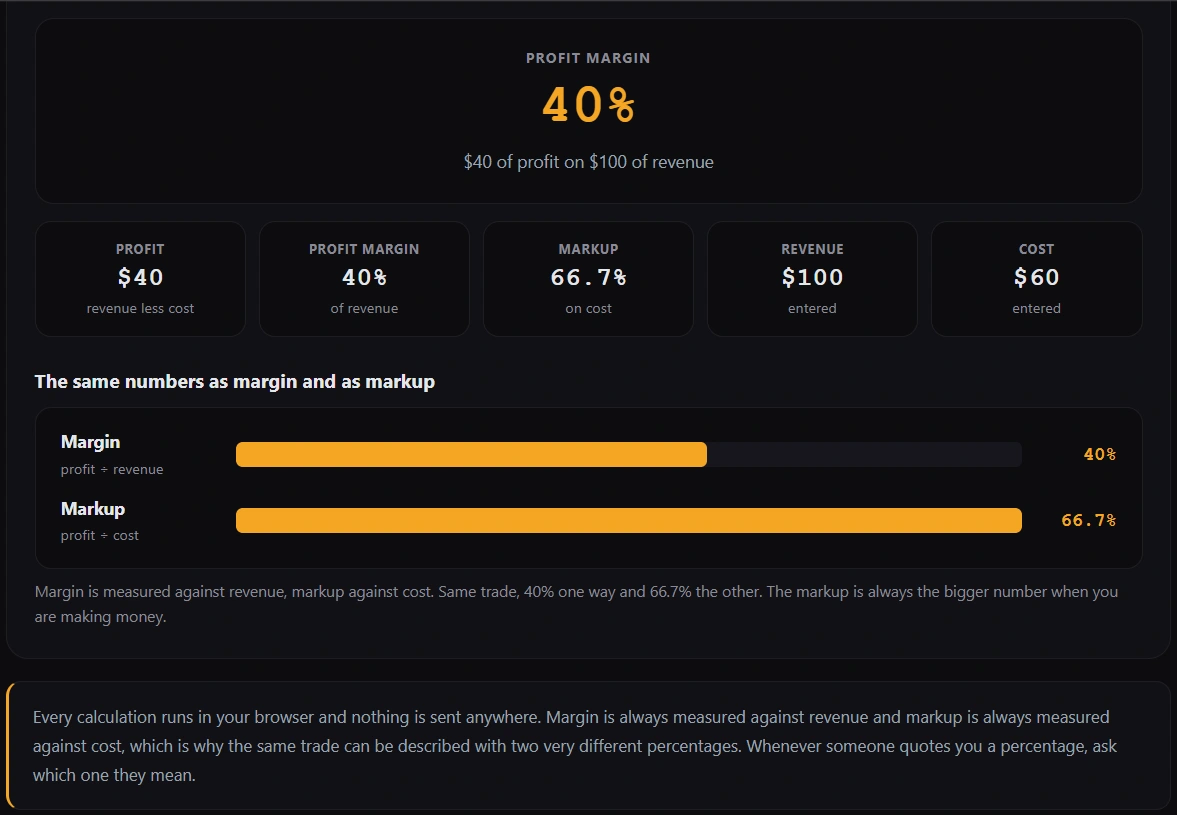
Sell something for $100 that cost you $60. Profit is $40. The profit margin is 40 divided by 100, so 40%. The markup is 40 divided by 60, so 66.7%. Same product, same profit, two very different percentages, and the only difference is what you divided by.
Margin is on revenue, markup is on cost
That single sentence is the whole distinction, and it is worth committing to memory because getting it wrong is expensive in one direction only. Margin always looks at what came in. Markup always looks at what went out. Margin can never exceed 100%. Markup can, easily and often.
Margin vs markup, with the conversion table
A supplier says they work on a 50% markup. A retailer says they need a 50% margin. These are not the same request, and the gap between them is where money quietly leaks out of a business.
Markup = Margin ÷ (1 − Margin)
Markup to margin
| Markup | Actual margin | Price on a $100 cost |
|---|---|---|
| 10% | 9.1% | $110 |
| 20% | 16.7% | $120 |
| 25% | 20% | $125 |
| 30% | 23.1% | $130 |
| 40% | 28.6% | $140 |
| 50% | 33.3% | $150 |
| 60% | 37.5% | $160 |
| 75% | 42.9% | $175 |
| 100% | 50% | $200 |
| 150% | 60% | $250 |
| 200% | 66.7% | $300 |
| 300% | 75% | $400 |
Read the highlighted row. A 50% markup is only a 33.3% margin. If you thought you were keeping half of every sale, you are keeping a third. Doubling your cost, which feels aggressive, gives you exactly a 50% margin and no more.
Margin to markup
| Target margin | Markup needed | Price on a $100 cost |
|---|---|---|
| 10% | 11.1% | $111.11 |
| 20% | 25% | $125 |
| 25% | 33.3% | $133.33 |
| 30% | 42.9% | $142.86 |
| 40% | 66.7% | $166.67 |
| 50% | 100% | $200 |
| 60% | 150% | $250 |
| 70% | 233.3% | $333.33 |
| 80% | 400% | $500 |
| 90% | 900% | $1,000 |
This is the table that costs people money. To hit a 40% margin on a $100 cost you need a 66.7% markup, which means charging $166.67. Add 40% instead, because 40 was the number in your head, and you charge $140 and land on a 28.6% margin. That is $26.67 per unit you never see again, on every single sale, forever.
Gross profit margin, operating margin and net profit margin
"Profit margin" on its own is an incomplete sentence. There are three, they measure different things, and a business can look healthy on one and be in trouble on another.
Gross profit margin
Gross profit divided by revenue. Gross profit is revenue less the cost of goods sold. It excludes operating expenses, interest and tax, so it tells you whether the product itself works.
Operating profit margin
Operating profit divided by revenue, after cost of goods and operating expenses but before interest and tax. It tells you whether the business around the product works.
Net profit margin
Net income divided by revenue, after everything including interest and tax. It excludes nothing, and it is the only one that tells you what actually ended up yours.
The same business, all three margins
| Line | Amount | Share of revenue |
|---|---|---|
| Revenue | $500,000 | 100% |
| Cost of goods sold | $-300,000 | 60% |
| Gross profit | $200,000 | 40% |
| Operating expenses | $-120,000 | 24% |
| Operating profit | $80,000 | 16% |
| Interest and tax | $-35,000 | 7% |
| Net profit | $45,000 | 9% |
A 40% gross margin that becomes a 16% operating margin and then a 9% net margin. The product is doing its job. The overheads are eating most of what it earns. If someone told you this business "runs at 40%", they were technically correct and practically misleading.
Which margin should you actually watch?
Gross margin for pricing decisions, because it responds directly to what you charge and what you pay. Operating margin for how well the business is run. Net margin for whether the whole thing is worth doing. Track all three over time rather than agonising over one: the direction each is moving tells you more than any single figure.
What a discount really costs you
This is the section worth showing to whoever asks for discounts. A price cut comes entirely out of profit, never out of cost, so a small discount takes a large bite from the margin.
| Discount | New price | New margin | Profit per unit | Volume needed |
|---|---|---|---|---|
| 5% | $95 | 36.8% | $35 | +14% |
| 10% | $90 | 33.3% | $30 | +33% |
| 15% | $85 | 29.4% | $25 | +60% |
| 20% | $80 | 25% | $20 | +100% |
| 25% | $75 | 20% | $15 | +167% |
| 30% | $70 | 14.3% | $10 | +300% |
| 40% | $60 | 0% | $0 | no volume recovers it |
| 50% | $50 | -20% | $-10 | no volume recovers it |
On a $100 product costing $60, a 10% discount cuts the margin from 40% to 33.3% and you need 33% more sales to make the same money. A 20% discount needs double the volume. And at a 40% discount the price equals the cost, so no amount of extra volume recovers anything at all.
The rule of thumb worth remembering: the thinner your margin, the more ruinous a discount is. A business on a 20% margin cannot survive a 10% discount without doubling its sales. A business on a 70% margin barely notices. That is why software companies discount freely and grocers do not.
If you want the other half of this picture, the break-even calculator shows the same asymmetry from the cost side: how many units you have to sell before any of this margin becomes actual profit.
What is a good profit margin?
There is no universal figure, and any page that gives you one is guessing. Profit margins vary enormously by industry, and a grocery chain running on low single digits can be a far better business than a consultancy running on forty percent.
So this page does not publish a table of average margins by industry. Reliable benchmarks are specific to a sector, a country, a business size and a year, and a figure lifted from a US retail survey may mean nothing in India, Germany or Brazil. What we can give you is the three questions that actually matter:
Is it going up or down?
Your own margin last quarter is the most useful benchmark you have, and the only one that is definitely comparable. Direction beats level.
Does it cover your fixed costs?
A margin only matters against volume. Work out the break-even point and see whether your realistic sales clear it comfortably.
How does it compare to your direct competitors?
Not to the economy, to the three or four businesses actually competing for the same customers. Public companies publish this in their filings.
Can you defend it?
A high margin with no moat attracts competition and comes down. A modest margin protected by contracts, switching costs or scale is often the better business.
How to improve your profit margin
There are only four levers, and they are not equally powerful.
Raise the price
The strongest lever by a distance, because a price rise goes straight to profit with no extra cost attached. On the $100 and $60 example, a 5% price rise lifts profit per unit from $40 to $45, a 12.5% profit increase from a change most customers will not notice.
Cut the cost of goods
Also goes straight to profit, but it is usually harder than it looks and it has a floor. Renegotiating supply, buying in larger quantities, reducing waste and removing steps from the process all work. Cheapening the product works too, right up until it does not.
Change the mix
The most underrated lever. Sell more of your high-margin lines and fewer of your low-margin ones and your blended margin rises without a single price changing. Most businesses have never worked out the margin on each line separately, which is why they cannot do this.
Sell more of the same thing
Volume improves net margin, because fixed costs spread across more units, but it does nothing at all for gross margin. If your gross margin is broken, volume makes the problem bigger rather than smaller.
Where profit margin fits with your other numbers
Margin on its own is a snapshot. These are the calculations it connects to.
Break-even point
Margin tells you what each sale contributes. The break-even calculator tells you how many of those contributions it takes to cover your fixed costs.
Business value
Buyers pay multiples of earnings, so margin drives price. The business valuation calculator shows how a few points of margin move what a business is worth.
Contribution margin
Gross margin's close cousin, measured per unit against variable costs only. It is the figure break-even analysis actually runs on.
More finance tools
All of these live together in the finance calculators section, alongside savings, loan and credit card tools.
Where profit margin calculations go wrong
Confusing margin with markup
The most common and most expensive error. A 50% markup is a 33.3% margin. Whenever someone quotes a percentage, ask which one they mean.
Forgetting payment fees
Card processing, marketplace commission and payment gateway fees are part of your cost of sale. On thin margins they matter more than most people allow for.
Using revenue including tax
Sales tax, VAT and GST are not your revenue. Including them inflates the margin and the error compounds through every downstream calculation.
Averaging across products
A blended margin hides which lines make money. Two products at 60% and 5% average to 32.5%, and that number describes neither of them.
Ignoring returns and refunds
A returned item costs you the shipping both ways and often the whole product. High return rates can turn a healthy stated margin negative.
Treating your own time as free
If you do not pay yourself a market wage, your margin is flattering you by exactly the amount you are underpaid.
Profit margin calculator FAQ
How do I calculate profit margin?
Subtract cost from revenue to get profit, divide that by revenue, then multiply by 100. Sell for $100 with a cost of $60 and the profit is $40, so the profit margin is 40%. The profit margin calculator above does this and gives you the markup at the same time, since the two are constantly confused.
What is the profit margin formula?
Profit margin % = (Revenue minus Cost) divided by Revenue, times 100. The markup formula uses the same numerator but divides by cost instead: Markup % = (Revenue minus Cost) divided by Cost, times 100. Margin measures against what came in, markup against what went out.
What is the difference between margin and markup?
Margin is a share of your selling price, markup is a share of your cost. A 50% markup is a 33.3% margin, not a 50% one. Margin can never exceed 100% because you cannot keep more than the customer paid; markup can go to any figure at all. The conversion is margin = markup divided by (1 plus markup).
What is a good profit margin?
It depends entirely on your industry, and this page deliberately does not publish an average, because any generic figure would be invented rather than researched. Better tests: is your margin rising or falling, does it clear your break-even point with room to spare, and how does it compare to your direct competitors rather than to the economy.
How do I calculate gross profit margin?
Subtract cost of goods sold from revenue to get gross profit, then divide by revenue. Cost of goods sold means the direct costs of making or buying what you sell: materials, direct labour and inbound freight. It excludes rent, salaries, marketing, interest and tax, which is exactly what makes it useful for pricing decisions.
What is the difference between gross margin and net profit margin?
Gross margin subtracts only the cost of goods sold. Net profit margin subtracts everything, including operating expenses, interest and tax. The gap between them is your overhead. In the worked example on this page a 40% gross margin becomes a 9% net margin, and that 31 point drop is the whole cost of running the business.
How do I work out the price for a target profit margin?
Divide your cost by one minus the margin expressed as a decimal. For a 40% margin on a $100 cost, that is 100 divided by 0.60, which is $166.67. Do not add 40% to the cost, which gives $140 and only a 28.6% margin. The pricing tab in the calculator above handles this, and the difference on this example is $26.67 per unit.
How much does a discount cost my profit margin?
Far more than the discount itself, because it comes entirely out of profit. On a $100 product costing $60, a 10% discount cuts the margin from 40% to 33.3% and requires 33% more sales to make the same money. A 20% discount requires double the volume. The thinner your margin, the worse this gets.
Can profit margin be more than 100%?
No. Margin is a share of revenue, so 100% would mean the product cost you nothing and anything higher would mean you kept more than the customer paid. Markup has no such ceiling and routinely runs above 100%. If someone shows you a margin above 100%, they have calculated a markup and labelled it wrongly.
Can profit margin be negative?
Yes, and the calculator reports it rather than refusing. A negative margin means cost exceeded revenue on that sale or in that period. It is common and often deliberate in early-stage businesses, in loss leaders and during clearance. What matters is whether you know it is happening and why.
Does this profit margin calculator work in any currency?
Yes. Choose your currency symbol and every figure is labelled in it, or pick no symbol for plain numbers. Margin is a ratio, so the arithmetic is currency neutral. What is not universal is what counts as a good margin, which is why this page points you at your own trend and your own competitors instead of a global average.
How does profit margin affect what my business is worth?
Substantially, because buyers pay multiples of earnings rather than of revenue. Two businesses with identical sales and different margins are worth very different amounts, and a few points of margin can move the price by a large multiple of those points. The business valuation calculator shows the effect across several valuation methods.
Sources and limits
The definitions of gross profit margin, operating profit margin and net profit margin follow Corporate Finance Institute: gross margin excludes operating expenses, interest and tax; operating margin excludes interest and tax; net margin excludes nothing. The margin and markup conversion identities are arithmetic and are proved in the calculator's test suite rather than asserted. No average or benchmark margins by industry appear anywhere on this page, because reliable figures are specific to a sector, a country and a year, and a generic table would mean inventing numbers.
Everything here is arithmetic on the figures you enter. It is not accounting or tax advice, and how revenue and cost of goods are defined for your statutory accounts varies by jurisdiction. For anything filed or contractual, check the treatment with your accountant. See our calculator accuracy policy for how these formulas were verified, and the finance calculators hub for the rest of the set.

Written & verified by
B.Tech Computer Science · 8 years in web development & SEO · Bhilwara, India
About ·
LinkedIn ·
Report an error