
Business Valuation Calculator
Value your business with six methods at once and get a range rather than a single number. Works out your seller discretionary earnings and adjusted EBITDA from your own accounts, then values them by multiple, by discounted cash flow, by capitalised earnings and by assets. Any currency.
Profit before income tax, as it appears on your accounts.
Total salary, dividends and drawings taken by one working owner.
Car, phone, travel, insurance and other personal costs run through the business.
Legal settlements, a rebrand, a flood. Costs that will not repeat.
What it would cost to hire someone to do your job. This is what turns SDE into adjusted EBITDA.
Must be below the discount rate.
| Line | Amount |
|---|
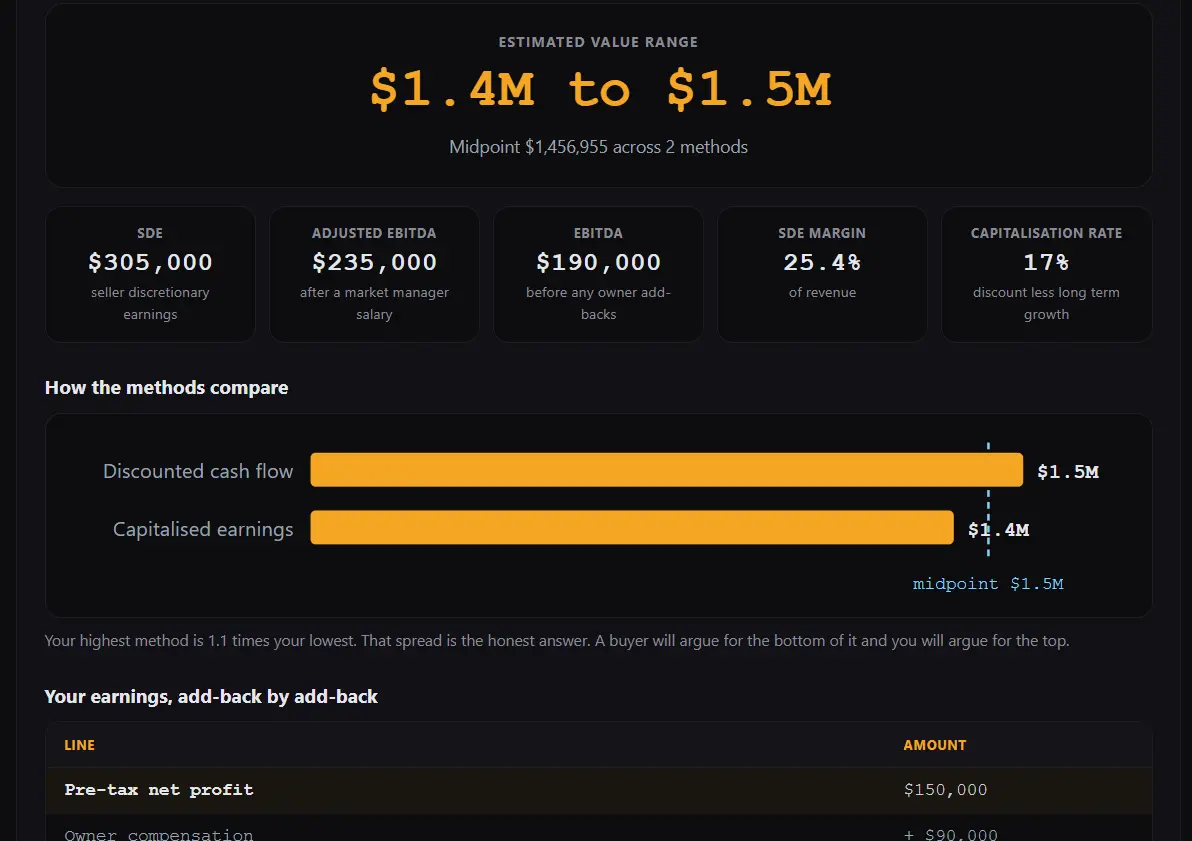
Seller discretionary earnings adds back one owner's full compensation. Adjusted EBITDA takes a market rate manager back out, because a buyer who will not run the business themselves has to pay one.
| Method | Based on | Value | Share of range |
|---|
| Year | Cash flow | Discount factor | Present value |
|---|
| Step | Amount |
|---|
Most quoted business values are for the whole enterprise. What actually reaches you is that figure less the debt the buyer takes on, plus any cash left in the business. Deal structure changes this, so treat it as an illustration.
How to use this business valuation calculator
Most tools that promise to value your business hand you one number. This business valuation calculator deliberately does not. It runs six methods on the same figures and gives you the range between them, because that spread is the honest answer and the single number is not.
Enter one full year of accounts
Revenue and pre-tax net profit, taken straight off your profit and loss. Use a full twelve months, not a good quarter multiplied by four.
Add back what a new owner would not pay
Your salary, the personal costs running through the business, one-off expenses, interest and depreciation. This is where a valuation is won or lost, and it is the step most calculators skip entirely.
Supply multiples from real comparable sales
The calculator will not invent a multiple for you, because multiples vary enormously by sector, size and geography and any figure published here would be made up. Get yours from broker listings, industry reports or an advisor who sees deals in your market.
Read the range, not the midpoint
The gap between your highest and lowest method is the negotiating range. A buyer will argue for the bottom of it. Your job is to know why the top is defensible.
How to value a business: the six methods
There is no single formula for how to value a business. There are several, they disagree with each other, and a professional valuation report will run more than one and then explain the difference. These are the six this calculator uses.
SDE multiple
Seller discretionary earnings times a multiple. The standard method for owner-operated small businesses, because it values the total benefit one working owner takes out.
EBITDA multiple
Adjusted EBITDA times a multiple. Takes over from SDE once a business is big enough to run without the owner, roughly when it can afford real management.
Revenue multiple
Annual revenue times a multiple. Crude, but it is what gets used when a business is growing fast and not yet profitable, and it is common in software.
Capitalised earnings
One year of earnings divided by a capitalisation rate. A perpetuity: it asks what lump sum, at your required return, would produce this income forever.
Discounted cash flow
Project cash forward, discount each year back to today, add a terminal value. The most rigorous method and the easiest to manipulate, because it runs on assumptions.
Asset based
Total assets less total liabilities. Usually the floor rather than the answer. If a profitable business is worth only its assets, something else is wrong.
Seller discretionary earnings and the add-backs that drive it
Before any multiple means anything you need the right earnings figure. The International Business Brokers Association defines discretionary earnings as earnings before income taxes, non-operating and non-recurring items, depreciation, amortisation, interest, and one owner's full compensation.
+ One-off costs + Interest + Depreciation and amortisation
Here is the worked example this page uses throughout. A business turning over $1,200,000 with $150,000 of pre-tax profit:
| Line | Amount |
|---|---|
| Pre-tax net profit | $150,000 |
| Owner compensation | + $90,000 |
| Owner benefits and personal expenses | + $15,000 |
| One-off and non-recurring costs | + $10,000 |
| Interest | + $12,000 |
| Depreciation and amortisation | + $28,000 |
| Seller discretionary earnings | $305,000 |
| Market rate manager salary | − $70,000 |
| Adjusted EBITDA | $235,000 |
Look at what just happened. The accounts said $150,000 of profit. The business actually generated $305,000 of benefit to its owner, which is a 25.4% margin on revenue. At a 3× multiple that difference is worth $465,000 of valuation. Add-backs are not an accounting technicality, they are most of the price.
Why adjusted EBITDA is lower, and when it matters
SDE assumes the buyer will work in the business. Adjusted EBITDA assumes they will hire someone to do your job, so it takes a market rate manager salary back out. In the example that is $70,000, which is why SDE is $305,000 and adjusted EBITDA is $235,000.
The two are not competing measures, they answer different questions. A working owner buying a business cares about SDE. A private equity buyer or a competitor absorbing you cares about EBITDA. Quote the wrong one and you will look either naive or dishonest.
Add-backs a buyer will accept, and ones they will not
Usually accepted
One owner's salary and benefits, a genuinely one-off legal case, a rebrand, personal vehicle and travel, family members paid above market rate for the work they do.
Usually argued about
A second family member's salary, marketing "the new owner would not need", repairs deferred rather than paid, anything described as one-off that has appeared in three consecutive years.
Almost never accepted
Costs that are genuinely part of running the business, capital expenditure the business will need again, and any add-back you cannot evidence with a document.
The test that matters
Would this cost still exist next year under a new owner? If yes, it is not an add-back, no matter how much you would like it to be.
What the six methods say about the same business
Same accounts, same year, six methods. This is what the business valuation calculator produces for the worked example above.
| Method | Based on | Value |
|---|---|---|
| Asset based | Assets $620,000 less liabilities $180,000 | $440,000 |
| SDE multiple | SDE $305,000 × 3 | $915,000 |
| Revenue multiple | Revenue $1,200,000 × 0.8 | $960,000 |
| EBITDA multiple | Adjusted EBITDA $235,000 × 4.5 | $1,057,500 |
| Capitalised earnings | Adjusted EBITDA ÷ 17% cap rate | $1,382,353 |
| Discounted cash flow | 5 years at 20% plus terminal value | $1,531,557 |
The highest method says $1,531,557. The lowest says $440,000. That is a 3.5 times spread on one business with one set of accounts, and the midpoint of $1,008,750 is not more correct than either end of it.
The pattern is normal and it is informative. Asset based sits at the bottom because a profitable service business is worth far more than its balance sheet. Discounted cash flow sits at the top because it counts every future year, including the ones nobody can see. The methods you should weight hardest are the ones that match how buyers in your sector actually think, which for most owner-operated businesses means SDE.
How much is my business worth? Reading the range honestly
This is the question the whole page exists to answer, and the answer is always a range. Anyone who gives you a single figure without seeing your contracts, your customer list and your accounts is guessing with a decimal point attached.
What moves you toward the top of your range
The business runs without you
The single biggest driver. If the owner is the business, a buyer is not buying a business, they are buying a job with risk attached.
Recurring, contracted revenue
Signed contracts and subscriptions are worth far more per dollar than the same revenue from one-off projects.
No customer concentration
One client at 40% of revenue can halve a multiple on its own, because that client leaving is an existential event.
Clean, reviewed accounts
Three consistent years that reconcile to tax filings. Messy books get discounted for risk whether or not the business is sound.
Growth that is already happening
Demonstrated growth, not projected growth. Buyers pay for a trend they can see in the accounts and discount one that lives in a spreadsheet.
Transferable everything
Lease, licences, supplier terms, staff, systems and the customer relationships. Anything that walks out with you comes off the price.
Business valuation multiples: why this calculator will not pick one for you
You will find pages listing multiples by industry. Treat them carefully. Multiples move with size, sector, geography, growth rate, customer mix, interest rates and the year you happen to be selling in, and a figure lifted from a US listings site may be meaningless in India, Germany or Brazil.
So this page does not publish a table of industry multiples. Every number on it comes from your own inputs or from a named formula. What we can show you is exactly how much the choice of multiple matters, which is what the arithmetic itself says:
| SDE multiple | Business value | Against a 3× base |
|---|---|---|
| 2× | $610,000 | -33% |
| 2.5× | $762,500 | -17% |
| 3× | $915,000 | base case |
| 3.5× | $1,067,500 | +17% |
| 4× | $1,220,000 | +33% |
| 4.5× | $1,372,500 | +50% |
| 5× | $1,525,000 | +67% |
Half a turn on the multiple is worth $152,500 on this business. That is why every hour spent making the multiple defensible is worth more than any hour spent refining the earnings figure.
Where to get a defensible multiple
Look at completed transactions rather than asking prices, in your country, in your sector, at your size band. Business broker listings show what people ask. Broker transaction databases and industry association reports show what they got, and the gap between the two is usually large. If you are working toward a real transaction, this is the point at which paying an advisor stops being optional.
Discounted cash flow, step by step
A discounted cash flow values a business as the money it will produce in future, adjusted for the fact that money arriving in year five is worth less than money arriving today. Two inputs do almost all the work: the discount rate, and the growth rate you assume after your forecast ends.
Terminal value = Final year cash flow × (1 + g) ÷ (r − g)
Requirement: g must be strictly below r
Running the example on adjusted EBITDA of $235,000, growing 5% a year for five years, discounted at 20%, with 3% long term growth after that:
| Year | Cash flow | Discount factor | Present value |
|---|---|---|---|
| Year 1 | $246,750 | 0.833 | $205,625 |
| Year 2 | $259,088 | 0.694 | $179,922 |
| Year 3 | $272,042 | 0.579 | $157,432 |
| Year 4 | $285,644 | 0.482 | $137,753 |
| Year 5 | $299,926 | 0.402 | $120,534 |
| Present value of the forecast | $801,265 | ||
| Terminal value at year 5 | $1,817,200 | $730,292 | |
| Total | $1,531,557 | ||
The terminal value problem
Notice that the terminal value contributes 48% of the total. Nearly half the answer rests on a single growth assumption about a period beyond anything you forecast. That is normal in DCF and it is also the model's weakest joint. Whenever someone shows you a DCF, ask what share of it is terminal value before you ask anything else.
Why growth above the discount rate breaks the model
If long term growth equals or exceeds the discount rate, the denominator in the terminal value formula hits zero or turns negative and the formula says the business is worth an infinite amount. That is not a bug, it is the model refusing an impossible assumption: nothing grows faster than the cost of capital forever. The calculator above stops and tells you rather than printing a number.
What the discount rate alone does
| Discount rate | DCF value | Terminal share |
|---|---|---|
| 15% | $2,181,694 | 59% |
| 18% | $1,739,412 | 52% |
| 20% | $1,531,557 | 48% |
| 22% | $1,367,640 | 44% |
| 25% | $1,177,909 | 39% |
| 30% | $955,885 | 32% |
Moving the discount rate from 15% to 30% cuts the valuation by more than half. Nobody outside the transaction can tell you which of those rates is correct, which is precisely why a DCF should never be the only method you look at.
From business value to what you actually keep
Most valuation methods produce an enterprise value, meaning the value of the business as an operating whole. What reaches your bank account is different. The IBBA defines enterprise value as a measure that includes debt and cash, so both have to be bridged out.
| Step | Amount |
|---|---|
| Midpoint business value | $1,008,750 |
| Less interest bearing debt | − $140,000 |
| Plus cash in the business | + $60,000 |
| Indicative equity value | $928,750 |
Deal structure changes this more than any formula does. Whether the sale is of shares or of assets, whether working capital is included at a normal level, whether part of the price is deferred or tied to future performance, and how the whole thing is taxed in your country, will all move what you keep by more than the difference between two valuation methods. None of that fits in a calculator.
What a business valuation calculator cannot see
This tool does careful arithmetic on the numbers you give it. It knows nothing about your business. These are the things a real valuation examines and no calculator can.
Customer concentration
Two businesses with identical accounts are worth very different amounts if one has 400 customers and the other has four.
Contracts and their terms
Whether revenue is contracted, for how long, and whether those contracts survive a change of ownership at all.
Owner dependence
If the relationships, the pricing decisions and the technical knowledge live in your head, much of what you are selling leaves with you.
The lease and the licences
A restaurant with two years left on a lease and a restaurant with fifteen are not the same asset, whatever the accounts say.
Why you are selling
Retirement after twenty years and a rushed sale under pressure produce different prices for identical businesses. Buyers can tell the difference.
Working capital
Almost every deal requires a normal level of working capital left in the business, and what counts as normal is negotiated, not calculated.
Use the output of this business valuation calculator to understand the shape of the answer and to prepare for the conversation. Do not use it as the number in a contract, a tax filing, a partnership settlement or a divorce. Those need a qualified valuer in your jurisdiction, and the cost of one is small next to the range you have just seen.
Business valuation calculator FAQ
How much is my business worth?
It is worth a range, not a figure. Run your accounts through several methods and the spread between them is your realistic negotiating range. On the worked example on this page, six methods on one business produced values from $440,000 to $1,531,557, a 3.5 times spread. The most reliable single anchor for an owner-operated business is seller discretionary earnings times a multiple taken from completed sales in your sector and country.
How do you value a business?
Work out the true earnings first by adding back owner compensation, owner benefits, one-off costs, interest, depreciation and amortisation to pre-tax profit. That gives seller discretionary earnings. Then apply a multiple from comparable completed transactions, and cross-check it against a discounted cash flow and against the balance sheet. Never rely on one method. The business valuation calculator above runs all six at once.
What is seller discretionary earnings?
SDE is the total financial benefit one working owner takes from a business in a year. The IBBA defines it as earnings before income taxes, non-operating and non-recurring items, depreciation, amortisation, interest, and one owner's full compensation. It is the standard earnings measure for valuing owner-operated small businesses, because it shows what a buyer who works in the business would actually receive.
What is the difference between SDE and EBITDA?
SDE adds back one owner's full compensation; EBITDA does not. The gap between them is exactly one manager's salary. SDE suits a buyer who will run the business themselves, EBITDA suits one who will hire a manager. In the example on this page, SDE is $305,000 and adjusted EBITDA is $235,000, a difference of the $70,000 it would cost to replace the owner.
What multiple should I use to value my business?
One taken from completed transactions in your sector, your size band and your country, not from a generic table. Multiples move with growth rate, customer concentration, owner dependence, contracted revenue and prevailing interest rates. This business valuation calculator deliberately does not supply a multiple, because any figure published here would be invented rather than researched. Half a turn on the multiple was worth $152,500 on the worked example, so it is worth getting right.
Is a business valuation calculator accurate?
The arithmetic is exact and the estimate is not. A calculator cannot see customer concentration, contract terms, owner dependence, the lease, the reason for the sale or the state of your market. Use it to understand the range and the drivers, then get a qualified valuation before anything binding. Treat any tool that returns a single confident number with suspicion.
How do I value a business that is losing money?
Not with multiples, since multiplying a loss produces nothing meaningful, which is why this calculator refuses to do it. Loss-making businesses are usually valued on assets, on revenue if there is a credible route to profit, or on what it would cost a buyer to build the same thing. If the loss is caused by add-backs such as an above-market owner salary, work out SDE first, because the business may be profitable once those come out.
What is a capitalisation rate?
The IBBA defines it as any divisor used to convert one period's economic benefit into a value. In practice it is your required rate of return less the long term growth rate. Divide one year of earnings by it and you get the value of that income stream in perpetuity. On the example here, a 20% discount rate less 3% growth gives a 17% capitalisation rate.
Why is the discounted cash flow number so much higher?
Because it counts every future year, including a terminal value standing in for everything beyond the forecast. On the example above the terminal value alone is 48% of the DCF answer. DCF is the most rigorous method and the easiest to inflate, since small changes to the discount rate or the long term growth rate move it enormously. Moving the discount rate from 15% to 30% more than halved it.
Does this business valuation calculator work in any currency?
Yes. Pick your currency symbol and every figure is labelled in it, or choose no symbol for plain numbers. The formulas are currency neutral because valuation is a relationship between earnings and a multiple or a rate. What is not universal is the multiple itself, which is why you should source yours from transactions in your own market.
What is an asset based valuation and when should I use it?
Total assets less total liabilities. It usually sets the floor rather than the answer, and on the worked example it was the lowest of six methods at $440,000 against a $1,531,557 top. It matters most for asset-heavy businesses, for businesses being wound up, and as a sanity check: if a profitable business values at only its assets, either the earnings methods or the accounts need another look.
How much does a professional business valuation cost?
It varies far too much by country, business size and the purpose of the valuation for any figure quoted here to be reliable, so we do not publish one. What is worth knowing is the shape of the market: a broker's informal opinion is usually free but not independent, a formal certified valuation for tax, litigation or a partnership dispute costs considerably more than one prepared for a straightforward sale. Ask two or three providers in your own country for a written quote.
Sources and limits
Definitions of seller discretionary earnings, EBITDA, enterprise value, fair market value and capitalisation rate follow the International Business Brokers Association glossary. The discounted cash flow method follows the standard formulation described by Corporate Finance Institute, with a Gordon Growth terminal value, which requires the perpetuity growth rate to be strictly below the discount rate. No industry multiples appear anywhere on this page or in the calculator, because reliable multiples are specific to a sector, a size band, a country and a moment in time, and publishing a generic table would mean inventing numbers.
Everything here is an estimate produced from figures you entered. It is not a valuation, an appraisal, or financial, tax or legal advice, and it is not suitable for any binding purpose. Before acting on a number, consult a qualified business valuer or accountant licensed in your jurisdiction. See our calculator accuracy policy for how these formulas were verified.

Written & verified by
B.Tech Computer Science · 8 years in web development & SEO · Bhilwara, India
About ·
LinkedIn ·
Report an error