
Finance · Auto leasing
Mercedes Lease Calculator
Work out the monthly payment on a Mercedes-Benz lease, and see exactly where each dollar goes. Enter the selling price you have been quoted, the residual and money factor from the dealer's worksheet, and the tool splits the payment into depreciation, finance charge and tax.
Every number below is one you can check by hand. The formula is written out in section 01 and worked through with real figures in section 02, so you can verify the result rather than take it on trust.
Quick fill: 2026 starting MSRP
Sticker price, before any discount.
The price on the worksheet. $2,050 below MSRP
Money you hand over at signing.
Percentage of MSRP, set by the lender. Ask for it.
= 3.26% APR equivalent (money factor × 2400)
36 months is the most common Mercedes term.
Enter 0 if your state has no sales tax.
Lender's setup charge. Confirm the exact figure.
Roll the acquisition fee into the lease
Off means you pay it at signing instead, which lowers the monthly slightly.
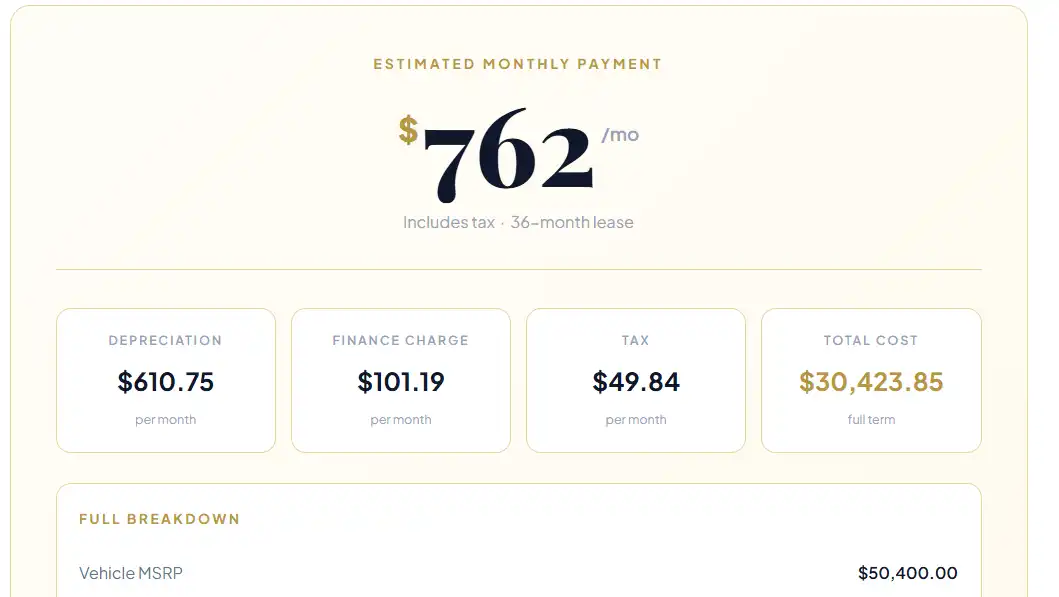
Estimated monthly payment
Tax included · 36-month term
Depreciation
0
per month
Finance charge
0
per month
Tax
0
per month
Due at signing
0
approximate
Full breakdown
Estimate only. Your actual payment depends on the residual and money factor the lender assigns you, your credit tier, state and local tax rules, registration and documentation fees, and any incentive running that month. Always check the figure against the dealer's own lease worksheet.
How a lease payment is actually calculated
A lease payment is three separate numbers added together. Dealers usually quote only the total, which is why leases feel opaque. Once you can see the three parts, you can tell instantly which one a dealer has moved.
Part 1 · Depreciation
(Adjusted cap cost − Residual value) ÷ Term
You are paying for the value the car loses while you have it. This is normally the largest part of the payment. Adjusted capitalised cost is the selling price, plus any fees you roll in, minus your cash down.
Part 2 · Finance charge
(Adjusted cap cost + Residual value) × Money factor
This is lease interest. The two figures are added rather than subtracted because you are charged on the average amount outstanding across the term. Multiply the money factor by 2400 to get the equivalent APR.
Part 3 · Tax
(Depreciation + Finance charge) × Tax rate
In most states you pay sales tax on the monthly payment rather than on the whole car, which is one of the genuine advantages of leasing. A few states tax differently, so see the limitations in section 04.
The one that catches people out is residual value. It is expressed as a percentage of MSRP, not of the price you negotiated. Negotiating the selling price down does not reduce the residual, which is exactly why negotiating works so well on a lease: the whole discount comes off the depreciation you pay for.
A worked example, start to finish
Take a GLC 300 at $49,550 MSRP, negotiated to $47,500, with $3,000 cash down, a 56% residual, a 0.00136 money factor, a 36 month term, 7% sales tax, and a $1,095 acquisition fee rolled into the lease. Here is the whole calculation.
Step 1 · Residual value
56% of the MSRP, not the selling price.$49,550 × 0.56 = $27,748
Step 2 · Adjusted capitalised cost
Selling price, plus the financed acquisition fee, minus cash down.$47,500 + $1,095 − $3,000 = $45,595
Step 3 · Monthly depreciation
($45,595 − $27,748) ÷ 36 = $495.75
Step 4 · Monthly finance charge
($45,595 + $27,748) × 0.00136 = $99.75
Step 5 · Monthly tax
($495.75 + $99.75) × 0.07 = $41.68
Step 6 · Monthly payment
$495.75 + $99.75 + $41.68 = $637.18
Roughly $637 a month, and $25,939 in total once the $3,000 down payment is added to 36 payments.
Now change one input. Leave everything else the same but do not negotiate, so the selling price stays at the $49,550 sticker. The payment becomes $701.09. That $2,050 discount saved roughly $64 a month, or $2,301 across the lease, which is more than the discount itself because you also avoid finance charge and tax on it. This is the single most useful thing to understand about leasing, and it is why the selling price field matters more than any other input on this page.
Money factor and residual, in plain terms
Money factor
Lease interest written as a small decimal. Multiply by 2400 for the APR. So 0.00136 is about 3.26% APR, and 0.00250 is 6%. Dealers can mark the money factor up above the lender's buy rate, and that markup is pure profit. Ask what the buy rate is. If they will not say, that itself tells you something.
Residual value
What the lender predicts the car will be worth at the end, as a percentage of MSRP. It is set by the lender, not the dealer, so it is not negotiable. A higher residual means less depreciation to pay for, which is why a strong residual model can lease for less per month than a cheaper car with a weak one.
Two numbers you should always ask for before you talk about monthly payments: the residual percentage and the money factor. With those plus the selling price, you can calculate the payment yourself and check whether the quote adds up. If a quoted payment is higher than your own calculation, something has been added that has not been explained.
What this calculator cannot tell you
This tool applies the standard lease formula correctly. It does not know anything about your specific deal, and there are real gaps worth stating plainly.
Your residual and money factor. Both are set by the lender based on the model, term, mileage allowance and your credit tier. The defaults here are illustrative. Substitute the real numbers from the worksheet or the output is meaningless.
State tax treatment. Most states tax the monthly payment, which is what this assumes. Some tax the full selling price up front, and some tax the cap cost reduction as well. If your state does either, the figure here will be low.
Registration, title, documentation and destination fees. Not included. These vary by state and dealer and can add several hundred dollars to the amount due at signing.
Incentives and lease cash. Manufacturer support changes monthly and can move a payment substantially. Apply any rebate as a reduction to the selling price.
Mileage and wear charges. Nothing here reflects what you might owe at the end for excess mileage or damage. A lower mileage allowance also usually means a higher residual and a lower payment, so the two interact.
Whether leasing is right for you. That is a question about how long you keep cars and how much you drive, not a maths problem. This tool has no opinion on it.
One piece of advice worth more than the calculator: a large cash down payment on a lease is usually a poor idea. It lowers the monthly payment, but if the car is written off or stolen early, insurance settles with the lender and that cash is generally gone. Financing more and paying less up front keeps the risk with the lender rather than with you.
Mercedes Lease Calculator: FAQs
Sources, disclaimer and independence
Where the numbers come from
The lease formula is the standard published method used across the industry and is written out in full in section 01 so you can check it by hand. Starting MSRP figures are 2026 model year prices from a published Mercedes-Benz dealer price list, checked in August 2026, and cross-referenced against the 2026 model lineup. Residual ranges are typical segment figures, clearly labelled as such, not quotes. No money factor or residual on this page is a live rate.
Not financial advice
This page is informational. It is not financial advice and it is not a quote or an offer of credit. Whether a lease suits your situation depends on circumstances this tool knows nothing about. Check any figure against the dealer's lease worksheet before you sign, and speak to a qualified adviser if the decision matters to you.
Not affiliated with Mercedes-Benz
Calcxi is an independent website. We are not affiliated with, endorsed by, sponsored by or connected to Mercedes-Benz Group AG, Mercedes-Benz USA, Mercedes-Benz Financial Services, or any Mercedes-Benz dealer. "Mercedes-Benz", "AMG", "4MATIC" and the model names used here are trademarks of their respective owners, referred to only to describe what this calculator does. We receive no commission on any vehicle or lease.
Related calculators
If you are weighing a lease against buying, or working out what you can commit to each month, these help:

Written & verified by
B.Tech Computer Science · 8 years in web development & SEO · Bhilwara, India
About ·
LinkedIn ·
Report an error