
Pine Straw Calculator
Estimate how many pine straw bales or rolls you need for garden beds, trees, slopes, and landscape areas. Add dimensions, choose coverage, include overage, and estimate total cost.
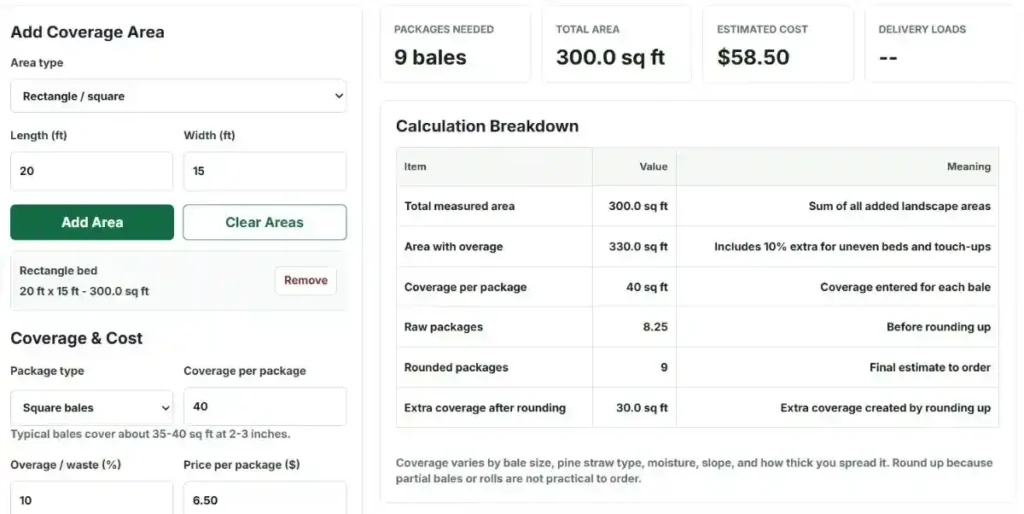
Calculation Breakdown
| Item | Value | Meaning |
|---|---|---|
| Add an area or use the sample result to calculate pine straw coverage. | ||
Coverage varies by bale size, pine straw type, moisture, slope, and how thick you spread it. Round up because partial bales or rolls are not practical to order.
Formula
What Is a Pine Straw Calculator?
A pine straw calculator is an online tool that estimates how much pine straw you need based on the size of your landscape area and the coverage per bale or roll. Instead of guessing how many bales to buy, you can calculate the total square footage and divide it by the coverage rate.
In simple terms, the calculator answers this question: how many bales of pine straw do I need for my yard, garden bed, or landscape project?
How to Use the Pine Straw Calculator
- Choose the area shape, such as rectangle, circle, triangle, or known square feet.
- Enter the required measurements in feet.
- Add one or more landscape areas if your project has multiple beds.
- Choose square bales, rolls, or a custom package size.
- Enter the coverage per package, overage percentage, and price if you want a cost estimate.
- Click calculate to estimate the number of pine straw bales or rolls needed.
Pine Straw Calculator Formula
The basic pine straw coverage formula is:
Packages needed = Total square feet / Coverage per packageIf you include overage, the formula becomes:
Packages needed = (Total square feet x (1 + overage percentage)) / Coverage per packageBecause pine straw is sold in full bales or rolls, the final result should always be rounded up.
How Many Square Feet Does a Bale of Pine Straw Cover?
A common rule of thumb is that one square bale of pine straw covers about 35 to 40 square feet when spread at a 2 to 3 inch depth. Coverage can vary based on bale size, pine straw type, moisture, spreading thickness, and supplier.
For lighter refresh layers, one bale may cover closer to 45 to 50 square feet. For thicker coverage on new beds or bare ground, one bale may cover closer to 30 to 35 square feet.
How Many Bales of Pine Straw Do I Need?
To estimate how many bales of pine straw you need, first calculate the total square footage of your landscape area. Then divide that area by the square feet covered by one bale.
Example:
Area = 600 sq ft
Coverage = 40 sq ft per bale
600 / 40 = 15 bales
If you add 10% overage:
600 x 1.10 = 660 sq ft
660 / 40 = 16.5
Round up = 17 bales
Pine Straw Bales vs Rolls
Pine straw is commonly sold as square bales or rolls. Square bales are often used for smaller residential landscaping projects. Rolls may cover more area and can be useful for larger jobs, but coverage depends on the supplier and how thick the straw is applied.
If your supplier gives a specific coverage number, use that number in the calculator for the most accurate result.
What Coverage Rate Should I Use?
Use a coverage rate based on how thick you want the pine straw layer to be:
- Refresh layer: about 45 to 50 sq ft per bale
- Standard layer: about 35 to 40 sq ft per bale
- Thicker new-bed coverage: about 30 to 35 sq ft per bale
- Rolls: often about 90 to 110 sq ft per roll, depending on supplier
Should I Add Extra Pine Straw?
Yes, it is usually smart to add a small overage. Landscape beds are rarely perfect rectangles, and pine straw can settle after spreading. A 5% to 10% overage helps cover curves, slopes, uneven edges, and touch-up areas.
How to Measure Your Landscape Area
For a rectangle or square bed, multiply length by width.
Area = Length x WidthFor a circle, use the diameter to calculate the area.
Area = 3.14 x (Diameter / 2)^2For a right triangle, multiply base by height and divide by two.
Area = (Base x Height) / 2For irregular beds, split the area into smaller rectangles, circles, and triangles, then add each area together.
Why Use Calcxi's Pine Straw Calculator?
Calcxi’s pine straw calculator is designed to be more flexible than a basic length and width calculator. It supports multiple area shapes, square bales, rolls, custom coverage, overage, cost estimates, delivery load estimates, and downloadable results.
This makes it easier to plan your project before buying pine straw, requesting a quote, or scheduling installation.
Frequently Asked Questions
How do I calculate how much pine straw I need?
How many square feet does one bale of pine straw cover?
How many bales of pine straw do I need for 1,000 square feet?
How many bales of pine straw do I need for 500 square feet?
How deep should pine straw be applied?
Apply 2–3 inches for standard landscape beds, this depth suppresses most annual weeds while still allowing water and oxygen to reach roots. Use 3–4 inches for heavy weed pressure or sloped areas prone to erosion. For an annual topdress refresh over existing straw, adding 1–2 inches is typically sufficient to restore appearance and coverage depth.
What is the difference between longleaf and slash pine straw?
How much more pine straw do I need for slopes?
Add 15–20% extra for sloped areas to account for material that settles and shifts downhill after installation. For flat beds with defined borders, a 5% buffer is enough. Irregular or free-form shaped beds should include a 10% overage. Select your bed type in the Overage dropdown in this calculator and the buffer is added to your total automatically.
How often should pine straw be replaced?
Refresh pine straw every 6–12 months. Longleaf holds its golden color for 12–14 months before significant fading. Slash pine typically fades after 6–8 months. Most landscapers recommend a full install in spring and a light topdress in fall, use the Refresh / Topdress mode in this calculator to calculate only the additional straw needed on top of your existing coverage.
How much does pine straw cost?
Pine straw costs $3–5 per bale for bulk slash pine, $5–7 for standard retail, and $8–12 per bale for premium longleaf. A typical residential project covering 1,000 sq ft costs $90–$280 in materials. Professional installation (spreading labor) adds $0.50–$1.50 per sq ft. Enter your price per bale in the Cost Estimator above for a total project estimate.
Can this calculator estimate pine straw cost?
Yes. Enter the price per bale or roll, and the calculator will estimate the total material cost based on the number of packages needed.
Can I use this calculator for pine straw rolls?
Yes. Select rolls as the package type and enter the coverage per roll. The calculator will estimate the number of rolls needed.
Should I remove old pine straw before adding new straw?
Generally no, pine straw decomposes into organic matter that benefits soil. Leave old straw in place and topdress with fresh straw to restore depth. If the old straw has matted down and compacted significantly, rake it lightly to break it up before topdressing to improve water infiltration. Only remove it completely if mold or disease is present. Use Refresh mode in this calculator to calculate only the additional depth needed.
How do I calculate pine straw for a circular or triangular bed?
For a circular bed, the area = π × radius² (where radius = diameter ÷ 2). A 10-foot-wide circle has area = 3.14159 × 25 = 78.5 sq ft. For a triangular bed: area = 0.5 × base × height. Select Circle or Triangle in the bed shape options above, the calculator handles the geometry automatically when you enter the relevant dimensions.
More Calculators

Written & verified by
B.Tech Computer Science · 8 years in web development & SEO · Bhilwara, India
About ·
LinkedIn ·
Report an error