
Female Delusion Calculator
Enter your dating standards. We match them against real US Census and CDC population data and tell you exactly how many people qualify and which requirement is costing you the most.
Pool: 127.5 million American men aged 18+.
Select more than one to widen the pool — they add together, not multiply.
Height data from CDC NHANES adult measurements.
Individual annual income, not household.
Used for the local headcount estimate only — it does not change your match percentage.
Free · No account · Takes 45 seconds
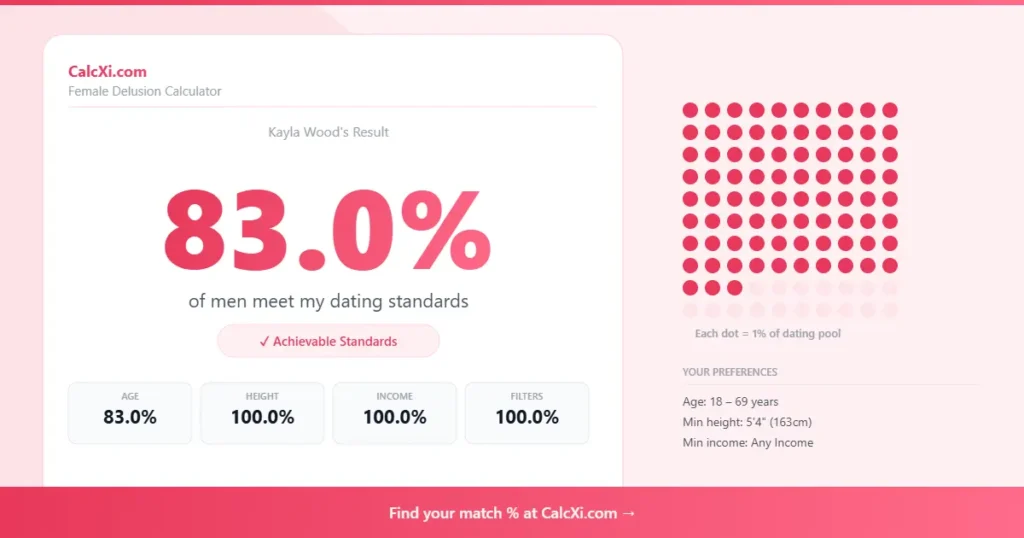
of American men meet every one of your standards.
- Deal-breaker ranking — which single requirement is destroying your pool, measured exactly
- Three fixes that work — the smallest changes that grow your pool the most, with the numbers
- Your strictness percentile — how you compare to everyone else who has run this
- Delusion score out of 10 + headcount in your city
- "How rare am I?" — flip it around and score yourself
- Shareable result card — download or post it
We send your report and occasional new-calculator updates. No spam, unsubscribe in one click. We never sell data.
What's actually costing you
Each bar shows how much of the remaining pool that single requirement removed. Ranked worst first.
Three changes with the biggest payoff
We tested relaxing every filter one at a time. These moved the needle most.
How you compare
Against everyone else who has run this calculator.
Your pool, visualised
Now flip it — how rare are you?
Enter your own numbers and we'll score you the same way you just scored everyone else.
What you asked for
Share it
Your card is ready below — download it, post it, or copy the full text breakdown.
Sources: Census ACS · CDC NHANES · Estimates, not predictions
What Is the Female Delusion Calculator?
The Female Delusion Calculator is a free online tool that uses verified US Census Bureau and CDC NHANES demographic data to calculate what percentage of American men match a woman’s stated dating preferences, including age range, height, income, marital status, and lifestyle filters.
Unlike opinion-based dating advice, this tool gives you a hard number. If you want a partner who is at least 6 feet tall, earns $100,000 or more per year, is unmarried, and between the ages of 28 and 38, the calculator tells you exactly what percentage of the male population fits all of those criteria simultaneously.
The result is not meant to shame your preferences or tell you to settle. It is meant to give you a clear, data-driven picture of how rare or how common your ideal partner actually is in the real world.
How Does the Female Delusion Calculator Work?
The calculator multiplies the probability of each preference against verified population data from two primary sources:
- US Census Bureau American Community Survey (ACS): for age distribution, income levels, marital status, and ethnicity breakdowns of the US adult male population.
- CDC National Health and Nutrition Examination Survey (NHANES): for height and body composition distributions among American men.
Each filter you apply reduces the pool independently. The combined probability is the product of all individual filters, which is why adding even one strict requirement can dramatically lower your final percentage.
For example: if 44% of men are unmarried, 14.5% are 6 feet or taller, and 18% earn $100,000 or more, the probability of one man meeting all three simultaneously is roughly 1.1%, not 44%, not 14.5%, not 18%.
This is the core insight the Female Delusion Calculator provides: preferences that seem individually reasonable can combine into an extremely rare profile.
What the Numbers Actually Say According to Real US Population Data
Understanding the real statistics behind common dating preferences helps put your results in context. Here is what verified US data shows about the adult male population:
HEIGHT
- 5’9″ or taller: 57% of men
- 5’11” or taller: 30% of men
- 6’0″ or taller: 14.5% of men
- 6’2″ or taller: 3.2% of men
- 6’4″ or taller: 1.1% of men
Source: CDC NHANES
INCOME
- $25,000 or more: 72% of men
- $50,000 or more: 52% of men
- $75,000 or more: 34% of men
- $100,000 or more: 18% of men
- $200,000 or more: 5.8% of men
- $500,000 or more: 0.9% of men
Source: US Census Bureau ACS
MARITAL STATUS
- Unmarried (never married, divorced, widowed): 44% of men
Source: US Census Bureau
EDUCATION
- Bachelor’s degree or higher: 36% of men
Source: US Census Bureau
These numbers are why even a modest-sounding combination of preferences — say, unmarried, college-educated, 6 feet tall, earning $75K+ — yields a match pool of less than 3% of the total male population.
What Is the "6-6-6 Rule" and What Does the Calculator Say?
The 6-6-6 rule is a dating standard that went viral on TikTok and Reddit, it refers to wanting a partner who is at least 6 feet tall, earns a 6-figure income ($100,000+), and has a 6-pack (athletic build).
When you enter these three filters into the Female Delusion Calculator, the results are striking:
- 6’0″ or taller: 14.5% of men
- $100,000+ income: 18% of men
- Unmarried: 44% of men
- Combined probability: approximately 1.1%
That means roughly 1 in 91 single American men meets all three of the 6-6-6 criteria. In a city of one million adults, that is approximately 4,900 men spread across all age groups, all neighborhoods, and all relationship preferences of their own.
The calculator does not say these men do not exist. It says they are statistically rare and that knowing the real number helps you make more informed decisions about which of your preferences are true non-negotiables versus which ones you might be open to reconsidering.
Female Delusion Calculator vs. Male Delusion Calculator
The same tool works for men calculating what percentage of women meet their dating standards. Simply switch the toggle to “Male Standards Calculator” and the tool recalculates using female population data from the same Census Bureau and CDC sources.
Common findings when men run the male version:
- Requiring a woman to be between 5’4″ and 5’7″, aged 22–30, slim build, and earning at least $50K typically yields a match pool of 3–8%.
- The biggest filters for men are age (wanting very young partners) and body type (excluding overweight/obese women, who represent approximately 41.9% of adult American women per CDC data).
Both calculators are intentionally neutral. The tool does not judge what your preferences say about you, it simply shows the statistical consequences of each filter you apply.
How to Use Your Result
Your result is a starting point for reflection, not a final verdict. Here is how to interpret common ranges:
ABOVE 20%: Broad standards. A large portion of the dating pool qualifies. Your challenge is meeting people, not a mismatch between standards and supply.
5% to 20%: Selective but realistic. Your ideal partner is not rare, they exist in significant numbers. Effort and the right dating strategy will matter more than adjusting preferences.
1% to 5%: Very selective. Your ideal partner is statistically uncommon. It may be worth identifying which single filter has the biggest impact on your pool size and deciding whether it is truly non-negotiable.
0.1% to 1%: Rare. A small but real population meets your standards. Be aware that members of this group are also highly sought-after by others, which affects real- world competition dynamics. Below 0.1% – Extremely rare. The combination of your preferences describes a very small number of people. This is worth examining honestly not to lower standards but to identify which single preference, if relaxed slightly, would open your pool most significantly.
Does the Female Delusion Calculator Store My Data?
No. The Female Delusion Calculator runs entirely in your browser using JavaScript. No information you enter — not your name, preferences, or results, is sent to any server, stored in a database, or tracked in any way.
All calculations happen locally on your device. Closing the page clears everything. Your data never leaves your browser.
Frequently Asked Questions
What is the Female Delusion Calculator?
The Female Delusion Calculator is a free data-driven tool that calculates what percentage of American men meet a woman’s specific dating preferences. It uses US Census Bureau and CDC NHANES data to produce statistically grounded results based on real population demographics.
How accurate is the Female Delusion Calculator?
The calculator uses verified data from the US Census Bureau American Community Survey and the CDC National Health and Nutrition Examination Survey, the same sources cited in peer-reviewed demographic research. Population-level results are statistically accurate. Individual outcomes depend on additional factors like geographic location, personal compatibility, and mutual attraction that no demographic tool can capture.
What does a result below 1% mean?
A result below 1% means that fewer than 1 in 100 American men simultaneously meet all of your stated preferences. It does not mean you should abandon your standards, it means your ideal partner is statistically rare. The breakdown section shows which individual filter reduces your pool the most, which can help you identify your true priorities.
Is there a Male Delusion Calculator?
Yes. Switch the toggle at the top of the tool from “Female Standards Calculator” to “Male Standards Calculator.” The same methodology applies using female population statistics from the US Census Bureau and CDC. Results show what percentage of American women meet a man’s stated preferences.
What is the most common result?
Most users who apply height, income, age, and marital status filters together get results between 0.5% and 5%. The most common single result is in the 1–3% range, driven primarily by the combination of above-average height and above-median income requirements applied simultaneously.
Why is it called a "delusion" calculator?
The name is a self-aware, tongue-in-cheek reference to the gap between idealized dating standards and statistical reality. It does not claim anyone is delusional. It simply quantifies the rarity of specific preference combinations using real data, letting users draw their own conclusions. The tool is also known as the Standards Calculator, Dating Standards Calculator, Reality Calculator, and Build-a-Man Calculator.
Does my location affect results?
The current version uses national US population data, so results reflect the overall American male population. Urban areas tend to have higher concentrations of college-educated and higher-income men, while height distributions are relatively consistent nationwide. Location-specific versions may be added in future updates.
Can I share my results?
Yes. The tool includes three sharing options: you can post your result directly to X (Twitter) with a pre-written message, generate and download a stylized share card image, or copy your full result breakdown including percentage, preferences, and filter analysis to paste anywhere.
About the Data Sources
All calculations in the Female Delusion Calculator are based on publicly available government demographic data:
US CENSUS BUREAU: AMERICAN COMMUNITY SURVEY (ACS) The ACS is the largest household survey in the United States, collecting detailed demographic, social, economic, and housing data annually from approximately 3.5 million addresses. CalcXi uses ACS data for age distribution, income levels, marital status, and ethnicity breakdowns of the US adult male population.
Source: census.gov/programs-surveys/acs
CDC: NATIONAL HEALTH AND NUTRITION EXAMINATION SURVEY (NHANES)
NHANES combines interviews and physical examinations to assess the health and nutritional status of the US population. CalcXi uses NHANES data for height and body composition distributions among American men and women.
Source: cdc.gov/nchs/nhanes

Written & verified by
B.Tech Computer Science · 8 years in web development & SEO · Bhilwara, India
About ·
LinkedIn ·
Report an error